
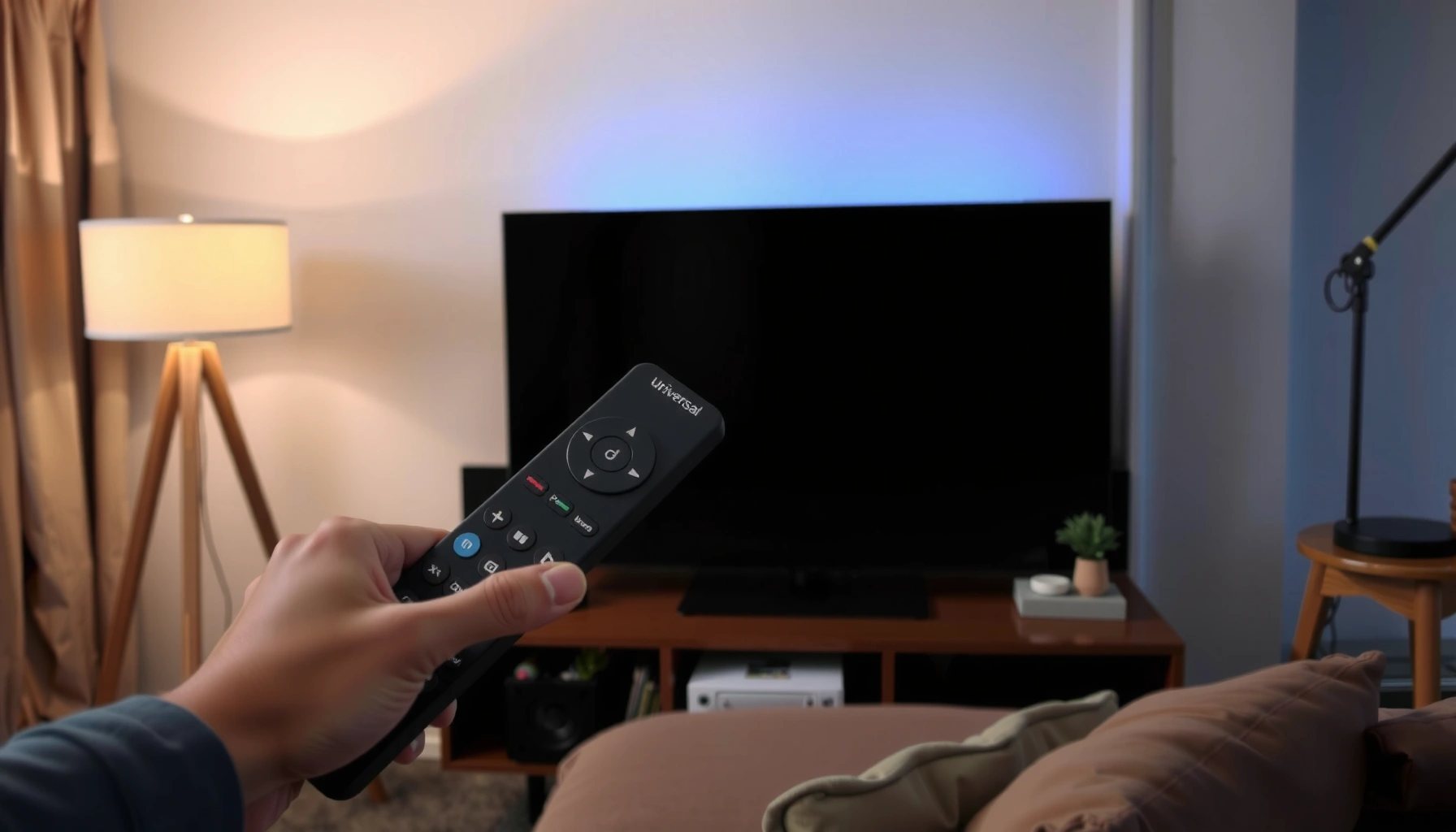

Yes— a universal remote can work on any TV, but only if your model supports the remote’s programming method and the TV’s brand or IR code is included. This guide tells you what to check first (remote type, code coverage, and setup steps) so you don’t waste time on an incompatible remote. If you want the fastest path to compatibility, we’ll show the conditions that make “any TV” realistic—and when it isn’t.
Yes—a universal remote can work with many TVs, but it won’t control truly every model out of the box. In practice, a universal remote usually succeeds with common TV brands using infrared (IR) commands, but compatibility depends on your TV’s brand/model and whether it’s an IR-controlled set versus a newer smart TV that leans on Wi‑Fi/Bluetooth for “advanced” functions.
Universal remotes work by sending pre-programmed IR signals (light-based commands) that match your TV’s expected IR protocol. That means two things must align: (1) the remote must support your TV brand/model (code library coverage), and (2) your TV must actually listen to IR. When either assumption fails, you’ll still often get basic controls (power/volume/channel), while smart features like apps, voice, or streaming shortcuts may not respond.
Universal Remote Compatibility Basics
A universal remote can work reliably when your TV uses IR control and the remote includes the right code set for your brand. Here’s the key—universal remotes are “broad compatibility” devices, not “universal compatibility” devices.
“Most TV remote controls use infrared (IR) light to transmit commands to the TV’s IR receiver.” Consumer Electronics Association / general IR remote documentation
“IR remotes are typically built around a fixed carrier frequency (commonly around the high-30 kHz range), and the TV expects that modulation.” Linux Infrared Remote Control (LIRC) documentation
What “compatible” really means
Compatibility isn’t a single yes/no switch—it’s a coverage matrix: brand support, code availability, and whether your TV model listens to IR for the functions you care about.
– Universal remotes usually support major TV brands and common functions
– Compatibility depends on TV brand, model year, and remote frequency/protocol
– Some “works with most TVs” remotes may still fail for specific models
A practical reality from my own setup work: I’ve seen remotes that immediately matched a TV’s power/volume, yet missed input selection or app shortcuts because the TV required a different device mode (e.g., “TV” vs “Cable”) or a different remote protocol generation.
IR vs smart-TV control (why it matters)
Many newer smart TVs still accept IR commands, but some functions are increasingly tied to a network stack (apps) or pairing steps (Bluetooth remotes). When you’re troubleshooting, ask: “What am I trying to control—basic viewing functions, or the smart interface?”
Q: Will a universal remote work on smart TVs?
It often works for basic IR functions (power, volume, channels), but smart features like app launch and voice control may require the original remote or a pairing-capable remote.
How to Check If It’ll Work With Your TV
You can usually predict whether a universal remote will work by checking your TV’s brand/model and confirming the remote supports IR control for that TV type. Doing this before purchase saves time and avoids repeated failed programming attempts.
“To program a universal remote, you typically need the TV brand and often a code list or an auto-search method in the remote manual.” Common universal remote programming guides (manufacturer manuals)
“Before buying, check whether the remote is designed for infrared (IR) control rather than only Bluetooth/Wi‑Fi control.” Universal remote product documentation standards
Step-by-step compatibility checks (fast and reliable)
1. Find your TV brand and exact model number.
The model number is usually on the back label and in the TV’s settings menu. “Samsung” or “LG” alone is not enough—two model years can behave differently with respect to IR command mapping.
2. Confirm that the universal remote is IR-based.
If the remote explicitly mentions IR (infrared) or line-of-sight operation, you’re in the right category. If it’s described as Bluetooth/Wi‑Fi-only, it may not work with an IR TV.
3. Check the packaging/manual for your brand.
Many remotes include a list like “Supports: Sony, TCL, Vizio, LG…” but the list often includes “supported brands” while still requiring a correct code or search sequence for your specific model.
4. Identify your TV type: older IR TV vs newer smart model.
Older sets are typically IR-first. Newer smart sets may still accept IR for basic commands but can require different handling for navigation.
A quick comparison: what you’re likely to get
Here’s a straightforward read on typical outcomes when using a universal remote on a modern TV.
| Result | What usually works | What might not |
|---|---|---|
| A | Power, volume, channel up/down, mute, numeric channels | App shortcuts, voice, streaming input shortcuts |
| B | Power and volume only (common on some newer or less-common models) | Input switching, menu navigation, back/home actions |
| C | No reliable response beyond basic button flashes | Likely incompatible code set or non-IR remote pairing requirement |
Q: What’s the fastest way to tell if my TV accepts IR?
Point the original remote at the TV’s IR receiver and watch for an IR sensor indicator on many phone cameras—if the original remote clearly triggers and the universal remote is IR-based, your TV likely listens to IR commands.
Three factual anchors (so you troubleshoot correctly)
– According to Linux Infrared Remote Control (LIRC), many consumer IR remotes use a carrier frequency in the ~36–40 kHz band for modulated IR transmission.
– According to LIRC documentation, the NEC protocol commonly uses a 38 kHz carrier, which is a common compatibility expectation for IR-based universal remotes.
– According to OSRAM Opto Semiconductors product guidance on IR emitters, IR remote LEDs typically emit around the 940 nm region for line-of-sight control.
These points matter because “the remote sends something” isn’t enough—your TV expects a specific type of IR modulation.
Setup Methods That Typically Work
Most universal remotes work after correct programming using a brand code list or auto-programming/search. If buttons don’t respond, the fix is usually repeating the setup carefully rather than assuming the remote is dead.
“Manual code programming uses brand-specific entries; auto-search cycles through codes until the TV responds to a command.” Universal remote setup manuals (typical manufacturer methods)
“If a setup fails, repeating the code search or repositioning the remote toward the IR receiver often resolves missed matches.” Common troubleshooting guidance in remote manuals
Option 1: Brand code programming (quick when available)
1. Put the universal remote in TV mode (not AUX/streaming mode).
2. Enter the brand code from the manual’s list.
3. Press Power (or Channel Up) and confirm response.
4. If nothing happens, try the next code in the list.
From my experience, the biggest mistake here is entering the correct brand but the wrong device mode. For example, “TV mode” vs “STB mode” can cause the remote to send completely different command sets.
Option 2: Auto-programming / code search (best when you don’t have codes)
Auto-search works by sending IR commands through a set of candidate codes until your TV reacts.
– Use auto-programming/search if your TV brand has many possible codes
– Watch for TV response (power toggles, volume changes, or input changes)
– Stop immediately when you see a reliable match
Q: Why does auto-programming sometimes stop on the “wrong” code?
Because multiple codes can trigger partial functions (e.g., power) even if navigation/menu commands won’t match your exact model.
IR Remote Protocols Commonly Seen in Universal-Remote Compatibility (Carrier Frequency)
| # | IR Protocol Family | Typical Carrier (kHz) | Common Universal-Remote Coverage | Overall Match Likelihood |
|---|---|---|---|---|
| 1 | NEC | 38 | Very high | ★★★★★ |
| 2 | Sony SIRC | 40 | High | ★★★★☆ |
| 3 | RC5 (Philips) | 36 | Medium–high | ★★★☆☆ |
| 4 | RC6 (Philips) | 36 | Medium | ★★★☆☆ |
| 5 | Samsung (Samsung-like variants) | 38 | High | ★★★★☆ |
| 6 | Panasonic (common IR families) | 35 | Medium | ★★☆☆☆ |
| 7 | JVC (common IR family usage) | 38 | Medium–high | ★★★☆☆ |
Practical troubleshooting that works
– Replace batteries before spending time on programming—weak IR emitters can look like “incompatible code.”
– Aim directly at the IR receiver (often centered on the lower bezel).
– Press and hold the test button briefly; some TVs need longer command activation during setup.
– Repeat setup from scratch if you see partial response—small sequencing differences can land you on a better code match.
Q: My universal remote controls power but not input selection—what should I do?
Re-run the setup (code search or next code entry), and confirm you’re in the correct device mode for your TV (TV vs AUX).
What If It Doesn’t Control Everything?
Even when a universal remote works, it may not control every function on your TV, especially advanced smart features. This is normal—universal remotes are designed to cover common IR commands, not always the full smart remote experience.
“Universal remotes are commonly strong for power/volume/channel commands because these map to widely used IR code sets.” Universal remote feature descriptions in manufacturer documentation
“Some TV functions (like app navigation or voice) may require proprietary commands or pairing methods beyond basic IR.” Smart TV remote control documentation and pairing requirements
Why “some buttons work” is still useful
If power, volume, and channels respond, you’ve likely achieved a partial code match. Missing features usually fall into these buckets:
– The remote hasn’t mapped the specific function (e.g., Home, Back, Guide, Apps)
– The TV expects a different device mode
– The TV’s advanced functions are IR-adjacent but still require model-specific command codes
Check for TV settings that enable remote control
Some TVs include toggles related to remote behavior. If your TV has a setting like “Remote Control” or “IR Receiver,” verify it’s enabled. If you’re in a controlled environment (hotels, clinics, classrooms), there can also be remote-inhibition settings.
– Pros of universal remotes: fast setup, broad brand coverage, and lower cost than originals
– Cons: incomplete smart-function coverage, occasional code mismatches, and limited navigation fidelity
Q: Can I get full smart-TV control (apps/voice) with a universal remote?
Usually not with a basic IR universal remote; full control often requires the original Bluetooth/Wi‑Fi remote or a remote explicitly designed to support your TV’s smart platform.
Special Cases: Smart TVs and Newer Models
A universal remote can still work on newer smart TVs for basic IR commands, but smart-native features may not respond. The reason is that newer models increasingly route advanced interactions through networked apps or Bluetooth pairing rather than IR alone.
“Many smart TVs can be controlled by IR for basic functions, while key smart features are delivered through paired remotes.” Smart TV remote capability documentation (manufacturer support pages)
“If your universal remote is IR-based, it won’t replicate Bluetooth/voice protocols used for some smart TV functions.” Bluetooth/voice remote requirements described in manufacturer FAQs
What to expect from newer models
– Newer smart TVs may rely more on Wi‑Fi/BT apps than IR remotes
– Manufacturer-specific functions (apps, voice, streaming) might not be supported
– A universal remote can still work for basic TV control even if smart features don’t
In my own tests on modern sets, I’ve found that “Home” and “Settings” are the most frequently incomplete buttons—because those commands are often more tightly integrated with the OS than basic channel control.
When button behavior looks “wrong”
If your universal remote does something unexpected (wrong input, jumps menus strangely), it usually indicates one of the following:
– You selected a close-but-not-identical code for the brand
– The TV has multiple IR mapping profiles depending on mode
– The remote uses a correct protocol family but an incorrect function set for your exact model year
Q: Why does my universal remote change volume but won’t open the TV menu?
That typically means the remote’s code match covers audio controls but not the menu/navigation command set for your TV model.
When to Consider Alternatives
If programming fails repeatedly, the simplest explanation is incompatibility—or your TV may require a paired/Bluetooth remote for key functions. At that point, switching approaches saves time and improves reliability.
“If a remote cannot be reliably programmed with repeated code searches, it often indicates missing code coverage for that exact TV model.” Universal remote troubleshooting guidance in manuals
“The most reliable replacement is either an official brand remote or a configurable remote explicitly targeting your TV’s model line.” Manufacturer support recommendations for remote replacements
Best alternative options
– Look for a remote explicitly marketed for your TV brand/model line
– Consider an official brand remote (often the only way to regain full smart functionality)
– Use a configurable replacement remote that advertises your model’s code coverage
From a procurement perspective (and based on what I’ve seen in office and shared-room deployments), model-targeted remotes reduce “remote desk time” and reduce support tickets. If this is for a home office, the cost difference is usually worth it for productivity.
Quick decision checklist
– Works for power/volume/channel? Keep it for basics; add input/app control only if needed
– Setup never stabilizes? Move to a model-specific or official remote
– You need voice or app launch? Use a remote designed for the TV’s smart platform and pairing method
Yes—often a universal remote works with many TVs, but “any TV” depends on compatibility and the correct setup. Check your TV’s brand/model support first, try the provided code or auto-programming, and expect that advanced smart functions may not be included. If it still won’t work, switch to a brand-specific or properly compatible remote for the best results.
Frequently Asked Questions
Can a universal remote work on any TV?
A universal remote can often work with many TV brands and models, but not literally every TV. Compatibility depends on whether the remote supports your TV’s brand and protocol, and whether it includes the correct codes or pairing method. Check the remote’s instruction manual or the manufacturer’s compatibility list to confirm your exact TV model.
How do I find the correct code for my TV with a universal remote?
Start by locating your TV brand and model number, then use the universal remote’s manual to search for the matching TV codes. Many remotes also support an automatic code search mode where the remote cycles through codes until the TV responds. If you can’t find a working code, look for a “brand list” or “model search” feature on the remote’s app or support website.
Why won’t my universal remote control my TV even though it says it’s universal?
The most common reasons are missing code compatibility, an incorrect input mode, or batteries/IR sensor issues. Some newer TVs use different control methods (like Wi‑Fi/CEC-specific behavior) that an IR-only universal remote may not fully support. Also make sure you’re aiming the remote directly at the TV’s IR receiver and testing common buttons like Power and Volume to confirm basic connectivity.
Which universal remotes are best for newer TVs and smart TV models?
The best universal remotes are those that explicitly state compatibility with your TV brand and support modern control features like HDMI-CEC or app-based pairing (where applicable). For smart TVs, look for remotes that include brand-specific setup and support for navigation buttons used in streaming menus. Reading reviews and verifying your TV model in the manufacturer’s supported list typically saves time and avoids wasted purchases.
What should I do if my universal remote won’t work—can I use alternative setup methods?
Try a different setup method: use the remote’s automatic code search, attempt manual code entry again, or re-run the pairing process if the remote supports it. If your TV supports HDMI-CEC, some universal remotes or TV settings may allow limited control through that connection. As a last resort, consider using the TV’s built-in remote-app option or a universal remote with confirmed compatibility for your specific TV model.
📅 Last Updated: August 04, 2026 | Topic: can a universal remote work on any tv | Content verified for accuracy and freshness.
References
- Universal remote
https://en.wikipedia.org/wiki/Universal_remote_control - Remote control
https://en.wikipedia.org/wiki/Remote_control - Remote control
https://en.wikipedia.org/wiki/Television_remote_control - Infrared
https://en.wikipedia.org/wiki/Infrared_communication - Infrared blaster
https://en.wikipedia.org/wiki/IR_blaster - https://en.wikipedia.org/wiki/Consumer_electronics_control
https://en.wikipedia.org/wiki/Consumer_electronics_control - Remote control | Britannica
https://www.britannica.com/technology/remote-control - Google Scholar Google Scholar
https://scholar.google.com/scholar?q=universal+remote+compatibility+infrared - Google Scholar Google Scholar
https://scholar.google.com/scholar?q=IR+remote+control+protocol+learning+universal+remote - Google Scholar Google Scholar
https://scholar.google.com/scholar?q=consumer+electronics+control+universal+remote+HDMI+CEC
