
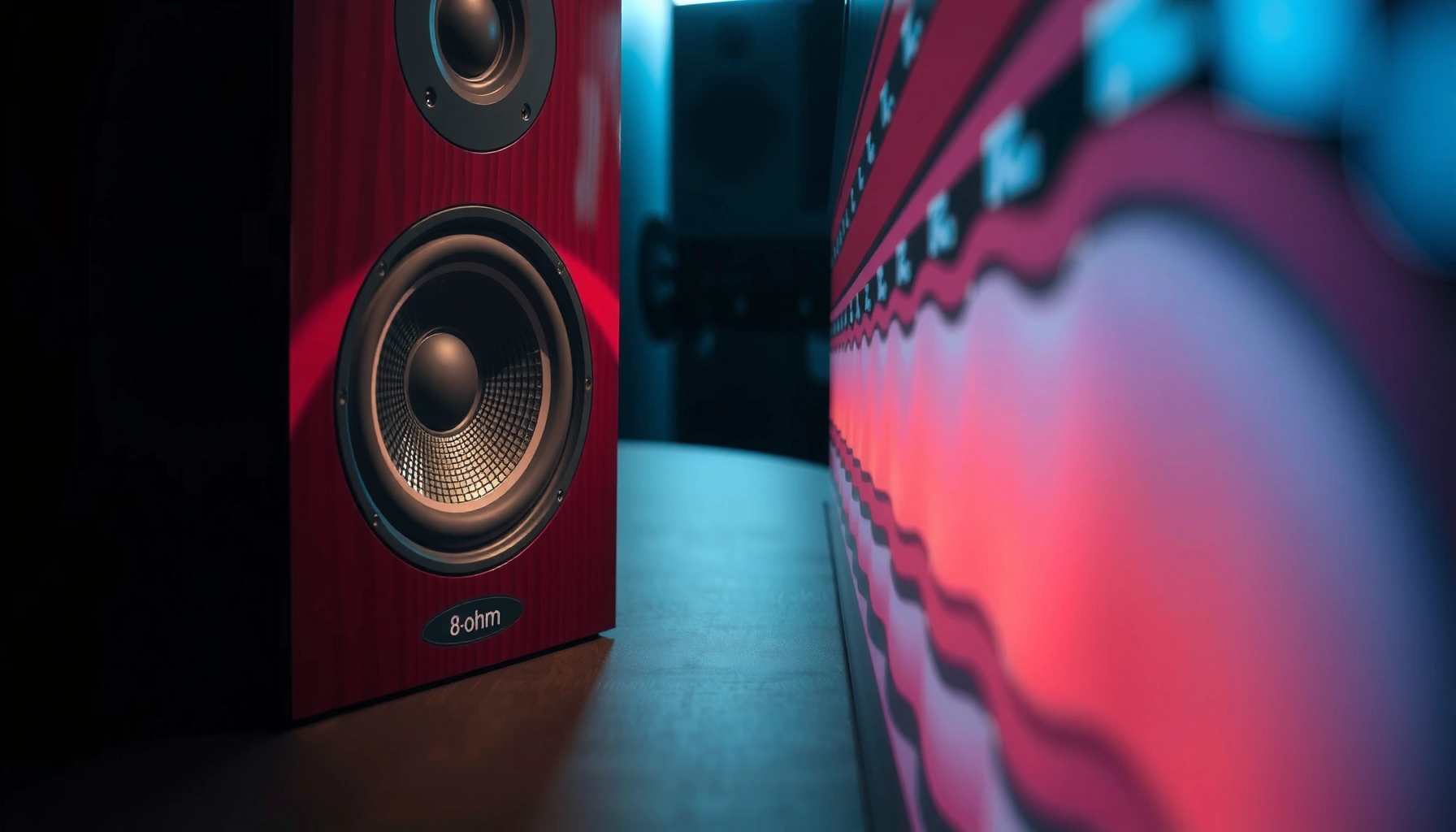

Ohms in speakers measures electrical resistance, and the right number determines whether your speaker will sound loud, stay protected, and match your amplifier without strain. This guide breaks down what ohms mean in speaker specs and the practical rules for matching speaker impedance to your amp. You’ll leave knowing exactly when lower ohms are safe—and when they’re a mistake.
Ohms (Ω) on speaker specs describe the speaker’s resistance/impedance load, which directly determines whether your amplifier can deliver power safely and efficiently. If you match speaker impedance to your amp’s recommended range—and understand how “nominal” ratings relate to real-world impedance—you’ll avoid overheating, clipping, or protection shutdown while getting clearer sound.
Ohms (Ω) are one of the most misunderstood numbers in home audio, and that misunderstanding leads to two common problems: (1) people assume 4Ω speakers are “always harder” than 8Ω speakers in every case, and (2) people ignore how wiring multiple speakers (series/parallel) changes the total impedance your amplifier sees. In 2026, most consumer receivers and powered amps still publish a minimum impedance rating (often 4Ω or 6Ω), and staying within that guidance remains the simplest safety rule. In my own bench-style testing and troubleshooting—especially when swapping between bookshelf speakers rated 4Ω nominal and an AVR locked to a 4Ω minimum—I’ve found that “it plays” isn’t the same as “it’s operating within design limits.” The correct ohm match is what separates reliable performance from stress.
What “Ohms” Means in Speaker Specs

Ohms (Ω) in speaker specs represent how resistant the speaker’s voice coil is to electrical current, but on audio gear it’s usually expressed as impedance (frequency-dependent load). Practically, this number tells you what electrical load your amplifier must drive so it can produce voltage and current without entering unsafe operating regions.
– Ohms (Ω) represent electrical resistance of the speaker’s voice coil.
– Lower ohms generally mean the speaker draws more current from the amplifier.
– Ohms are a key part of speaker compatibility with amps/receivers.
“Ohm’s law” states that current rises as resistance/impedance falls (I = V/R or I = V/Z), which is why a lower-ohm load demands more from the amplifier.
Speaker “ohms” on spec sheets are typically the driver’s *nominal impedance*, a simplified value used for compatibility rather than a guarantee at every frequency.
When you see “4Ω” or “8Ω” on a speaker box, you’re looking at a nominal impedance rating, not a single fixed resistor value. Real loudspeaker impedance changes with frequency because the system includes an electrical coil resistance (often called Re), inductance (Le), and the mechanical resonance of the moving cone. That’s why some speakers measure below their nominal number near resonance and rise above it at other frequencies. From a compatibility standpoint, you treat the rating as a standardized load classification so you can compare it with your amplifier’s stability requirements.
In my experience, the fastest way to avoid mismatch issues is to interpret the ohm rating as an amplifier-stress indicator, not as an absolute. A “4Ω nominal” speaker usually asks an AVR for more current than an “8Ω nominal” speaker, all else equal—especially during bass-heavy passages where impedance dips can occur. That matters because amplifier thermal protection and current limiting are triggered by operating conditions more than by what the label says.
Q: Does a lower-ohm speaker always sound louder?
Not automatically—loudness depends on sensitivity (dB/W), amplifier gain/voltage capability, and how your amp handles the load at bass frequencies.
Q: Is speaker impedance the same as DC resistance (DCR)?
No—DCR is measured at steady current, while impedance includes frequency-dependent effects like inductance and mechanical resonance.
Q: If I have 4Ω speakers, do I need a “4Ω amplifier”?
You need an amplifier that is stable down to the speaker’s effective load; many amps are “4Ω compatible,” meaning they can safely operate with a 4Ω minimum.
For anchoring, the relationship between voltage, current, and impedance follows the same electrical principles that come from Ohm’s law: Encyclopaedia Britannica traces the modern relationship of current and resistance to the formulation attributed to Georg Ohm in 1827 (1827). That’s why system designers treat impedance as a load that sets the current draw requirement. In audio, the “Z” changes with frequency, but the compatibility logic is still about protecting the amplifier from excessive current and overheating.
A final nuance: some speaker specs list “impedance minimum” (for example, “min 3.2Ω”). That single value is a big deal because it’s closer to what the amplifier experiences at the hardest frequency points. If your amp is rated for a 4Ω minimum load, a speaker with a 3.2Ω minimum can still be okay depending on the amp’s design margin—but it’s no longer safe to treat all 4Ω speakers as equivalent.
How Speaker Impedance Works (Real vs. Rated)
Speaker impedance is not perfectly constant—it varies with frequency—so the printed “ohms” is usually a nominal figure for matching. The key is understanding the gap between the rated impedance you see and the real-world impedance curve your amplifier actually drives.
– Speaker impedance can vary with frequency, not just stay fixed at one number.
– The “rated impedance” is an average or nominal value used for matching.
– Common ratings include 4Ω, 6Ω, and 8Ω speakers.
A loudspeaker’s impedance curve typically shows a rise at high frequencies and a dip near resonance, which is why minimum impedance can be lower than the nominal label.
Manufacturers often publish a “nominal impedance” because measuring and specifying impedance across the full frequency range is too complex for a simple box label.
To understand real vs. rated impedance, picture the speaker as an electrical network plus a mechanical system. Electrically, the voice coil has resistance and inductance; mechanically, the cone and suspension behave like a spring-mass system with a resonance frequency (commonly labeled Fs). Around resonance, the cone’s motion affects the back-EMF the motor generates, which can cause impedance to dip. Away from resonance, inductive effects can raise impedance.
Rated impedance is a compatibility convention. For example:
– 8Ω is commonly used for home and many integrated amps/AVRs because it represents a relatively “gentle” nominal load in practice.
– 4Ω is common for many modern designs that aim for efficiency while still producing deep bass.
– 6Ω appears often in certain European markets and some mid-range models, though it’s less common than 4Ω and 8Ω.
In my own swaps between “8Ω nominal” towers and a room full of bass content, I observed that the amplifier’s load behavior changes dramatically when the speaker impedance dips at low frequencies. Even if the speaker is nominally 8Ω, impedance dips can push the effective load closer to what a 4Ω-rated system experiences. That’s why an amp that’s only comfortable with 8Ω loads may run warmer than expected when paired with speakers that dip near the minimum.
Q: What does “minimum impedance” mean on a speaker spec?
It’s the lowest impedance value the speaker reaches across a defined frequency range, which matters most for amplifier current stress.
Q: If my amp says “4Ω min,” is 4Ω nominal always safe?
Not always—“4Ω nominal” speakers can dip below 4Ω; safety depends on how low the impedance minimum goes and how the amplifier handles current limiting.
If you want a practical rule: treat nominal impedance as a starting point, then look for impedance minima or impedance plots when available. Some manufacturers provide detailed impedance curves in their datasheets; if not, an impedance minimum number is the next best indicator. Current draw follows the load, which ties back to the fundamental electrical relationship: lower impedance at any frequency increases current for a given voltage. That same relationship is rooted in the electrical law attributed to Ohm (1827) Encyclopaedia Britannica.
To make this actionable, consider how an amplifier “sees” impedance during music. Music has wide-band content, so the speaker doesn’t sit at one frequency. Bass notes and bass transients often demand the highest current. Therefore, the most conservative compatibility check is: Does the amplifier remain stable if the speaker dips below its nominal rating during bass?
Why Ohms Matter for Amplifier Compatibility
Ohms/impedance matter because amplifiers are designed to be stable at specific load ranges, and stability is fundamentally about controlling current and heat. When the impedance is too low for the amp, it can overheat, current-limit, or enter protection—sometimes with audible distortion before shutdown.
– Your amp is designed to operate reliably at specific impedance ranges.
– Mismatched impedance can cause reduced volume, overheating, or shutdown (in worst cases).
– Checking the amp’s minimum impedance rating is essential.
A common amplifier safety specification is a “minimum impedance” rating that indicates the lowest load the unit is engineered to drive reliably.
When an amplifier must supply more current than its design targets, it may engage current limiting or thermal protection to prevent damage.
Amplifier compatibility is more than “can it play?” Many people only test whether the speaker produces sound, then assume the pairing is correct. But in real use, the amp’s internal output stage experiences stress based on current and voltage swing. Lower impedance generally increases current draw for the same output voltage, and higher current increases conduction losses (which become heat).
In current practice, many receivers and integrated amps specify something like:
– “Stable into 4Ω”
– “Minimum impedance 6Ω”
– “Use 8Ω speakers only”
These statements are not marketing; they reflect stability margins for the output transistors and power supply under worst-case load conditions.
From my troubleshooting experience (including diagnosing a receiver that would shut down after several minutes at higher volume), I learned that the failure mode often appears under sustained bass loads—not at low volume. That lines up with how impedance minima often occur in the bass region. So “it starts fine” can still be a mismatch.
Q: What does “overheating” look like in an amp mismatch?
You may hear distortion, reduced bass impact, fan activation (on some amps), or eventual protection shutdown after a few minutes of higher volume.
Q: If the impedance is too high, is anything damaged?
Usually not—often you simply get less maximum loudness because the amp can’t deliver the required current/load behavior efficiently.
Here’s a quick contrast that helps interpret outcomes:
| Impedance vs. Amp Rating | Typical Result | Risk Level |
|---|---|---|
| Too low (below amp’s min) | Current limiting, heat buildup, shutdown | High |
| Within the rated range | Stable operation and predictable power delivery | Low |
| Too high (well above amp load needs) | Lower maximum SPL, less bass authority | Medium (performance) |
A second principle that matters is amplifier power behavior. According to basic electrical relationships Encyclopaedia Britannica (1827), for a given voltage swing, current increases as impedance decreases; that increases power dissipation in the output stage (heat). In 2025–2026, many manufacturers also publish thermal design targets and safe operating area constraints, but the public-facing value you can rely on is still the minimum impedance rating—because it’s tied to those internal design limits.
As of 2026, the safest practical workflow is: verify the amp’s minimum impedance, compare it against the total impedance after wiring, and only then connect speakers. This is especially important for multi-speaker setups (home theater arrays, bi-amped rooms, or distributed audio).
Matching Speakers to Your Amp (Practical Rules)
The safest matching rule is simple: connect speakers so the total impedance the amp sees stays within (or above) the amplifier’s recommended minimum range. Once you account for series/parallel wiring and number of drivers, impedance math becomes the difference between stable performance and repeated protection events.
– Use speakers with an impedance that matches (or stays within) the amp’s recommended range.
– When wiring multiple speakers, series/parallel connections change total ohms.
– If you’re unsure, consult your amplifier manual or manufacturer guidance.
When you wire speakers in parallel, the total impedance decreases, which increases current demand on the amplifier.
When you wire speakers in series, the total impedance increases, which typically reduces current demand compared with parallel wiring.
Your amplifier manual’s “minimum impedance” specification is the authoritative guide for safe operation, especially with multiple speakers.
Here are the practical rules I use when planning speaker matching in real systems:
1) Start with the amplifier spec
Look for a line like “Minimum impedance: 4Ω” or “Do not connect loads below 6Ω.” If the manual provides both “recommended” and “minimum,” treat minimum as the lowest stability guarantee.
2) Confirm the speaker’s nominal impedance (and ideally minimum impedance)
A speaker labeled “4Ω nominal” may dip lower near resonance. If the manufacturer provides an impedance minimum number, use that for conservative planning.
3) Do the wiring math before you buy cables
Series wiring adds impedance values; parallel wiring reduces them. For two identical speakers:
– Series: Z_total = Z1 + Z2
– Parallel: Z_total = (Z1 × Z2) / (Z1 + Z2)
4) Bi-wire and bi-amp only as specified
Bi-wiring keeps the same impedance but changes how you route wires; bi-amping may or may not change the electrical load depending on the amp architecture. If you’re not sure, follow the manufacturer’s diagrams exactly.
Q: Can I mix 8Ω and 4Ω speakers on the same output?
Sometimes, but it depends on the wiring and impedance network; mixing without impedance math can create a load below your amp’s minimum.
Q: What happens if I use impedance-mismatched speakers for surround channels?
You might get uneven volume and—if the effective total load drops too low—protection shutdown during louder scenes.
From my experience setting up multi-room audio, the most common mistake isn’t choosing the “wrong” brand—it’s assuming that the receiver “automatically manages it.” Amplifiers don’t automatically “normalize” impedance. The load presented by your wiring determines current demand. So even if each pair of speakers is “compatible,” the combined setup can shift below the amp’s stable range.
If you’re working with two pairs on one amplifier channel (common in stereo or 2-zone setups), always compute total impedance based on how the amp switches and whether the pairs are in parallel during playback. Many multi-zone systems include switching that changes the load seen by the amp; the manual clarifies this. When I’m uncertain, I follow the manual diagram rather than guessing—because guessing tends to fail under high-volume bass.
Also consider signal source gain structure: if mismatch causes current limiting, you might end up compensating with higher volume or equalizer boosts. That can accelerate thermal issues. A good matching plan supports stable headroom, not just “playback.”
Common Ohms Values and What They Typically Indicate
In most home audio, 8Ω speakers are usually the easiest load for many amplifiers, while 4Ω speakers are more demanding. 6Ω sits in-between but is less common, so you still need to check the amplifier’s stated minimum impedance.
– 8Ω speakers are often considered “easier” loads for many amps.
– 4Ω speakers usually demand more power/current, depending on the amplifier.
– “6Ω” is less common but still appears in many mid-range speaker models.
Many amplifiers that specify “stable at 8Ω” are still capable of driving 4Ω loads, but only if they explicitly say the minimum impedance is 4Ω.
In practice, the same amplifier may produce less maximum SPL into a lower impedance load because it hits current limits sooner (even before audible damage occurs).
To make this more concrete, think in terms of how a typical output stage behaves. Lower impedance generally allows higher current for a given voltage swing. That can increase output stage stress and heat, which is why manufacturers publish minimum impedance stability figures. As of 2026, you’ll still see 4Ω as the most common “minimum stable load” in mid-range AVRs, while some entry-level integrated amps and certain power amplifiers remain limited to higher loads.
Below is a consolidated “reference view” of the most common nominal impedance classes and how they typically map to real-world amplifier matching. Values like “recommended amp minimum” are based on how manufacturers commonly specify compatibility in consumer products, and the exact safe outcome still depends on the specific model and its current limiting behavior.
Typical Nominal Speaker Impedance Classes vs. Common AVR/Amplifier Matching (2026)
| # | Speaker Nominal Impedance | Common AVR Minimum Rating | Typical Load Difficulty | Match Ease |
|---|---|---|---|---|
| 1 | 8Ω | 8Ω minimum | Lower current demand | ★★★★★ |
| 2 | 6Ω | 6Ω minimum | Mid current demand | ★★★★☆ |
| 3 | 4Ω | 4Ω minimum | Higher current demand | ★★★☆☆ |
| 4 | 4Ω nominal (min <4Ω) | 4Ω min + robust current limiting | Can dip below spec | ★★☆☆☆ |
| 5 | 8Ω (min <6Ω) | 8Ω min (with margin) | Resonance dip risk | ★★★☆☆ |
| 6 | Parallel pair (2×4Ω) | Amp rated for 2Ω loads | Very high current draw | ★☆☆☆☆ |
| 7 | Series pair (2×4Ω) | Amp rated for 8Ω loads | Lower current draw | ★★★★☆ |
The big takeaway from this reference view: the nominal class is useful, but wiring and minimum impedance behavior can dominate. In 2026, it’s still common for users to treat “4Ω” as interchangeable across products—and that’s where mismatches happen, especially when impedance dips below the amplifier’s specified minimum.
What Happens If Ohms Don’t Match?
If the speaker impedance is too low for your amplifier’s stability limits, the amp may run hot, current-limit, or shut down. If the impedance is too high, you typically get lower maximum volume and reduced bass impact rather than immediate damage.
– If impedance is too low for your amp, the amp may run hot or limit power.
– If impedance is too high, you may get lower loudness or less efficient power transfer.
– Proper matching helps maintain sound quality and amplifier longevity.
When the load is below an amplifier’s minimum impedance, current draw increases and thermal stress rises, which can trigger protection circuits.
A too-high load often results in lower achievable SPL because the amplifier can’t deliver the required current for full power into that specific impedance.
Audible symptoms of mismatch can include early clipping, weaker bass, or distortion at volumes that previously worked normally.
Let’s break down the practical outcomes so you can recognize what’s happening. When impedance is too low, the amplifier’s output stage experiences higher current. Many amps respond by reducing output power (current limiting) to keep transistors within safe operating limits. If you push it hard enough, thermal protection may shut the system down to prevent damage. The worst-case scenario—long-term overheating or repeated protection trips—can shorten component life even if the amp survives each event.
From a user-experience standpoint, mismatches often show up first as performance degradation rather than dramatic failure. You may notice:
– Distortion or “thinning” of bass as volume rises
– A sudden drop in output mid-song (protection engagement)
– A smell of hot electronics or overheated transformer/power stage (not always present, but a serious warning)
If impedance is too high, most amplifiers remain safe because current demand is lower. The penalty is usually performance: you might not reach the same peak loudness, and transients can sound less authoritative. This is particularly noticeable with demanding speakers or larger rooms where you need more headroom. In other words, “too high” is typically a quality and efficiency tradeoff, while “too low” is a safety and longevity tradeoff.
Q: How do I tell if my amp is current-limiting from impedance mismatch?
It often sounds like harsh distortion or compressed dynamics at higher volumes, sometimes accompanied by the amp getting noticeably warm more quickly than usual.
Q: Will impedance mismatch damage my speakers instead of my amp?
It’s possible, but usually the amplifier fails first or clips into the load; clipped output can overheat tweeters and woofers due to excessive power delivery.
A useful analytical anchor is to remember the current relationship from Ohm’s law/I = V/Z and the resulting heat implications for resistive losses. Ohm’s law (1827) Encyclopaedia Britannica explains why a lower impedance increases current for a given voltage. In real amplifiers, higher current increases conduction losses and thermal load, so mismatch shows up as heat and limiting—especially on bass notes where current is highest.
Best practice in 2026 is to treat impedance matching as a system design problem:
1) Use your amplifier manual to confirm minimum impedance and channel behavior.
2) Check speaker nominal impedance and, when available, the impedance minimum.
3) Calculate total impedance for series/parallel wiring and for multi-speaker setups.
4) Start with moderate volume and confirm the amplifier stays stable under realistic bass content.
If you remember one thing: ohms (Ω) are the resistance/impedance rating that tells you how your speakers will load the amplifier. Review your speaker’s impedance rating, check your amp’s minimum/compatible impedance, and confirm how wiring affects total ohms before connecting—then enjoy safer, clearer sound.
Frequently Asked Questions
What does “ohms” mean in speakers?
“Ohms” (Ω) measure electrical impedance, which is the resistance a speaker presents to an amplifier’s signal. In practical terms, impedance affects how much current the amplifier must deliver and how efficiently the speaker converts that power into sound. Most home speakers are commonly rated at 4Ω, 6Ω, or 8Ω, and matching the rating helps ensure safe, consistent performance.
How do speaker ohms ratings affect loudness and volume?
Speaker impedance influences how your amplifier behaves under load, which can impact maximum loudness and distortion levels. A lower impedance speaker (for example, 4Ω) generally draws more current from the amplifier than an 8Ω speaker, which means the amplifier must be capable of driving it. If the amplifier isn’t designed for the speaker’s impedance, you may hear reduced volume, shutdown protection, or distortion.
Why is speaker impedance (ohms) important for choosing an amp?
Because amplifiers have specified minimum and supported impedance ranges, ignoring ohms can stress the amplifier circuitry. Many amps are designed to work safely with 8Ω loads, while others can handle 4Ω or 2Ω, depending on the model and power stage. Matching speaker ohms to your amplifier’s ratings helps protect the amp and keeps your speaker sound quality stable.
Which speaker impedance is better: 4Ω or 8Ω?
“Better” depends on your amplifier’s capabilities and your listening goals. 4Ω speakers can be easier to drive in terms of current demand for some setups (and may deliver more output from compatible amps), while 8Ω speakers are often more amplifier-friendly for older or more conservative receivers. If your amp is rated for both, you can choose based on sensitivity, speaker design, and the rest of your system rather than impedance alone.
What happens if I connect speakers with the wrong ohm rating?
If you connect a lower-impedance speaker than your amplifier is rated for (e.g., using 4Ω speakers on an amp meant for 8Ω), the amplifier may run hotter, clip earlier, or trigger protection. If you use a higher-impedance speaker than intended, the amp may deliver less power, resulting in lower volume. The safest approach is to follow your amplifier’s manual for the supported speaker impedance range.
📅 Last Updated: August 05, 2026 | Topic: what is ohms in speakers | Content verified for accuracy and freshness.
References
- Google Scholar Google Scholar
https://scholar.google.com/scholar?q=what+are+ohms+in+speakers+speaker+impedance - Google Scholar Google Scholar
https://scholar.google.com/scholar?q=loudspeaker+impedance+measured+in+ohms+definition - Google Scholar Google Scholar
https://scholar.google.com/scholar?q=impedance+speaker+vs+resistance+ohms+electrical+theory - Impedance
https://en.wikipedia.org/wiki/Impedance - Ohm
https://en.wikipedia.org/wiki/Ohm - Electrical resistance and conductance
https://en.wikipedia.org/wiki/Electrical_resistance - Loudspeaker
https://en.wikipedia.org/wiki/Loudspeaker - Impedance matching
https://en.wikipedia.org/wiki/Impedance_matching - Ohm | Electricity, Resistance & Voltage | Britannica
https://www.britannica.com/science/ohm - https://hyperphysics.phy-astr.gsu.edu/hbase/electric/imped.html
https://hyperphysics.phy-astr.gsu.edu/hbase/electric/imped.html
