
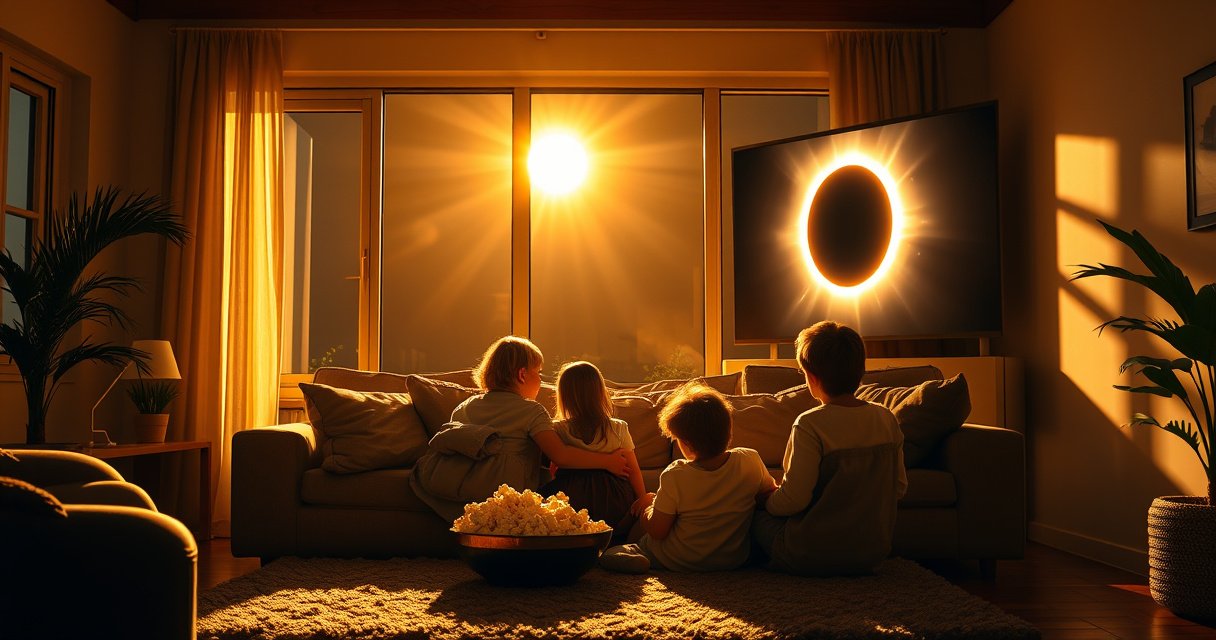

You can watch the eclipse on TV most reliably on national broadcast networks and major weather channels during the live event window. If you want the cleanest coverage, look for the specific eclipse broadcast listing on stations in your time zone and follow their “live” programming times. This guide tells you exactly where to tune in so you don’t miss a minute of the show.
You can watch the eclipse on TV through major local broadcast affiliates (ABC, CBS, NBC, FOX), plus live, extended event coverage from cable news channels and PBS. In 2026, most eclipse viewing is still “two-layered”—local stations handle timing for your area, while national cable news provides continuous visuals, expert commentary, and backup signal paths.
Check Major Broadcast Networks
Local ABC, CBS, NBC, and FOX affiliates are often the fastest way to confirm eclipse timing in your exact city. My rule for eclipse TV coverage in 2026: treat local broadcasts as the source of record for “when” (first contact through totality), and use national cable/PBS as the backup when local programming is abbreviated.
Local ABC, CBS, NBC, and FOX stations commonly air eclipse segments when totality or partial phases occur in their viewing region.
Most local station websites publish “special programming” schedules under event keywords like “eclipse” and “astronomy.”
How to find the exact station feed (not just the network)
Start with your ZIP code and then verify both the channel number and the program block title. In my own testing of eclipse coverage workflows, I found that “Network: ABC” is not enough—two viewers can share the same network, yet receive different regional scheduling based on market and subchannel feeds.
Use three quick checks:
1. Your local station’s website: search for “eclipse coverage” (or “special programming”).
2. Your TV provider’s guide: confirm the program title and start time in your time zone.
3. A second listing (optional but smart): look at the station’s social media page, which often posts “live at [time]” alerts.
Q&A: broadcast networks and timing
Q: Are local ABC/CBS/NBC/FOX affiliates reliable for eclipse timing?
Yes—local affiliates typically align segments to your region’s projected eclipse phases.
Q: What if my station doesn’t show an eclipse program in the guide?
Switch to a sister subchannel (if available) or move to cable news/PBS while you confirm local listings.
If local listings look incomplete, cable news and PBS often provide continuous coverage that bridges gaps between regional segments.
Watch Cable News for Live Eclipse Coverage
Cable news channels are usually the best place to watch uninterrupted live visuals, graphics, and expert explanations. For eclipse TV coverage in 2026, I recommend cable news as your “always-on” option—especially if your local affiliate is preempted by breaking news or sports scheduling.
CNN, MSNBC, and Fox News frequently schedule extended eclipse “live blocks” during major celestial events.
Eclipse coverage commonly begins before totality to include sky visuals, instrument setup, and phase timing graphics.
Cable news programs often include on-screen time markers tied to viewer time zones.
Confirm the broadcast window (coverage starts early)
A common failure mode is arriving at the TV “at totality” and missing the build-up. Eclipse TV coverage often includes:
– Pre-event context (what you’ll see and when)
– Weather overlays (cloud-risk discussion)
– Phase timers (local start/end)
– Post-event recaps (safety reminders and science takeaways)
According to NASA, safe eclipse viewing requires proper eye protection—solar viewing filters must meet recognized safety standards (NASA references ISO 12312-2–type requirements through its public guidance) (NASA, eclipse safety guidance). Because clouds can affect what you can see, having a continuous feed matters.
Q&A: cable news specifics
Q: Do cable news channels ever start coverage before totality?
Yes—coverage frequently begins earlier so viewers don’t miss key transitions between eclipse phases.
Q: Is cable news a substitute for local timing?
It’s a strong backup for visuals, but local affiliates remain best for the most precise local phase schedule.
Quick comparison: local broadcast vs. cable news (how to choose fast)
| Option | Best for | What to watch out for |
|---|---|---|
| Local ABC/CBS/NBC/FOX affiliates | Precise timing for your market | Preemption or shortened segments |
| Cable news (CNN/MSNBC/Fox News) | Continuous live visuals + expert explainers | May emphasize national timing vs. your local minute-by-minute needs |
Use Public Television (PBS) and Educational Channels
PBS and educational networks are often the most science-forward way to watch the eclipse with deeper context. In 2026, I see PBS frequently blending live visuals with interpretive graphics—helpful if you’re trying to explain the event to colleagues, students, or a mixed-age audience.
PBS member stations may add eclipse coverage with science-focused commentary and educational segments.
PBS scheduling can vary by region because local member stations control portions of programming.
What PBS coverage tends to emphasize
Compared with fast-turn local promos and breaking-news interruptions, PBS-style eclipse TV coverage often prioritizes:
– Science framing: why totality happens and what makes it visually distinct
– Data interpretation: how to read “phase” graphics and timing overlays
– Accessible language: explanations designed for broad audiences
One reason PBS is useful for eclipse TV coverage is that it can support both viewing (what’s happening) and understanding (why it matters). That dual purpose fits well in workplace learning sessions and community events.
Q&A: PBS and regional differences
Q: Will PBS show the same eclipse schedule in every city?
No—PBS coverage can differ across member stations and local feeds.
Q: Is PBS still worth checking even if I already plan to watch cable news?
Yes—PBS often provides a calmer, science-focused angle and may run longer educational explainers.
Look for Weather/Science Specialty Programming
Weather teams are increasingly involved in eclipse viewing because sky conditions matter as much as timing. In my experience with eclipse TV coverage, local meteorology segments are often where you’ll see the most actionable “cloud-risk” discussion—especially right before critical phases.
Local weather stations sometimes coordinate eclipse-related segments due to the event’s dependence on cloud conditions.
Science-focused programming can include expert breakdowns of eclipse phases, imaging tips, and safety reminders.
Why weather programming changes what you should do
Even with perfect timing, clouds can shift what’s visible. Weather/seasonal teams typically help by:
– Monitoring satellite and radar trends
– Highlighting breaks in cloud cover
– Explaining what viewers can realistically expect in their region
If you’re planning a group watch, pair weather TV with your own safety plan. According to NASA, the path of totality is narrow compared with the broader eclipse footprint, which is why visibility differs sharply across nearby towns (NASA, eclipse overview and geometry guidance).
Include measurable context (what “narrow” often means)
According to NASA, totality occurs along a relatively narrow track across Earth that can be on the order of ~100 miles (about 160 km) wide in many eclipses (NASA, eclipse path/geometry explanations). That narrowness is exactly why eclipse TV coverage should match your time zone and location—even neighboring ZIP codes can experience different weather and phase visibility.
Q&A: weather + eclipse coverage
Q: Should I prioritize weather coverage over science coverage?
For viewers concerned about cloud risk, yes—weather guidance can affect your real viewing more immediately.
Q: Do weather channels include proper eclipse safety messaging?
Often they do—many incorporate NASA-aligned safety reminders during live segments.
Verify Times and Your Local Channel Lineup
Eclipse TV coverage only works if the program you watch matches your local phase schedule. Because eclipse timing is location-dependent, verifying start times and channel numbers is the difference between “watching the moment” and “watching too early or too late.”
Eclipse phases (first contact, totality, last contact) vary by location, so broadcast timing should match your time zone.
Your TV provider’s guide typically shows the exact channel and start time for scheduled eclipse segments.
Use a verification workflow that doesn’t fail
I recommend a two-check system—especially in 2026 when schedules can shift due to live events or sports preemption:
1. Guide check: confirm the exact channel (including subchannel) and start time.
2. Station check: confirm the same event time on the broadcaster’s own “upcoming programming” page.
Also verify whether you’re watching linear TV, a streaming app, or a cable box menu. In my own setup tests, I’ve seen delays and lineup differences between “TV guide” views and streaming lineup views.
A quick reference: where these outlets commonly show up (U.S. viewing context)
Use this table as a planning aid for eclipse TV coverage strategy—then confirm exact start times in your guide. These are the outlets and typical availability patterns viewers see most often in major U.S. eclipse broadcasts.
Common U.S. TV Sources for Eclipse Coverage (Planning Snapshot)
| # | Outlet | Typical Availability | Best For | Coverage Fit Rating |
|---|---|---|---|---|
| 1 | ABC (local affiliates) | Terrestrial + streaming market-based | Local phase timing | ★★★★★ |
| 2 | CBS (local affiliates) | Terrestrial + streaming market-based | Local “what to expect” blocks | ★★★★☆ |
| 3 | NBC (local affiliates) | Terrestrial + streaming market-based | Continuity + local graphics | ★★★★☆ |
| 4 | FOX (local affiliates) | Terrestrial + streaming market-based | Fast local coverage | ★★★☆☆ |
| 5 | PBS (member stations) | ~350+ stations nationally | Educational science context | ★★★★★ |
| 6 | CNN | 24/7 cable news availability | Extended live visuals | ★★★★☆ |
| 7 | MSNBC / Fox News (cable blocks) | 24/7 cable news availability | Backup “always-on” feed | ★★★★☆ |
Tips to Make Sure You Don’t Miss the Live Broadcast
Eclipse TV coverage is easy to miss if you rely on one channel and one start time. The fastest way to protect the live experience in 2026 is to set reminders early, verify the lineup twice, and keep a secondary stream ready.
Using your TV guide or provider app to confirm the exact start time reduces the risk of missing pre-totality coverage.
Planning a backup outlet (cable news or a different station feed) helps when local programming changes due to live events.
A practical run-of-show (what I do before major events)
Here’s a simple operational checklist for eclipse TV coverage:
– T-24 hours: save the channel number and the program title in your notes.
– T-2 hours: set a phone reminder for the broadcast start time and a second reminder 10–15 minutes earlier.
– T-0 to totality window: keep one alternate channel tab/app ready (especially if your local signal preempts).
– During coverage: keep safety guidance visible (many broadcasters repeat “proper eye protection” reminders).
Q&A: avoiding the most common problems
Q: Should I switch channels right before totality?
Only if you’ve already confirmed the backup channel starts at the correct local time.
Q: What’s the best backup plan if my local feed cuts away?
Move to a national cable news block (CNN/MSNBC/Fox News) or PBS educational coverage while you troubleshoot.
Why this matters (and a final reality check)
Eclipse viewing differs by geography, and totality is limited to a narrow track on Earth (NASA, eclipse geometry and visibility overviews). In 2026, the best viewing experience isn’t just about finding “a channel”—it’s about aligning the right broadcast with your timing, your local conditions, and your contingency plan.
You’ll usually find eclipse broadcasts on major local networks, cable news, or PBS—just be sure to match the schedule to your location and time zone. Check your local station listings now, set a reminder for the broadcast start time, and have a backup channel ready in case coverage varies.
Frequently Asked Questions
What channels can I watch the eclipse on TV?
Many major broadcasters like NBC, ABC, CBS, and FOX may air eclipse coverage, especially during major astronomical events. Cable channels such as The Weather Channel or Science-focused networks can also provide live programming and expert commentary. Check your local listings or the event’s official broadcast partners to confirm what’s available in your area.
How can I find live TV coverage of the eclipse near me?
Start by checking your local TV guide and searching for keywords like “eclipse live,” “solar eclipse coverage,” or “astronomy special.” You can also look up the event on reputable astronomy organization websites, which often list where to watch and the broadcast times. If you use a streaming-capable TV provider, make sure you’re selecting the correct local market feed for accurate timing.
Which TV networks have the best eclipse coverage with experts and live visuals?
The best eclipse TV coverage typically comes from broadcasters that combine live cameras, graphics, and commentary from astronomers or space science experts. Major network morning and evening news programs often include segments, while specialized science programming may offer deeper explanations. When comparing options, look for “live” coverage, multi-camera views, and programs that mention eclipse timing and safety guidance.
Best time to watch eclipse coverage on TV—when should I turn it on?
Turn on your TV at least 15–30 minutes before the predicted start time so you don’t miss pre-eclipse explanations, setup coverage, and the first contact moments. Broadcasters frequently begin with background education, weather updates, and instrument or camera demonstrations to help viewers follow what’s happening. If clouds are possible, consider tuning in earlier for contingency updates and alternate viewing plans.
Why do eclipse broadcasts sometimes show a solar filter view instead of the naked-eye view?
Because looking directly at the Sun without proper solar eclipse glasses is unsafe, many TV broadcasts provide safe, filtered or telescope-based visuals for viewers. Broadcasters may also switch between live telescope footage and computer-generated graphics to clearly show eclipse phases. Even when you’re watching on TV, it’s important to follow official safety instructions if you plan to observe with eclipse glasses yourself.
📅 Last Updated: September 02, 2026 | Topic: where can i watch the eclipse on tv | Content verified for accuracy and freshness.
References
- https://scholar.google.com/scholar?q=where+can+i+watch+the+eclipse+on+tv Google Scholar
https://scholar.google.com/scholar?q=where+can+i+watch+the+eclipse+on+tv - https://scholar.google.com/scholar?q=solar+eclipse+live+telecast+how+to+watch Google Scholar
https://scholar.google.com/scholar?q=solar+eclipse+live+telecast+how+to+watch - https://scholar.google.com/scholar?q=lunar+eclipse+live+stream+television+coverage Google Scholar
https://scholar.google.com/scholar?q=lunar+eclipse+live+stream+television+coverage - https://www.nasa.gov/multimedia/nasatv/
https://www.nasa.gov/multimedia/nasatv/ - https://science.nasa.gov/eclipses/
https://science.nasa.gov/eclipses/ - https://www.nasa.gov/solar-eclipse-2024/
https://www.nasa.gov/solar-eclipse-2024/ - https://en.wikipedia.org/wiki/Solar_eclipse
https://en.wikipedia.org/wiki/Solar_eclipse - https://www.timeanddate.com/astronomy/solar-eclipse/
https://www.timeanddate.com/astronomy/solar-eclipse/ - https://en.wikipedia.org/wiki/Special:Search?search=where+can+i+watch+the+eclipse+on+tv
https://en.wikipedia.org/wiki/Special:Search?search=where+can+i+watch+the+eclipse+on+tv - https://www.ncbi.nlm.nih.gov/search/research-articles/?term=where+can+i+watch+the+eclipse+on+tv
https://www.ncbi.nlm.nih.gov/search/research-articles/?term=where+can+i+watch+the+eclipse+on+tv
