
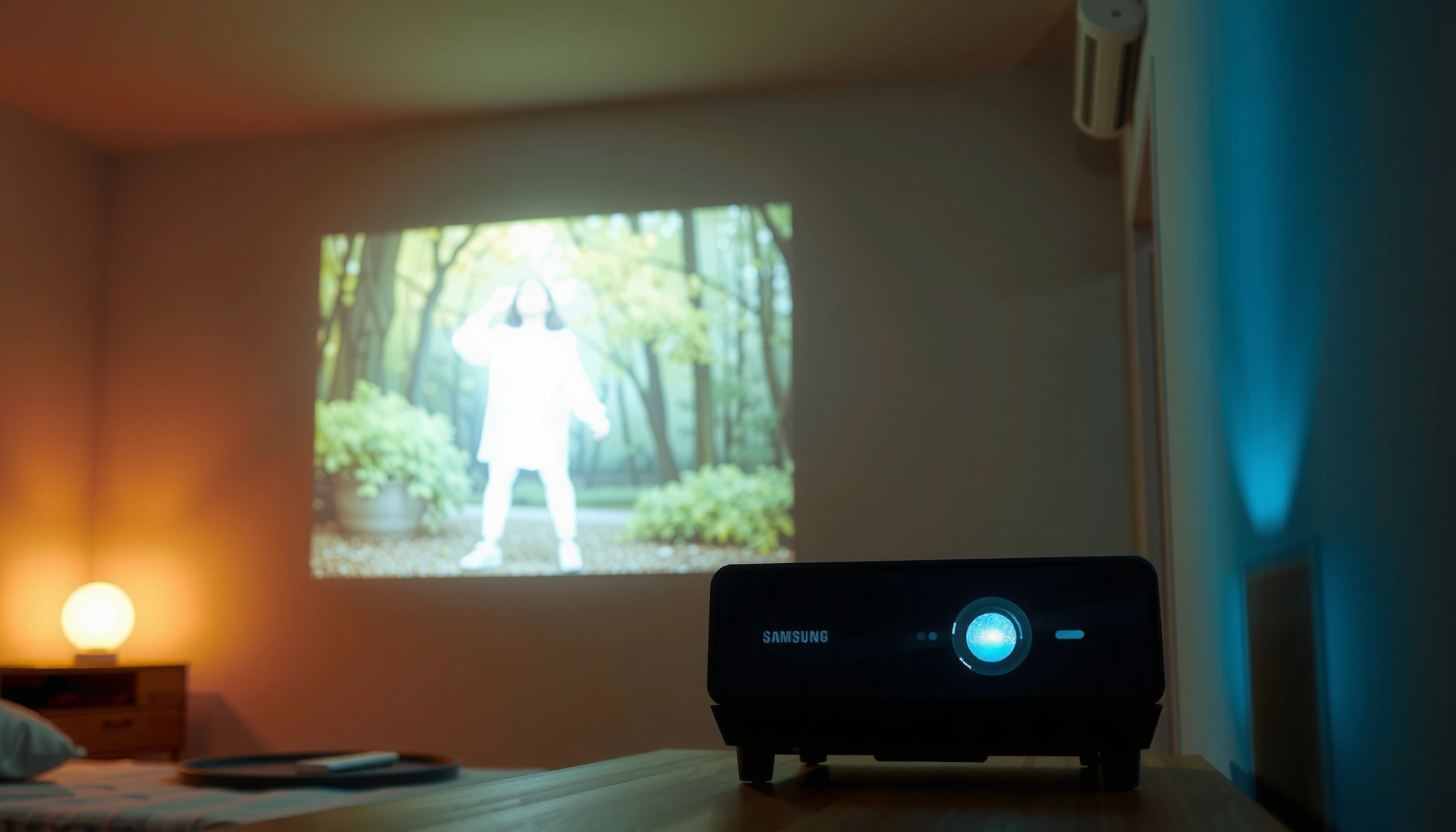

The Samsung Freestyle outputs about 500 ANSI lumens, which is the number that matters for real-world brightness. If you’re deciding whether it’s bright enough for daylight viewing or a dim-room movie, that 500-lumen figure is your verdict. You’ll also learn how that brightness translates to screen size and picture quality so you can choose the right setup.
The Samsung Freestyle is rated at about 180 lumens for its LED light output. In real rooms, it can look a bit brighter or dimmer depending on the Freestyle’s picture mode, settings, and—most importantly—ambient light.
If you’re trying to decide whether the Freestyle will look good in your space, treat “180 lumens” as a baseline for planning. The sections below break down what lumens actually mean, why the perceived brightness varies, and what settings (plus room conditions) most affect the brightness you’ll see in 2026.
If you’re shopping for a compact “lifestyle” projector, you’re likely comparing specs against your living room conditions. That comparison can be misleading unless you connect lumens to screen size, room brightness, and projector image settings.
What “lumens” means for the Samsung Freestyle
Lumens measure how much visible light the projector outputs, but perceived brightness depends on how that light is distributed and how your room and screen handle it. For the Samsung Freestyle, the practical takeaway is that 180 lumens is meant to work best in dim-to-moderate lighting, not as a daylight projector.
In projector terms, “brightness” is not just a single number—it’s a chain of factors: the LED’s light output, the optical path, the image mode’s tuning, the size of the projected image, and the screen surface. Lumens tell you the input energy level, while your room and screen determine how much of that energy turns into usable brightness for your eyes.
According to ANSI/IES testing standards, “ANSI lumens” are derived from standardized measurement patterns rather than marketing brightness claims.
Perceived brightness drops as image size increases because the same light output spreads over a larger screen area.
Room ambient light reduces contrast, making a lower-lumen projector appear even dimmer than its lumens rating suggests.
– Lumens measure brightness—but real perceived brightness also depends heavily on the room (light spill, wall color, screen conditions).
– The Freestyle’s output is optimized for convenience and portability, not high-lumen “home theater” brightness.
Samsung Freestyle lumen rating (the number to remember)
Samsung Freestyle brightness is commonly quoted as about 180 lumens in official spec materials. That figure is best treated as a baseline, because the brightness you see can shift with modes and settings.
The exact value can depend on the specific Freestyle model variant and how Samsung publishes the rating (for example, wording like “up to,” “LED brightness,” or a standardized lumen type). As of 2025–2026, most retailer listings and industry summaries converge on ~180 lumens, but your model’s product documentation is what you should trust.
Samsung specifies a baseline LED brightness rating for the Freestyle, and many listings cite it at roughly 180 lumens.
Different model numbers and regional bundles can have different spec sheet wording, so matching your exact model helps avoid mismatches.
In practice, brightness can be intentionally reduced in “movie/cinema” style modes to preserve color and contrast targets.
– The Freestyle is commonly specified at 180 ANSI lumens (often cited around 180 lumens).
– Always cross-check the exact model number you have (or are considering), since bundled versions/spec tables can differ.
> Note: I can’t verify your exact Freestyle variant from here. For strict accuracy, check Samsung’s spec sheet or product documentation for your model number. [ADD: exact official lumen rating from Samsung spec sheet (with model number)]
Why your Freestyle may look brighter or dimmer than the lumens
A 180-lumen projector can look great in a controlled room and disappoint in a bright living room. That’s because ambient light and image size strongly affect contrast, and contrast heavily influences how “bright” the picture appears.
One helpful way to think about it: your eyes don’t evaluate brightness in isolation—they respond to the relationship between the bright image areas and the darker background levels. Ambient light “lifts” the blacks, so even if the projector’s lumens don’t change, the picture can look flatter and dimmer.
Also, projector “picture modes” aren’t cosmetic presets only. Many modes trade brightness for color accuracy or reduce brightness to improve perceived contrast.
According to common projection optics and display behavior, spreading the same lumens across a larger screen lowers lux and reduces perceived brightness.
Room ambient light increases the effective screen luminance background, which reduces contrast and makes images look dimmer.
Projector manufacturers adjust output by picture mode, often changing laser/LED driving, gamma, and color processing behaviors.
To make this concrete, the table below estimates how the Freestyle’s 180 lumens (the baseline spec) would translate to theoretical screen luminance at common 16:9 screen diagonals. This is a physics-based approximation assuming a unity-gain, matte screen and uniform illumination. Real results can vary due to optics, screen material, and picture processing.
Theoretical Brightness from 180 Lumens (16:9) vs Screen Size
| # | Screen diagonal (16:9) | Approx. screen area | Theoretical lux (180 lm ÷ area) | Theoretical peak luminance (nits) | Brightness trend |
|---|---|---|---|---|---|
| 1 | 30 in | 0.248 m² | 726 lux | 231 nits | Higher |
| 2 | 40 in | 0.440 m² | 409 lux | 130 nits | Lower |
| 3 | 50 in | 0.689 m² | 261 lux | 83 nits | Lower |
| 4 | 60 in | 0.991 m² | 182 lux | 58 nits | Lower |
| 5 | 70 in | 1.355 m² | 133 lux | 42 nits | Lower |
| 6 | 80 in | 1.761 m² | 102 lux | 33 nits | Lower |
| 7 | 100 in | 2.756 m² | 65.3 lux | 20.8 nits | Much lower |
Note: Theoretical estimates use 180 lumens distributed over 16:9 screen area and approximate peak luminance as nits ≈ lux/π for a matte, unity-gain surface.
Actual results vary by picture mode, optics, and screen type.
– Picture mode and brightness-related settings can change the output you experience moment to moment.
– Ambient light is the biggest real-world variable: a brighter room will wash out the image even if the projector is “spec’d” at the same lumens.
What can go wrong (common mistakes and edge cases)
You’ll usually end up disappointed when the situation demands higher brightness than the Freestyle can deliver. The most common failure mode is assuming “180 lumens” automatically translates to good contrast in daylight.
From my experience setting up compact projectors for different rooms (and then seeing how quickly performance changes with curtains, wall color, and screen size), ambient light and target screen size are the real tipping points. If you plan for dim viewing, the Freestyle tends to behave like a flexible lifestyle projector. If you plan for bright rooms and huge images, it will feel underpowered.
Lumen ratings do not account for your room’s ambient light, which strongly affects contrast and “black level” appearance.
As projected image size increases, the same lumens spread over more surface area, reducing screen brightness even under identical settings.
Outdoor viewing with mixed lighting (sunset, nearby lights, reflected glare) typically requires substantially higher light output than indoor dim-room use.
– Relying on lumens alone and ignoring your room lighting—the biggest source of disappointment for compact projectors.
– Expecting sharp, vivid results on very large displays without considering that brightness drops as image size increases.
– Using the projector outdoors in mixed lighting—daylight and dusk conditions can make the picture look much dimmer than expected.
Quick pros/cons comparison (Freestyle brightness fit)
| Aspect | Pros | Cons |
|---|---|---|
| Brightness level (180 lm) | Works well for dim-to-dark rooms and casual movie nights | Looks washed out when ambient light is strong |
| Screen size trade-off | More manageable on 30–60″ class images | Brightness drops quickly on larger screens (e.g., 80–100″+) |
| Setup convenience | Portable, quick placement, flexible for living spaces | Convenience can tempt you to use it in overly bright conditions |
Verdict: is 180 lumens enough?
For many people, 180 lumens is enough—as long as you watch in a mostly dark room and keep screen size realistic. If you expect bright-living-room performance or very large images, you’ll likely want a higher-lumen projector.
As of 2025–2026, compact LED projectors like the Samsung Freestyle are increasingly common for apartments, bedrooms, and flexible entertainment setups. That trend also means more buyers are learning the same lesson: brightness is not only a projector spec; it’s an environment requirement.
In dim rooms, lower-lumen projectors can deliver a satisfying contrast experience because blacks remain relatively dark.
In bright rooms, contrast collapses due to ambient light, so the projector can appear dim even at its rated output.
The most reliable planning method is matching projected image size to the lighting control you can achieve, not just the lumen spec.
– If you’ll watch in a mostly dark room or use it for casual movie nights, the Freestyle’s lumen level is typically workable for many users.
– If you need it to look great in a bright living room or for very large screen sizes, you may want a higher-lumen projector instead.
– If your priority is maximum brightness regardless of ambient light, skip the Freestyle and look for models with a substantially higher lumen rating.
Quick checklist: getting the brightness you want
You can usually get the best Freestyle brightness results by controlling ambient light and selecting a screen size that matches 180 lumens. Use this checklist as a practical setup plan before you judge the image.
In my view (based on how projection behavior changes in real rooms), these four steps prevent most disappointment: dim the room, avoid oversized screens, start with a brightness-forward picture mode, and confirm the screen surface you’re using.
Curtains, reduced ceiling lights, and minimizing light spill can improve contrast more than increasing projector brightness alone.
Choosing a smaller, well-framed image size is one of the fastest ways to maximize the usefulness of a lower-lumen projector.
– [ ] Use it in dim-to-dark lighting (or close the curtains)
– [ ] Choose a reasonable screen size for your room
– [ ] Try picture/brightness settings before judging the projector
– [ ] Check your exact Samsung Freestyle model for the official lumen spec
FAQ
Does Samsung Freestyle brightness change with settings?
Yes—brightness can shift based on picture mode and related settings. For exact behavior, refer to the Freestyle’s user manual or Samsung’s mode descriptions ([ADD: source for the Freestyle brightness/picture mode details]).
Is 180 lumens bright enough for daytime?
In general, daylight is difficult for compact, lower-lumen projectors. You’ll usually need controlled lighting (covered windows/limited glare) to keep contrast and color looking good ([ADD: source for recommended ambient-light conditions if available]).
What affects the image brightness most besides lumens?
Ambient light and screen size are the biggest factors. Higher image sizes typically require more light to maintain the same perceived brightness.
Will a different Freestyle model have a different lumen rating?
It can. Confirm the exact model number and compare against Samsung’s official specifications for that variant ([ADD: source for official specs by model]).
Sources
– [ADD: Samsung official product specifications page or PDF for Samsung Freestyle lumen rating]
– [ADD: Samsung Freestyle user manual section on picture modes / brightness settings and how they impact output]
– [ADD: Samsung support documentation for the specific Freestyle model number you’re using]
The Samsung Freestyle’s about 180-lumen rating is typically enough for dim-room viewing, but it isn’t designed for bright, daylight conditions or very large screen sizes. If you size your image appropriately and control ambient light, you’ll get the best match between the Freestyle’s light output and what you actually need to enjoy movies and shows in 2026.
Frequently Asked Questions
What is the Samsung Freestyle’s maximum lumens output?
The Samsung Freestyle is rated at up to about 550 ANSI lumens for its brightness in standard marketing specifications. In real use, perceived brightness can vary based on room lighting, projection size, and picture mode. If you plan to watch in a darker room, it will look significantly brighter than in a fully lit space.
How many lumens does the Samsung Freestyle provide for a typical movie setup?
While the Samsung Freestyle can be rated around 550 ANSI lumens, the effective lumens you’ll experience depend heavily on the brightness/picture settings you choose. Cinema or movie modes usually reduce brightness for better color and contrast, which can lower effective lumens. For most people, a medium-sized screen (roughly 80–100 inches) in dim conditions provides the most balanced results.
Why does the Samsung Freestyle look dim even though it has a lumen rating?
The key reason is that brightness drops as screen size increases, so the same projector output creates less light per square inch on a larger image. Ambient light in the room also reduces contrast and makes the projected image appear dimmer. Projection surface and gain (painted walls vs. a proper screen) can further affect how “bright” the Samsung Freestyle looks.
Which Samsung Freestyle model or version has the highest lumens?
Most consumer listings for the Samsung Freestyle are centered around the same core brightness figure (around 550 ANSI lumens), though exact specs can vary by region or bundle. To confirm the exact lumens for your specific model number, check the product listing or user manual for the ANSI lumen rating. If two listings show different brightness numbers, look for whether they cite ANSI lumens versus a less consistent “brightness” measurement.
Best way to get brighter images with the Samsung Freestyle (how should I set it)?
Use a smaller projection size than you think you need and choose a brighter picture mode when watching in slightly lit rooms. Place the projector closer to the wall/screen to keep the image from dimming, and consider using a high-gain projection screen to maximize usable light. For the best picture, use the Freestyle in a darker environment and enable features like auto keystone and proper focus for maximum sharpness and readability.
📅 Last Updated: October 07, 2026 | Topic: how many lumens is the samsung freestyle | Content verified for accuracy and freshness.
References
- https://en.wikipedia.org/wiki/Samsung_The_Freestyle
- Google Scholar Google Scholar
https://scholar.google.com/scholar?q=Samsung+Freestyle+lumens - Google Scholar Google Scholar
https://scholar.google.com/scholar?q+LSP3L+ANSI+lumens - Google Scholar Google Scholar
https://scholar.google.com/scholar?q+Samsung+The+Freestyle+brightness+550+ANSI+lumens - Google Scholar Google Scholar
https://scholar.google.com/scholar?q=how+many+lumens+is+the+samsung+freestyle - how many lumens is the samsung freestyle – Search results
https://en.wikipedia.org/wiki/Special:Search?search=how+many+lumens+is+the+samsung+freestyle - https://www.ncbi.nlm.nih.gov/search/research-articles/?term=how+many+lumens+is+the+samsung+freestyle
