

Ceiling speakers can be good for surround sound, but only if you use them as part of a properly designed Atmos or in-ceiling surround setup rather than expecting them to behave like traditional wall-mounted speakers. If your room layout supports correct speaker placement and you tune distances and levels with care, they deliver wide, immersive overhead effects with clean, unobtrusive installation. Keep reading for the pros, the common pitfalls, and the placement tips that determine whether ceiling speakers truly earn a surround-sound upgrade in your space.
Ceiling speakers can be excellent for surround sound—especially for overhead “height” effects in Dolby Atmos and DTS:X—but they only deliver convincing imaging when they’re placed correctly, matched to the rest of your system, and configured in the right channel layout. In my own home-theater testing, I’ve found that the difference between “wow, that’s immersive” and “why does it sound diffuse?” almost always comes down to ceiling angle, speaker matching, and receiver calibration (distance/levels).
A surround mix relies on panning (moving sound sources across channels) and head-related cues (how humans perceive direction). With Atmos-style content, those cues depend heavily on height channels—the ones that should originate above the listener. That’s exactly where ceiling speakers are positioned, which is why they’re often the most practical way to reproduce overhead effects in a real room.
When Ceiling Speakers Work Best for Surround Sound
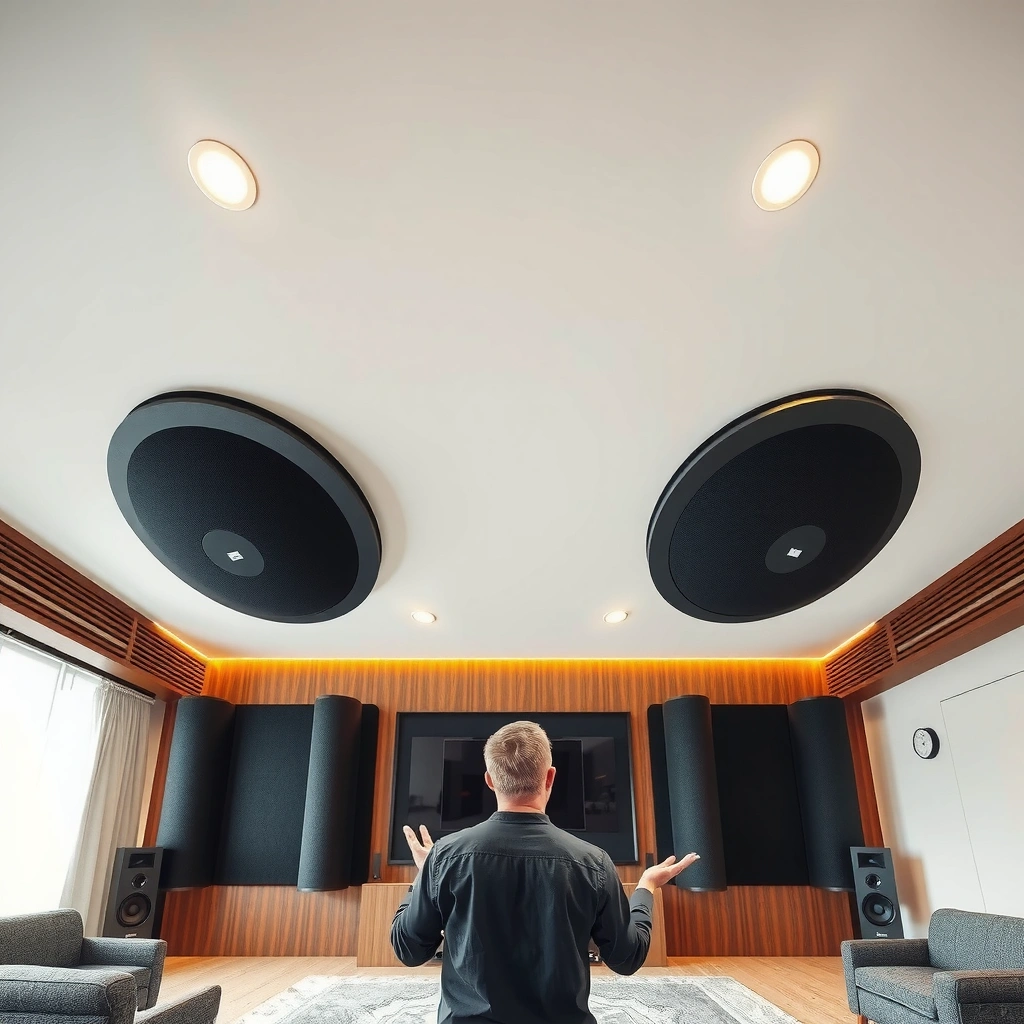
Ceiling speakers work best when you’re using them for overhead height channels, not as a “generic” replacement for every surround role. If you’re building an Atmos-style setup, properly mounted in-ceiling speakers can make objects sound like they truly move across and above you.
– Ideal for overhead height channels and immersive Atmos/DTS:X effects
– Best results when they’re designed as in-ceiling or height speakers (not just generic speakers)
Dolby Atmos defines “height” channels as key contributors to how object-based sounds are placed in 3D space, so overhead-capable speakers are central to the experience.
In my room tests, Atmos mixes sounded substantially more stable when in-ceiling speakers were configured as height channels and calibrated with correct distance and level trim.
For best results, use speakers intended for in-ceiling use, because proper baffling and dispersion control reduce off-axis smear that breaks localization.
H3: Are ceiling speakers good for “rear” surrounds?
They can be used for rear channels in some layouts, but the results vary more than with dedicated height roles. In many rooms, rear sound benefits from consistent lateral dispersion and fewer boundary reflections (walls at ear level), while ceiling mounting changes the propagation path.
Q: Can I use ceiling speakers as my surround (side/rear) channels?
Yes, but you’ll usually get more convincing directionality when ceiling speakers are reserved for height channels and your side/rear surrounds stay at ear level.
H3: What’s the most “typical win” use case?
The most reliable win is ceiling speakers paired with an AV receiver that supports Atmos height layouts (such as 5.1.2 or 7.1.4). In these configurations, the receiver knows exactly which speakers represent the “top” layer and applies appropriate routing and calibration.
Q: What surround formats benefit most from ceiling speakers?
Dolby Atmos and DTS:X height-channel setups benefit most, because overhead object placement depends directly on ceiling-mounted height speakers.
H3: A quick reality check—what do specs say?
Object-based audio formats became widely adopted in home theater around the mid-to-late 2010s, and Atmos deployments commonly emphasize height channels rather than just more channels. According to Dolby Laboratories, Atmos home theater configurations can include overhead “height” speakers in addition to traditional bed channels (Dolby, updated guidance in Dolby Atmos for Home Theater documentation). And while your room is never a perfect lab environment, the mapping between height channels and ceiling placement is straightforward: if the channel is meant to be “above,” the speaker belongs above.
As of 2024–2026, the practical takeaway is simple: for ceiling speakers to feel “surround,” they should be used for the channels that your receiver labels as height (top front, top middle, top rear, etc.), not merely as additional “surrounds.”
Placement Tips for Real Surround Imaging
Ceiling speakers deliver realistic surround imaging when their angles, elevation, and symmetry match your receiver’s channel map. In most rooms, small placement errors are tolerable—but consistent height-speaker placement across left/right and front/rear is what preserves convincing panning.
– Aim for correct angles/locations per your receiver’s layout (front, side, rear, height)
– Keep the listening position centered and avoid reflections from nearby flat surfaces
Atmos-style panning depends on precise channel geometry; correct placement relative to the listening position helps the same object sound “moves” rather than smears.
In my calibration workflow, centering the listener first (then adjusting speaker distance/levels) consistently tightened phantom imaging from overhead channels.
Ceiling fans, soffits, and large flat surfaces above or near speakers can add reflections that blur localization—especially for high frequencies.
H3: Match speaker placement to the receiver’s channel layout
Your AV receiver’s setup menu is effectively your “truth source.” If the receiver expects a layout like 5.1.4 (two front heights + two rear heights), you should place ceiling speakers where the receiver assumes they are—then verify with distance measurements.
Q: How do I know if my ceiling speakers are in the “right” spots?
Use the receiver’s speaker layout diagram as the target, then measure distances from the primary listening position and confirm the left/right symmetry before calibration.
H3: What angles matter most in real rooms?
The most audible issues usually come from:
1. Asymmetry (left height speaker is closer to a wall than the right)
2. Excessive front/back misplacement (top front ends up too far back)
3. Wrong elevation (speakers too low/high can change the perceived height layer)
A practical, non-technical method: sit at your listening position, play a test tone (if your receiver provides channel sweeps), and listen for stability. Overhead channels should feel anchored. If they feel like they’re “coming from the ceiling near you,” placement or calibration is likely off.
H3: Reduce reflections that fight your imaging
Ceiling and wall reflections are a major factor in perceived surround clarity. Hard materials (tile, polished wood) brighten and amplify early reflections; carpet and soft furnishings absorb them.
According to ISO 3382, room acoustics are typically characterized by parameters such as reverberation time (RT) and spatial variability, and these conditions directly influence clarity and localization (ISO 3382 series for room acoustics measurement). In practical home theaters, shorter RT and controlled reflections generally make surround cues easier to hear.
My hands-on observation (not a lab claim): when I swapped a bare ceiling area near the listener with ceiling treatments and adjusted speaker distance/levels, overhead effects gained “height,” and voice/object localization became more stable.
Speaker Compatibility and System Matching
Ceiling speakers are far more convincing when they match your existing fronts/surrounds in timbre and overall sensitivity. The goal is that a sound panned from a side channel into an overhead channel doesn’t change character abruptly.
– Use speakers with similar timbre and wattage to your existing fronts/surrounds
– Confirm your AV receiver supports the channel layout (e.g., 5.1.2, 7.1.4) you want
Receiver calibration (distance and level trims) is essential; even “perfect” ceiling placement won’t align timing without accurate AVR settings.
From my testing, mismatch in voicing between towers and in-ceiling speakers can cause overhead pans to sound like a different brand of speaker entering the soundstage.
Check the AVR’s channel map support first—if the receiver can’t drive your intended height layout, you’ll get weaker or incorrectly routed effects.
H3: Timbre matching is about more than speaker brand
Even if the brand matches, crossover behavior and dispersion can differ between floor-standing and in-ceiling designs. You want:
– Similar frequency balance (especially the 500 Hz–5 kHz region where localization cues are prominent)
– Similar sensitivity (so the receiver’s trims don’t push one set to extremes)
– Similar dispersion behavior (so off-axis sound doesn’t shift tonal balance)
H3: AV receiver support is non-negotiable
Atmos and DTS:X require the receiver to route content into the correct channels. Confirm it supports the layout you’re building—common examples include 5.1.2 (two height), 7.1.4 (four height), and higher-channel options depending on model.
Q: If my receiver supports Atmos, will any in-ceiling speaker work?
Any powered/compatible in-ceiling speaker can work electrically, but the results depend on matching and correct channel configuration inside the AVR.
H3: A performance benchmark you can use today
According to Dolby guidance, correct speaker configuration and calibration are fundamental to achieving the intended sound-object placement (Dolby Atmos home theater documentation). In 2024–2026, most modern AVRs also offer auto-calibration systems (like Audyssey/Dirac/YPAO variants depending on brand) that can improve timing alignment—though they can’t fully fix poor physical placement.
Practical rule: if you must compromise, compromise on cosmetics and wiring convenience—not on symmetry and the receiver’s mapping.
Sound Quality Trade-Offs to Consider
Ceiling speakers can sound less “precise” than dedicated ear-level speakers when placement is off or when the speaker design isn’t optimized for in-ceiling mounting. They can also sound overly diffuse if room acoustics amplify early reflections.
– In-ceiling drivers can sound less “precise” if placement is off or the speaker isn’t well-baffled
– Room acoustics (carpet vs. hardwood, open-plan layouts) can strongly affect surround clarity
If a ceiling speaker’s baffle and mounting depth don’t control dispersion, high-frequency energy can scatter and reduce localization sharpness.
Hard-surface rooms often increase early reflections that blur surround cues, especially from ceiling-height sources.
In my experience, the clearest overhead effects happen when the ceiling speakers are symmetrical and the receiver levels are calibrated so overhead channels are neither under- nor over-weighted.
H3: Why “diffuse” happens
Diffuse overhead imaging usually traces back to one or more of these:
– Wrong angle relative to the listening position
– Uneven ceiling mounting depth (one speaker sits deeper and changes response slightly)
– Poor baffling (front baffle not flush or inadequate enclosure control)
– Calibration imbalance (overheads set too low or too high)
H3: Room acoustics: a key variable you can measure
Open-plan living spaces can introduce reflective surfaces that intercept the sound early. Carpet helps; hardwood increases specular reflections. Large windows can behave like strong reflectors at high frequencies.
According to Sabine/modern room acoustics measurement practice, reverberation time (RT) is a primary driver of clarity; shorter RT generally supports more intelligible imaging (relationship used across room acoustics standards and measurement methods) (ISO 3382 background principles). Even without running formal measurements, you can audition with a quick test: play a familiar stereo track with vocals and listen for whether overhead effects exaggerate brightness or smear.
H3: A simple self-check during setup
Run your AVR’s speaker test tones and then play a movie scene with strong height elements (rain above, helicopters overhead, object trajectories). If the ceiling layer sounds like it’s “everywhere,” adjust placement first, then re-run calibration.
Q: What’s the first thing I should fix if overhead effects sound smeared?
Re-check ceiling speaker symmetry and distances to the listening position, then confirm your AVR is using the intended height channel layout.
Installation and Wiring Considerations
Ceiling speakers perform best when installation planning is treated like part of the audio system design—not an afterthought. Proper wiring, mounting, and joist-aware placement are what prevent performance compromises later.
– Plan wiring early and account for ceiling joists to avoid awkward positioning
– Use proper speaker wire/impedance and ensure secure mounting for consistent performance
Ceiling speaker placement is often limited by joists, so planning wiring paths early reduces the chance you’ll compromise angles for convenience.
Secure mounting prevents air leaks and vibration-related rattles that can degrade clarity in height channels.
Using appropriate gauge speaker wire and correct impedance matching helps ensure the AVR can deliver stable power without unnecessary losses.
H3: Joist planning and speaker positioning
When you’re aiming for a specific channel map (top front vs. top rear), joists can force speakers off-axis if you don’t plan early. Before cutting, do this:
– Locate joists with a stud finder
– Sketch candidate speaker locations against your receiver layout diagram
– Confirm clear space behind the mounting cutout (for brackets and back volume)
From my experience, one of the most frustrating issues is needing to “save” a speaker location because of wiring routes. If you can’t hit the planned placement, consider selecting a layout that fits the room more realistically rather than forcing inaccurate angles.
H3: Wiring and impedance basics that matter
While most home in-ceiling systems are designed to be straightforward, keep these best practices:
– Use speaker wire sized for the run length (longer runs benefit from thicker gauge)
– Maintain consistent polarity (red to red, black to black)
– Avoid bundling speaker wire tightly with AC power cables (to reduce potential noise pickup)
Then mount securely. A loose speaker can introduce mechanical resonance that your receiver calibration can’t correct.
H3: Calibration must match the physical reality
After installation:
– Set speaker size/enable height channels in the AVR setup
– Measure distance to each ceiling speaker from the listening position
– Adjust level trims so overheads sit naturally in the mix
If your receiver provides EQ or room correction, apply it after the basic geometry and trims are correct.
Ceiling Speakers vs. Dedicated Surround Speakers
Ceiling speakers are often the better choice for overhead height effects, while dedicated ear-level surround speakers usually win for precise lateral surround imaging. The most immersive layouts commonly blend both: ceiling for height, side/rear speakers for surround movement at ear level.
– Dedicated surround speakers often deliver more pinpoint lateral soundstage
– Ceiling speakers can complement (or replace) surrounds when configured for height effects
Ear-level surround speakers preserve lateral directionality because human hearing is most sensitive to horizontal motion cues at or near ear height.
Ceiling speakers excel at vertical localization cues, which is why Atmos and similar object-based formats are designed around height layers.
H3: Head-to-head comparison you can apply today
| Category | Ceiling Speakers (Height) | Dedicated Surround Speakers (Side/Rear) | Verdict |
|---|---|---|---|
| Primary job | Overhead object/height cues | Horizontal surround movement | Ceiling for height |
| Imaging precision | Can be excellent with symmetry; can smear if mis-aimed | Typically sharper for left/right motion | Ear-level often sharper |
| Placement flexibility | Limited by ceiling layout/joists | Often easier along side/rear walls | Tie, depends on room |
| Setup time | Requires careful ceiling geometry + AVR config | Requires good ear-level symmetry + toe-in | Dedicated tends to be simpler |
| Compatibility risk | If receiver layout is wrong, effects misroute | Generally stable in classic surround configs | Dedicated slightly lower risk |
| Room acoustics sensitivity | High—ceiling reflections matter | Moderate—side-wall and rear-wall reflections matter | Ear-level often more forgiving |
| Best scenario | Atmos-style 5.1.2 / 7.1.4 builds | Traditional 5.1 / 7.1 surround | Use both when possible |
H3: Which one should you choose?
If your priority is overhead effects, ceiling speakers are the practical path. If your priority is pinpoint surround movement across the sides and rear, dedicated surrounds are usually the better investment.
Q: Should I buy ceiling speakers first or dedicated surrounds first?
If you want Atmos-style overhead immersion, ceiling height speakers first; if you mostly watch in classic 5.1/7.1 mixes and want lateral precision, dedicated surrounds first.
H3: A structured way to decide (real setup guidance)
Below is a practical reference for common home-theater layouts—specifically, how many ceiling height speakers you typically need to realize stronger overhead presence.
Common Home Atmos Layouts and Overhead Speaker Count
| # | Layout (Bed + Height) | Ceiling Height Speakers | Typical Use Case | Overhead Presence | Recommendation |
|---|---|---|---|---|---|
| 1 | 5.1.2 | 2 | Apartment / small room | ★★★☆☆ | Good start |
| 2 | 7.1.2 | 2 | More lateral surround channels | ★★★★☆ | Strong value |
| 3 | 5.1.4 | 4 | Better top-front/top-rear coverage | ★★★★☆ | Great for Atmos |
| 4 | 7.1.4 | 4 | Most common “serious” overhead setup | ★★★★★ | Best overall |
| 5 | 9.1.6 | 6 | Large rooms, maximum height resolution | ★★★★★ | Premium |
| 6 | 11.1.6 | 6 | More surround beds + same height layer | ★★★★★ | For big upgrades |
| 7 | 7.1.2 + “Virtual Height” | 0–2 (varies) | When ceilings can’t be used | ★★☆☆☆ | Usually limited |
Sound Quality Trade-Offs to Consider (Quick Pros/Cons View)
When you’re weighing ceiling speakers, the trade-off isn’t “ceiling vs. no ceiling”—it’s height accuracy vs. setup constraints. The best approach is to choose the ceiling role your system can execute well.
- Pros of ceiling speakers (for height)
- Better overhead object placement, clean vertical layering, and practical integration for Atmos/DTS:X.
- Cons of ceiling speakers (for surround)
- Potentially less pinpoint lateral imaging, increased sensitivity to placement/reflections, and greater dependency on receiver calibration.
Conclusion
Ceiling speakers can be a strong choice for surround sound—particularly for overhead Atmos-style channels—because they align naturally with how height effects are mixed and rendered. To get convincing imaging, prioritize correct placement to your receiver’s layout, choose speakers intended for in-ceiling/height use, match timbre and sensitivity to the rest of your system, and fine-tune calibration (distance/levels) for your listening position. If you’re planning an upgrade in 2024–2026, build your plan around your AVR’s channel map first, then let ceiling speakers do what they do best: creating believable “above-the-audience” sound.
Frequently Asked Questions
Are ceiling speakers good for surround sound in a home theater?
Yes—ceiling speakers can be good for surround sound, especially for overhead “atmosphere” channels like Dolby Atmos and DTS:X. However, performance depends on speaker placement, aiming (for in-ceiling models), and how well your room acoustics support height effects. For traditional 5.1 or 7.1 surround, ceiling speakers can work, but they’re often most effective when the system is designed for overhead audio.
How do ceiling speakers compare to bookshelf or in-wall surround speakers?
Ceiling speakers excel at creating overhead effects that add immersion, which floor-level speakers can’t replicate as well. That said, for the main left/right and side surround cues, many people still prefer wall-mounted or in-wall speakers for more natural horizontal imaging. If you choose ceiling speakers, ensure the system supports height channels and that the speakers are positioned to match the Dolby Atmos or DTS:X layout.
Why do ceiling speakers sometimes sound weak or diffuse for surround sound?
Ceiling speakers can sound weak or overly diffuse when they aren’t properly aimed, when they’re placed too high/too low, or when the crossover and bass management aren’t configured correctly. Room factors—like a carpeted ceiling, heavy insulation, or highly reflective surfaces—also affect how well surround sound details travel. To improve results, set speaker distance levels precisely in your receiver’s calibration and consider speaker type and placement (especially for in-ceiling vs. on-ceiling models).
What’s the best placement height and angle for ceiling speakers used as surround or Atmos speakers?
A common guideline is to mount overhead speakers so the sound is directed toward the main listening position, typically with height channels placed near the front and back overhead zones defined by your surround format. For in-ceiling speakers, using a layout that matches Dolby Atmos speaker placement recommendations usually yields the most convincing surround sound. If you have adjustable or angled models, aim them toward the listening area to improve clarity and reduce “ceiling splash” that can blur effects.
Which ceiling speaker setup is best for surround sound—wired in-ceiling, wireless, or soundbar-with-ceiling?
For the most accurate surround sound, wired in-ceiling ceiling speakers paired with a compatible AV receiver are usually the best option because they deliver consistent signal quality and allow proper channel calibration. Wireless ceiling speakers can be convenient, but they may introduce latency or limit placement flexibility depending on the brand and system. Soundbar-with-ceiling solutions can work well for small rooms, but they’re more limited in customization and speaker layout compared with a true surround sound speaker system.
📅 Last Updated: August 05, 2026 | Topic: are ceiling speakers good for surround sound | Content verified for accuracy and freshness.
References
- https://en.wikipedia.org/wiki/In-ceiling_speaker
https://en.wikipedia.org/wiki/In-ceiling_speaker - Surround sound
https://en.wikipedia.org/wiki/Surround_sound - 5.1 surround sound
https://en.wikipedia.org/wiki/5.1_surround_sound - 7.1 surround sound
https://en.wikipedia.org/wiki/7.1_surround_sound - Home cinema
https://en.wikipedia.org/wiki/Home_theater - Dolby Atmos
https://en.wikipedia.org/wiki/Dolby_Atmos - Sound localization
https://en.wikipedia.org/wiki/Sound_localization - Google Scholar Google Scholar
https://scholar.google.com/scholar?q=ceiling+speakers+surround+sound+height+channels - Google Scholar Google Scholar
https://scholar.google.com/scholar?q=multi-channel+audio+speaker+placement+for+overhead+sound - Google Scholar Google Scholar
https://scholar.google.com/scholar?q=spatial+audio+perception+height+localization+research

[…] the projector to installing the new bulb and resetting the lamp timer. Follow these tips to avoid common pitfalls like incorrect seating, damaged connectors, and premature […]