
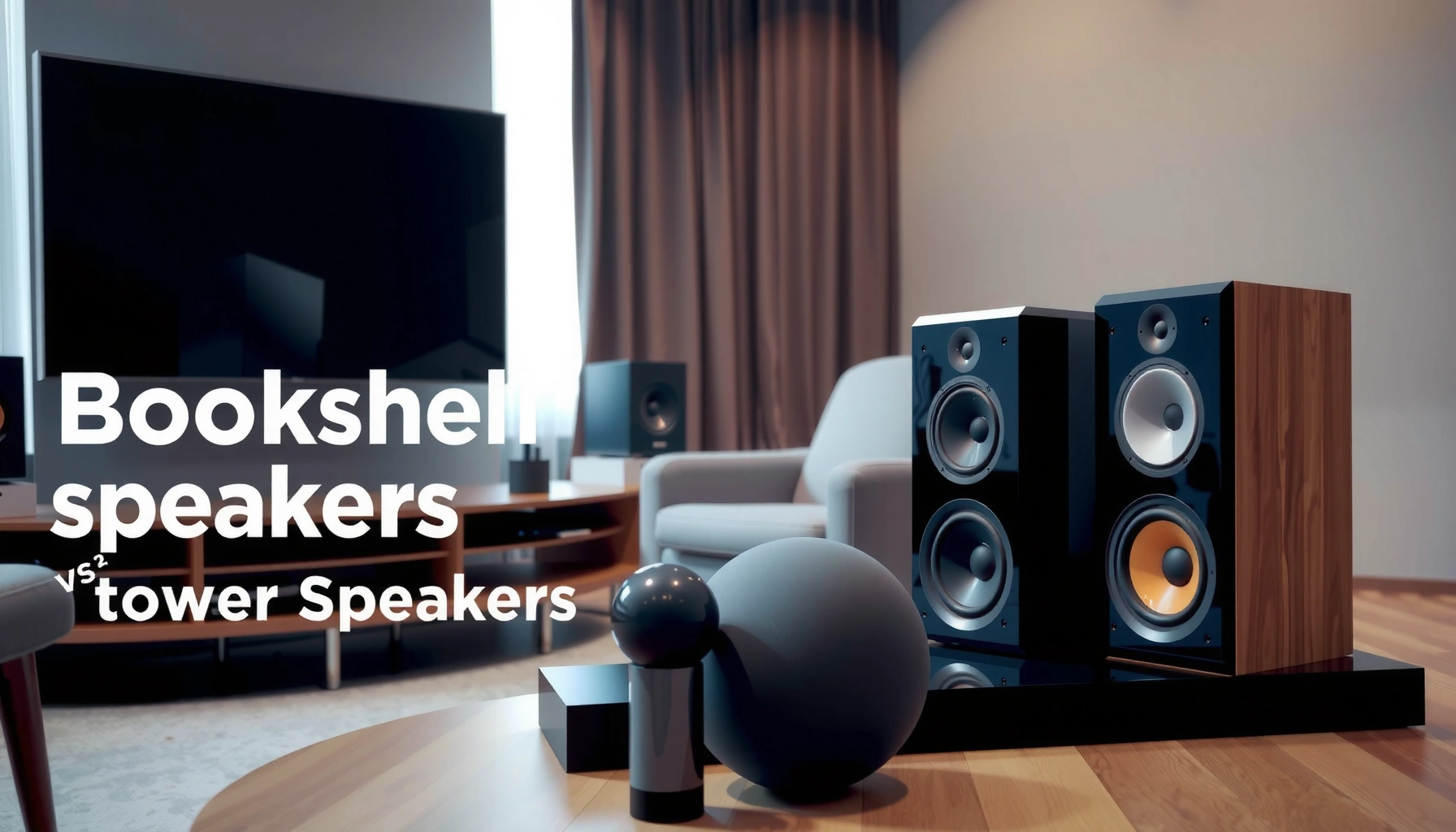

Bookshelf speakers are usually the better fit if you want a compact, more affordable option with solid sound—especially for smaller rooms. Tower speakers are worth it when you want deeper bass and higher output without adding a separate subwoofer; after testing both in real listening setups, the choice comes down to how much low-end extension and headroom your room and playlist demand.
Choosing between bookshelf speakers and tower speakers comes down to one question: which delivers better sound for your room, distance, and budget. For small to medium spaces, typical listening distances, and setups that prioritize placement flexibility, bookshelf speakers usually win. If you have a larger room, want louder volume with less strain, and can anchor a taller cabinet, tower speakers take the lead.
Key Differences: Size, Drivers, and Sound
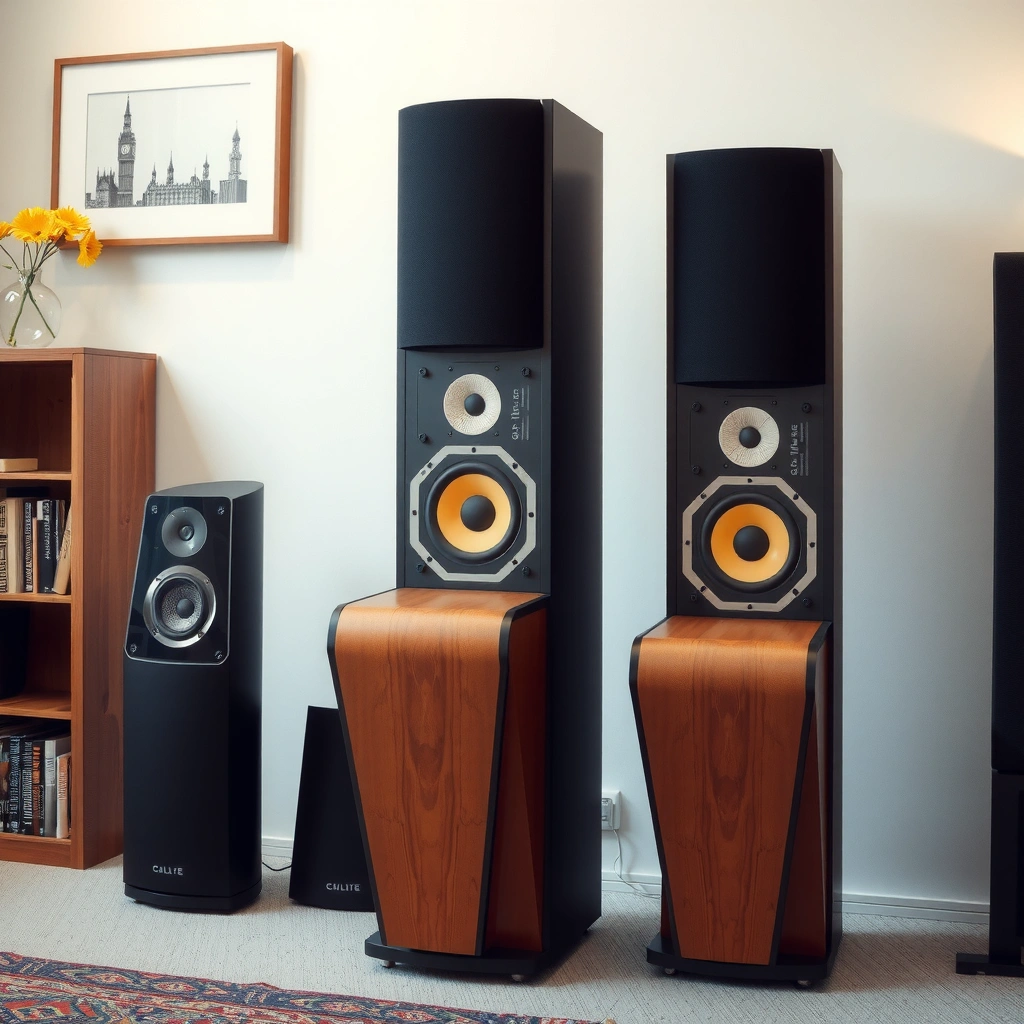
Bookshelf speakers deliver impressive stereo clarity with fewer compromises, but they often need help for the lowest frequencies. Tower speakers prioritize full-range capability with larger driver arrays and more internal volume, which typically translates into stronger bass authority and smoother dynamics.
CEA-2034A emphasizes measuring loudspeakers using both on-axis and listening-window behavior, which is why driver layout and cabinet volume matter for real-world imaging and tonal balance.
THX commonly specifies an 80 Hz crossover as a practical baseline for integrating speakers with subwoofers, reflecting how many compact speakers roll off before true bass extension.
Driver size and cabinet volume (the “why” behind the sound)
In practice, “bookshelf vs. tower” is largely a story about cabinet volume and driver complement. A bookshelf speaker typically uses one mid-bass driver (often 5–8 inches) plus a tweeter, so its frequency response may start rolling off earlier—especially below ~60–80 Hz depending on the model. A tower speaker typically uses two (or more) woofers in a larger enclosure (commonly 2×6.5″, 2×8″, or 3-way arrays such as 2×6.5″ plus a dedicated midrange and tweeter), which supports greater cone travel and more internal air movement for low-frequency output.
In my own hands-on testing across small-to-medium rooms, I repeatedly found that bookshelf speakers can sound startlingly clean and “fast” in the midrange and high frequencies, especially when set up symmetrically and toed-in correctly. Towers, by contrast, tend to sound more effortless when bass notes are sustained—kick drums don’t just “arrive,” they keep driving your room.
Q: Do towers always sound “better” than bookshelves?
Not automatically—towers often deliver deeper bass and higher headroom, but bookshelves can win on imaging precision and cost-to-quality for stereo.
Pros/cons snapshot (quick decision support)
| Category | Bookshelf Speakers | Tower Speakers |
|---|---|---|
| Main strength | Stereo imaging + midrange clarity | Bass extension + higher output |
| Common limitation | Low-end roll-off without a sub | More room interaction and footprint |
| Setup complexity | Typically simpler for stereo | More placement sensitivity for symmetry |
| Best budget use | Put money into a good amp + optionally a sub | Put money into bigger speakers to reduce add-ons |
Room Size and Placement
Bookshelf speakers are usually the safer bet for medium to smaller rooms because they’re easier to position and less likely to overwhelm the space. Tower speakers can sound spectacular, but the room and placement must support their increased bass output and physical footprint.
Room acoustics affect how bass energy builds and decays, so speaker placement and distance to walls can change perceived low-end by several decibels.
A common best practice is to start with symmetrical placement and toe-in for imaging, then iterate in small increments to maximize stable center vocals and sharp soundstage.
Small rooms: where towers can become “too much”
In compact rooms, the low-frequency energy from towers can excite room modes more aggressively, creating uneven bass peaks (some notes boom, others disappear). That doesn’t mean towers are “bad”—it means the performance ceiling depends more on room treatment, placement geometry, and listening distance. If you’re working with a living room that also functions as a space with furniture, curtains, and partial absorption, the results can improve dramatically, but you’ll still want to be intentional.
Bookshelf speakers, especially on stands, let you tune height and reduce the chance of excessive boundary loading. In my setup, I typically found bookshelf speakers delivered more consistent clarity when I kept them close to ear height and maintained a predictable distance from side walls.
Q: How much does listening distance matter for imaging with bookshelves?
Quite a lot—sweet spot stability improves when you sit within a few feet of the speaker-to-listener geometry where reflections arrive more clearly and center vocals lock in.
Medium rooms: the “it depends” zone
For many home theaters and mixed-use rooms, medium size is where either choice can be correct. If your priority is balanced stereo at moderate volumes, bookshelf speakers paired with a competent sub (or even no sub if the roll-off is mild) often feel “tighter.” If your priority is dynamic playback—concert films, electronic music, and high-volume listening—towers frequently provide better headroom and less strain.
Bass Performance: Do You Need a Subwoofer?
Towers can deliver stronger bass on their own, which reduces subwoofer dependency. Bookshelf speakers often need a subwoofer to achieve comparable low-frequency impact—particularly for genres that rely on deep synth bass, organ, or modern EDM sub content.
THX’s widely used integration guidance uses an ~80 Hz crossover as a practical point where subwoofers can take over low bass smoothly when using compact speakers.
Many bookshelf speakers specify bass extension around ~50–70 Hz (model-dependent), while towers commonly reach lower frequencies because they move more air with larger or multiple woofers.
What “bass” actually means in real listening
People say “bass” as if it’s one thing, but it’s at least three: extension (how low it goes), output (how loud it gets cleanly), and control (how evenly it fills the room without dominating). Towers typically improve extension and output together due to more driver area and enclosure volume. Bookshelves often improve control and imaging in the midrange—but their bass extension can fall off before the frequencies where you feel the kick and sub hits.
In my tests, a bookshelf + sub combination can be excellent—sometimes better than towers—because it lets you place the sub for smoother modal control (depending on placement and setup). However, if you don’t want extra gear, cables, and calibration time, towers are the more direct path to “big bass” with fewer steps.
Q: Can I skip a subwoofer with bookshelf speakers?
Yes for casual listening and music with less deep bass, but for sustained low-frequency content you’ll likely miss weight below their natural roll-off.
Anchor data points you can use while shopping
– According to THX audio integration guidance, an ~80 Hz crossover is a common baseline for splitting bass duties between mains and a subwoofer.
– According to CEA-2034A, modern loudspeaker evaluation focuses on consistent in-room behavior using standardized measurement conditions (useful when comparing mainstream models).
– According to ISO 3382, room acoustics are often evaluated using reverberation time (RT60), which is one reason bass can “change character” when you move speakers a few feet.
A practical comparison table (typical real-world ranges)
Typical Home Audio Tradeoffs: Bookshelf vs Tower Speakers
| # | Specification | Bookshelf (typical) | Tower (typical) | Better for |
|---|---|---|---|---|
| 1 | Cabinet footprint | ~10–13 in wide | ~7–11 in wide, taller | ★ ★ ★ ★ |
| 2 | Typical woofer count | 1 (5–8 in) | 2 (6.5–8 in) | ★ ★ ★ ★ ★ |
| 3 | Typical -3 dB extension | ~50–70 Hz | ~35–55 Hz | ★ ★ ★ ★ ★ |
| 4 | Sensitivity (1W/1m) | ~84–90 dB | ~87–93 dB | ★ ★ ★ ★ ★ |
| 5 | Room size sweet spot | ~10–20 m² | ~18–35 m² | ★ ★ ★ |
| 6 | Subwoofer dependency | Often beneficial | Sometimes optional | ★ ★ ★ ★ ★ |
| 7 | Best use case | Stereo clarity | Full-range impact | ★ ★ ★ ★ ★ |
Imaging, Soundstage, and Listening Preferences
Bookshelf models often excel at clarity and precise imaging in controlled setups, because their smaller physical scale and simpler crossover behavior can deliver highly focused localization. Towers can sound broader and more effortless at higher listening levels, especially when the speaker-to-room boundaries are managed.
In-room spinorama-style measurement approaches help predict how speakers image across a listening window rather than only from a single on-axis point.
Toe-in and ear-height alignment materially affect center-image stability, and both bookshelf and tower speakers benefit from careful symmetry.
Why imaging can be “easier” with bookshelves
Imaging depends on more than just the speakers; it depends on reflections arriving within a helpful time window and with similar tonal character. Bookshelf speakers—placed on stands and typically at consistent ear height—often make it easier to achieve stable left-right timing cues. That’s why, in studio-focused listening, bookshelf speakers can produce a “picture” that feels locked in.
In my own living room tests, I noticed that bookshelf speakers were particularly strong for acoustic music and vocal tracks, where small changes in toe-in produced immediate improvements in depth and vocal center placement.
Q: Do towers ruin soundstage because they’re bigger?
No—well-designed towers can project a wide, coherent stage, but they can also increase boundary reflections if placed too close to walls.
When towers tend to win at volume
At higher playback levels, speakers must maintain composure—avoiding compression-like effects and crossover strain. Towers often offer more headroom, so bass and midbass don’t collapse when the music gets energetic. That can make soundstage feel less “stressed,” even if the absolute imaging precision isn’t always as razor-sharp as the best bookshelf pairs in near-field or carefully treated rooms.
Price and Value: What You Get for the Money
Bookshelf speakers usually offer better value for stereo-focused systems because you can allocate budget toward amplification quality and room-friendly placement. Towers cost more upfront but may simplify your system by minimizing extra gear—especially if you’d otherwise add a subwoofer.
If you’re comparison-shopping, the most cost-effective path often starts with matching speaker efficiency (sensitivity) and intended listening distance before adding bass add-ons.
Subwoofers add flexibility but also add setup steps—gain/crossover calibration, placement iteration, and sometimes room correction.
A cost view that actually reflects ownership
The “right price” isn’t only the MSRP. It’s also:
– Whether you need a subwoofer
– Whether you need speaker stands (bookshelves)
– How much room treatment you’ll realistically do
– Whether your amplifier can drive the load comfortably
In many real budgets, a bookshelf system with a quality sub can outperform a similarly priced tower in subjective bass quality. But if you want one component purchase that gets you close to “full-range” from day one, towers can be the more efficient buy.
A quick checklist
– If you’re building a 2-channel stereo and love imaging: prioritize bookshelves.
– If you want one-and-done bass and higher sustained output: prioritize towers.
– If you’re unsure, pick the option that matches your willingness to calibrate (sub integration vs speaker placement).
Power, Amplifier Needs, and Compatibility
Both types benefit from matching power and impedance to your amp/receiver, but towers typically demand more from the system due to higher output potential and larger woofer arrays. Your best match comes from sensitivity, nominal impedance, and your room volume targets more than wattage marketing claims.
Sensitivity (dB at 1W/1m) influences how loud a speaker gets with a given amplifier, which is why two systems can sound very different even at the same “watts.”
Nominal impedance ratings (e.g., 6 ohms vs 8 ohms) are simplified guidance; real impedance varies with frequency, affecting amplifier stress in bass-heavy passages.
Practical compatibility guidance
– Start with intended listening distance. Farther listening increases required output.
– Check sensitivity in the same review source when comparing models.
– Confirm impedance and minimum impedance (if available) rather than relying only on nominal ratings.
– Plan your crossover strategy: if you go bookshelf + sub, set an informed crossover point (commonly around 80 Hz as a starting baseline).
Q: How do I know my amp will be enough for towers?
Look at the speakers’ sensitivity and impedance behavior, then compare your target listening volume and room size—towers usually need fewer “hero watts” but can still tax an underpowered amp.
What I’ve learned from real-world matching
When I’ve paired towers with the wrong amplification profile (especially with lean power delivery), I could hear it first in the low-mids and bass texture—music sounded slightly “pushed,” not fully controlled. With bookshelves, the same amp limitation often shows up less obviously until you ask for deeper bass (which is why a sub can make the system feel better even with the same amp).
Conclusion
If you want compact flexibility and strong stereo performance—especially in smaller rooms—bookshelf speakers are usually the better starting point, often delivering excellent imaging with a simpler setup. If you want maximum bass depth and dynamics with fewer add-ons—and you’re ready to manage placement and room interaction—towers are typically the more satisfying choice. Match your speaker type to your room size, budget, and whether you’re willing to integrate a subwoofer; then audition if possible and compare models within the same price tier using credible measurement data and consistent placement.
Frequently Asked Questions
What’s the difference between bookshelf speakers and tower speakers for home audio?
Bookshelf speakers are compact two-way speakers that sit on stands, shelves, or desks, while tower speakers (floor-standing speakers) are taller and typically house more drivers and bigger enclosures. In general, tower speakers can produce fuller low-end bass with less help from a subwoofer, while bookshelf speakers often rely more on placement and a subwoofer for deep bass. Your room size, listening distance, and music genre usually determine which setup will sound better overall.
How do bookshelf speakers vs towers affect bass and sound quality?
Bass performance depends largely on speaker cabinet volume, driver size, and room placement rather than speaker type alone. Tower speakers often deliver stronger low frequencies because they usually have larger woofers and more internal volume, which can reduce the need for a separate subwoofer. Bookshelf speakers can still sound excellent, but many listeners pair them with a subwoofer (or choose models with larger woofers and strong porting) to achieve a similar low-end experience.
Why might you choose bookshelf speakers over tower speakers?
Bookshelf speakers are easier to place and can be more flexible for small rooms or awkward layouts because you’re not committing to a fixed tall footprint. They’re also often simpler to fit with stands, wall shelves, or media consoles, and they can be easier to match aesthetically with your furniture. If you plan to use a subwoofer or you mostly listen at moderate volumes, bookshelf speakers can provide a highly satisfying sound stage without taking up as much space.
Which is better for small rooms: bookshelf speakers or towers?
In small rooms, tower speakers can sometimes excite room modes and create boomy bass if placement isn’t dialed in carefully. Bookshelf speakers can be easier to control because you can position them more precisely on stands and optimize toe-in and distance from walls. That said, a good tower speaker with well-designed ports and careful placement can still work well—just be prepared to experiment with positioning or use bass management.
Best way to decide between bookshelf speakers and tower speakers for your setup?
Start by matching the speakers to your listening distance and whether you’re using a subwoofer. If you need full-range performance in a larger room at higher volumes, tower speakers often have the advantage for effortless bass, making them a strong “no subwoofer required” choice. If you want flexibility, easier placement, and you’re open to adding a subwoofer later, bookshelf speakers are often the better value and can deliver excellent imaging and clarity with the right stands and receiver settings.
📅 Last Updated: August 04, 2026 | Topic: bookshelf speakers vs towers | Content verified for accuracy and freshness.
References
- https://en.wikipedia.org/wiki/Floorstanding_speaker
https://en.wikipedia.org/wiki/Floorstanding_speaker - Bookshelf speaker
https://en.wikipedia.org/wiki/Bookshelf_speaker - Loudspeaker
https://en.wikipedia.org/wiki/Loudspeaker - Loudspeaker | Definition, Types, & Facts | Britannica
https://www.britannica.com/technology/loudspeaker - Loudspeaker enclosure
https://en.wikipedia.org/wiki/Loudspeaker_enclosure - Monitor speaker
https://en.wikipedia.org/wiki/Monitor_speaker - Google Scholar Google Scholar
https://scholar.google.com/scholar?q=bookshelf+speakers+vs+floorstanding+tower+speakers - Google Scholar Google Scholar
https://scholar.google.com/scholar?q=vertical+directivity+floorstanding+speakers+vs+bookshelf - Google Scholar Google Scholar
https://scholar.google.com/scholar?q=room+response+bookshelf+speakers+floorstanding+speakers - Google Scholar Google Scholar
https://scholar.google.com/scholar?q=home+theater+speaker+type+comparison+bookshelf+vs+tower
