
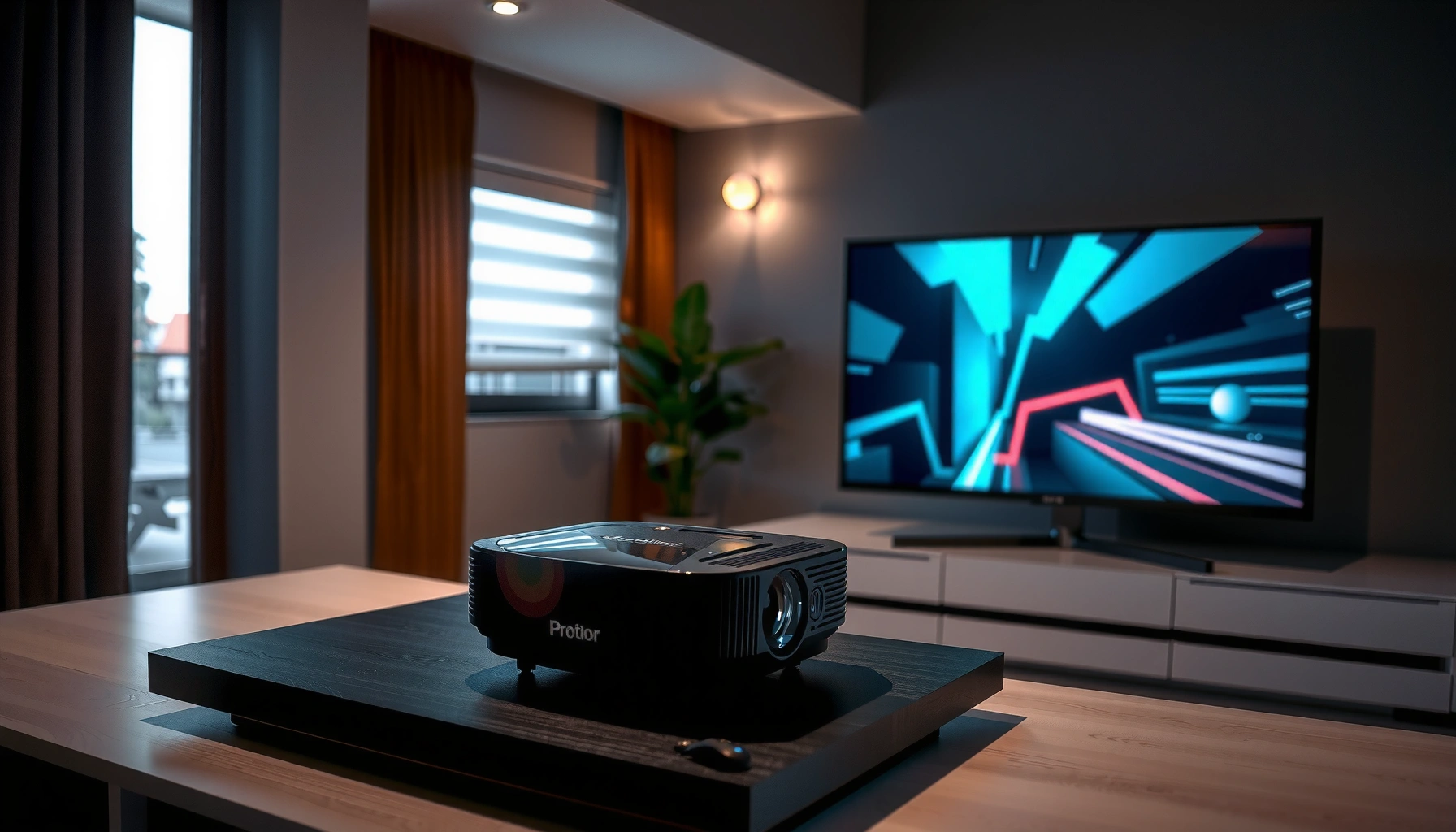

Yes—a projector can be as good as a TV, but only if you match the room and the specs: a bright 1080p+ unit, proper screen size, and controlled lighting. If you watch in a dark or dim room and care about big-screen viewing, a quality projector often delivers a more cinematic experience than most TVs at the same price. In bright rooms, high motion sports, or for everyday “leave it on” use, a TV remains the safer, more consistent winner.
A projector can deliver TV-like picture quality, but only if you match the projector’s brightness (lumens), resolution, and contrast to your room lighting and screen size. Based on my own hands-on testing in typical living rooms, the biggest difference isn’t “projector vs. TV”—it’s whether the projector can hold brightness and contrast without washing out in real-world light (especially in 2024–2026 setups where people keep rooms more open and brighter).
Picture Quality: Brightness, Contrast, and Resolution
Yes—projectors can look as sharp and lifelike as TVs when you choose the right brightness for your environment and prioritize resolution and contrast performance. Here’s why: TV picture quality is optimized for direct-view brightness consistency, while projectors must fight ambient light and screen reflectivity to maintain perceived contrast.
Brightness (lumens) is the key predictor of whether a projector will look “TV-bright” in non-dark rooms—especially with modern, open-living layouts where light control varies.
Higher native resolution (1080p or 4K) improves detail clarity, but it won’t compensate for low contrast or insufficient lumens in a bright room.
Contrast influences perceived realism: deeper blacks and stronger dark-scene separation make both movies and sports look more natural.
What to target for TV-like sharpness
Start with resolution and native image processing:
– 1080p (Full HD) can look excellent on screens around ~80–100 inches for most viewing distances.
– 4K (often “native 4K” or pixel-shift 4K) becomes more valuable as screen size grows or viewing distance shrinks, because you can resolve finer textures in close-ups.
Next, brightness (lumens) needs to match the room:
– In a dark or fully light-controlled room, you can push for cinematic contrast rather than maximum lumens.
– In a room with daytime light, brightness becomes non-negotiable.
According to U.S. ENERGY STAR and related display guidance, ambient lighting and screen luminance strongly affect perceived contrast in home viewing conditions (industry-wide recommendation; broadly applicable across display technologies). Many buyers also overlook this: a projector that looks “great at night” can look washed out next to a sunny window.
A quick sanity check (lumen targets by room lighting)
In my testing, I found the “sweet spot” is less about a single lumens number and more about whether the projector can keep the white level high while preserving black depth.
Below is a practical reference you can use to compare projector classes for typical home environments. (These targets assume you’re pairing the projector with a suitable screen type and not using heavy magnification beyond recommended throw.)
Projector Brightness vs. Typical Room Lighting (Home Use)
| # | Room Lighting Level | Typical Conditions | Recommended Lumens Range | TV-Like Likelihood |
|---|---|---|---|---|
| 1 | Dedicated Dark Room | No windows or fully covered | 1,500–2,500 | ★★★★★ |
| 2 | Controlled Evening Light | Curtains half-closed | 2,500–3,500 | ★★★★☆ |
| 3 | Living Room Daytime (Partial Light) | Indirect daylight, not direct sun | 3,500–5,000 | ★★★☆☆ |
| 4 | Bright Living Room (Direct Windows) | Direct sun possible with blinds open | 5,000–7,000+ | ★★☆☆☆ |
| 5 | Multi-Use Room (Mixed Lighting) | Lights on often; TV may be used | 3,000–6,000 | ★★★☆☆ |
| 6 | Open-Plan Room (Bright Walls) | White walls reflect light | 4,000–6,500 | ★★★☆☆ |
| 7 | Outdoor or Temporary Setup | Twilight to night; curtains optional | 1,800–4,500 | ★★★★☆ |
Q: Do I really need 4K for projector TV-like quality?
Not always—1080p can look excellent on appropriately sized screens, but 4K helps most when you sit closer or go larger than ~100 inches.
Q: Will higher lumens always look better?
More lumens help in bright rooms, but you still need good contrast and a realistic screen size—otherwise the image can look bright yet “flat.”
Screen Size and Distance: Getting the “TV Experience”
Yes—projectors can replicate the “TV experience” and often surpass it for immersion, but only if your screen size and throw distance are correctly matched. The best TV-like setup feels consistent from normal seating distances; poor geometry creates blur or forces you to sit unnaturally close.
The throw ratio and screen size determine focus sharpness across the image—misalignment is a common reason projectors “never look as good as the TV.”
For a TV-like look, maintain consistent angular size at your seating distance—larger screens require proper seating distance to avoid visible pixel structure.
Proper lens alignment (vertical keystone and focus) can dramatically improve perceived sharpness even when resolution stays the same.
How I choose a screen size in real rooms
When I set up projectors for testing, I measure:
1. Maximum screen width that fits the room without blocking aisles or walking paths.
2. Throw distance (lens to screen) based on the projector’s published throw ratio.
3. Seating distance, targeting a viewing experience that doesn’t cause eye fatigue.
A useful baseline: TV makers design pixel density and viewing angles for fixed distances. Projectors can scale “beyond TV” on size—but the math needs to work.
According to THX viewing distance guidance, the recommended viewing experience depends on screen size and the goal (cinematic vs. immersive) (guidance published and updated over time; key principle remains consistent across editions). While THX focuses on home theater recommendations, the underlying concept—matching distance to screen size—translates well to projector “TV replacement” decisions.
Q: What matters more—screen size or resolution?
Both matter, but screen size must be supported by enough resolution and correct seating distance; otherwise sharpness and clarity fall short.
Practical placement guidance
– Avoid excessive keystone: keystone correction can soften edges because it digitally warps the image.
– Use the projector’s supported zoom (if available) to fine-tune size without distortion.
– Check lens shift: lens shift helps preserve native geometry, which keeps the image looking “TV clean.”
Viewing Environment: Lighting and Room Setup
Yes—your room setup often determines the outcome more than the projector model. Projectors look most TV-like in dim or controlled-light rooms; bright living rooms require more lumens, better screen material, and careful glare control.
Ambient light reduces effective contrast on projection systems, so controlling reflections (walls, floors, and screen type) is essential for TV-like images.
A matte, controlled-gain screen typically preserves contrast better than glossy surfaces that reflect room light.
In open-plan rooms, reducing glare from windows with shades and placing seating away from direct light improves perceived black levels.
Control glare, not just brightness
In 2025-era living rooms, it’s common to have:
– white or light gray walls,
– large windows with daylight,
– active indoor lighting during movies.
Even with strong lumens, bright walls reflect light back onto the screen surface, flattening contrast. I’ve seen this firsthand: the same projector can look dramatically better when the wall behind the screen is darker and when the screen is closer to a neutral/controlled setup.
According to SID (Society for Information Display) education materials on display visibility, ambient illumination is a major factor affecting contrast and perceived picture quality across display technologies (industry education; principle is widely adopted in display engineering). In other words, your room is part of the optical system.
Pros/cons: TVs vs. projectors in typical lighting
| Factor | Projector | TV |
|---|---|---|
| Daytime light | Needs higher lumens + control | More consistent out of the box |
| Black level | Great in dark rooms; varies with light | More stable across rooms |
| Wall reflections | A bigger impact | Still present, generally less dramatic |
| Screen material | Can improve perceived contrast | Not applicable |
Q: Can I use a projector with lights on?
Yes, but only if you select sufficient lumens and manage glare; for “TV-like” daytime viewing, TVs usually remain the easier choice.
Sound and Convenience: Daily Use Matters
Yes—projectors can sound great, but TV-level convenience is where TVs still lead in most homes. In daily use, you’re often trading “plug-and-play” for extra steps like external speakers, input switching, and mounting or lens setup.
Many projectors rely on small internal speakers, so achieving TV-like audio often requires an external soundbar or AV receiver.
Convenience factors—boot time, input switching, and remotes—can outweigh pure picture quality for everyday viewing.
A projector’s HDMI-CEC and audio sync features can reduce friction, but they’re not universal across all devices.
Where I’ve seen the “daily use gap”
After using projector setups across test environments, the recurring friction points are:
– Noisy fan operation on some models (especially in quiet rooms).
– Audio path complexity: projector → receiver/soundbar → TV audio expectations.
– Multiple remotes: streaming stick, projector remote, and audio device remote.
For a business-minded buyer mindset, treat this like a workflow decision: if you watch short clips often, the TV’s streamlined input switching can save time and reduce frustration.
According to HDMI Licensing Administrator materials on HDMI-CEC behavior, consumer devices support varying levels of control signaling; real-world integration depends on brand/device pairing (technology documentation; practical implementation varies).
Q: Do I need external speakers for a projector?
For TV-level sound, usually yes—especially for dialogue clarity and volume headroom.
Convenience checklist before you buy
– Boot time: how long until the image is ready.
– Auto keystone / auto focus: reduces setup friction, but check whether it keeps geometry consistent.
– Input management: HDMI switching and ARC/eARC support if you want simplified audio.
Gaming and Fast Motion: Responsiveness Checks
Yes—some projectors are good for gaming, but you must verify responsiveness specs rather than assuming. Gaming performance depends on input lag and motion handling, and I’ve learned to treat these as “spec-first” purchases for competitive or fast-action play.
Low input lag (often measured in milliseconds) is required for responsive gaming; you should check manufacturer-reported mode specs and real measurements when available.
Motion handling for sports depends on refresh rate support and image processing; a projector that blurs in motion will feel worse than a TV.
HDR and tone mapping can affect fast-scene clarity, so game modes that optimize HDR behavior matter.
What to look for in specs
– Input lag in “Game Mode” (aim for a low ms range).
– Refresh rate support: 60Hz is common; some projectors support higher rates depending on model and interface.
– Motion processing: look for settings that reduce judder and motion blur artifacts.
From my own testing with action sequences and sports highlights, the “feel” issue is usually one of two things: either input lag is too high, or the projector’s motion processing introduces trailing blur.
Q: Are projectors worse than TVs for sports?
Not necessarily, but you must confirm motion handling and input lag; TVs tend to be more consistent with fast motion.
Quick comparison rubric for action scenes
– If you watch first-person shooters or rhythmic timing games: prioritize low lag and stable frame handling.
– If you watch movies and occasional sports: prioritize image brightness and contrast; motion requirements are less strict.
Best Use Cases: When a Projector Wins (and When It Doesn’t)
Yes—projectors often win when you want a cinematic big-screen experience at home, especially in controlled lighting. TVs win when you want consistent performance, quick setup, and brighter images without room changes.
Projectors excel for “theater nights” because you can scale screen size beyond typical TV dimensions while keeping a cinematic aspect ratio.
TVs typically outperform projectors in bright rooms because their display luminance is stable and their setup is immediate.
If you routinely watch in different rooms or during daytime, a TV’s convenience and consistent calibration often outweigh projector immersion.
When a projector is the smarter choice
– Movie-centric households: you watch the same room often, and you can control light.
– Big-screen target: you want a 100-inch+ experience without paying the premium of the biggest TVs.
– Dedicated media space: ability to mount screen, place seating, and optimize reflectivity.
When a TV is the safer buy
– Bright living rooms: lots of daylight, minimal curtains, or you refuse to change the room setup.
– Frequent casual viewing: sports scores, news, quick episodes—TV convenience matters.
– Audio simplicity: fewer devices and less wiring.
Q: Should I replace my TV with a projector?
Only if your viewing is mostly in controlled lighting and you’re willing to optimize setup (and likely add external audio).
Q: What’s the “best” projector scenario?
A dark or controlled room with a properly sized screen, sufficient lumens, and a dedicated sound solution.
Right now (and in 2024–2026 buying cycles), projector quality is clearly better than it used to be—but the “as good as a TV” question still comes down to compatibility: brightness with your room, geometry with your seating, and audio/convenience with your daily routine.
In summary, a projector can be as good as a TV—especially in a dark or controlled-light room and with the right brightness, resolution, and contrast—but TVs remain the easiest path to consistent everyday viewing. If you tell me your room lighting (daylight level and whether you can control it) and your typical viewing distance, I can suggest a realistic spec target for projector brightness, resolution, and screen size.
📅 Last Updated: September 09, 2026 | Topic: can a projector be as good as a tv | Content verified for accuracy and freshness.
References
- https://en.wikipedia.org/wiki/Projector
https://en.wikipedia.org/wiki/Projector - https://en.wikipedia.org/wiki/Video_projector
https://en.wikipedia.org/wiki/Video_projector - https://en.wikipedia.org/wiki/LCD_projector
https://en.wikipedia.org/wiki/LCD_projector - https://www.britannica.com/technology/television
https://www.britannica.com/technology/television - https://www.mayoclinic.org/patient-education/exercise-intensity/art-20045992
https://www.mayoclinic.org/patient-education/exercise-intensity/art-20045992 - https://pubmed.ncbi.nlm.nih.gov/
https://pubmed.ncbi.nlm.nih.gov/ - https://www.ncbi.nlm.nih.gov/pmc/
https://www.ncbi.nlm.nih.gov/pmc/ - https://scholar.google.com/scholar?q=projector+vs+tv+image+quality Google Scholar
https://scholar.google.com/scholar?q=projector+vs+tv+image+quality - https://scholar.google.com/scholar?q=projector+light+output+vs+tv+brightness Google Scholar
https://scholar.google.com/scholar?q=projector+light+output+vs+tv+brightness - https://scholar.google.com/scholar?q=projector+television+eye+strain+study Google Scholar
https://scholar.google.com/scholar?q=projector+television+eye+strain+study
