
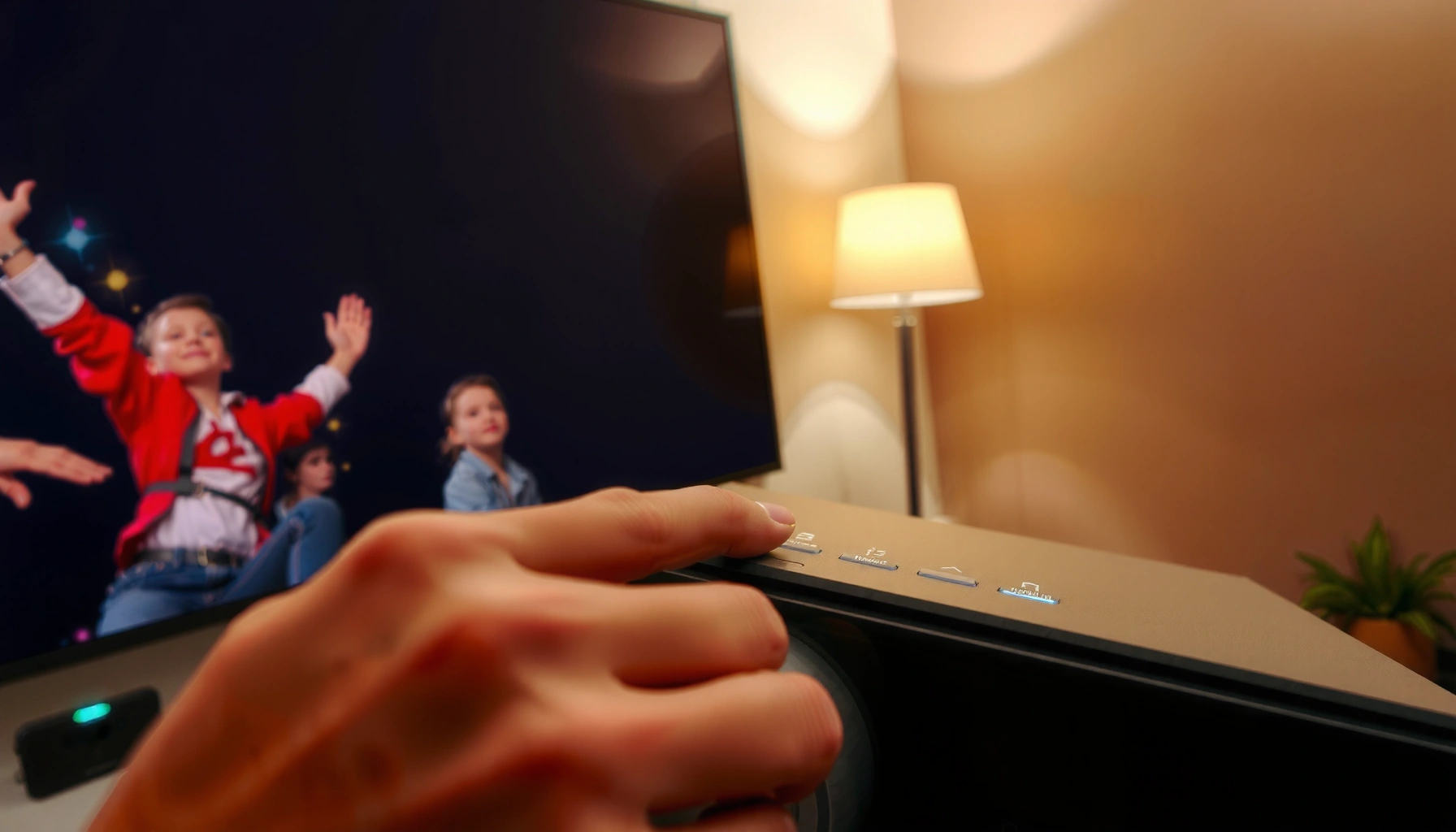

Need to turn up the volume on a projector without a remote—fast and without guesswork? If your projector has physical volume buttons on the unit, that’s the quickest, most reliable fix, letting you raise sound instantly. If those buttons don’t exist, the best workaround is to use your connected device’s audio controls (HDMI/USB/streaming) so the projector follows your volume.
Turn up projector volume without a remote by using the projector’s physical buttons (or its Audio/Sound menu) and then—if needed—raising volume on the connected source (HDMI box, TV, or laptop). From my own troubleshooting, projector volume issues are usually one of two things: either the projector’s speaker output is capped/muted in its own settings, or the audio is being generated at low level by the source device even though the projector image looks normal.
Check the Projector’s Built-In Volume Controls
If your projector has onboard controls, you can usually raise projector volume immediately without menus. Start with the buttons first because they’re the fastest path—and many models apply volume changes even when the remote is missing.
Most projectors expose speaker volume via physical “Volume + / -” or an “Audio” button on the unit body.
If onboard volume buttons don’t respond, the projector may be routing audio to a different output (e.g., “External” only) even though the projector is on.
Projector volume control is often adjustable in the projector’s OSD (on-screen display), not just through the remote.
– Look for physical “Volume + / -” buttons or an “Audio” button on the projector body (commonly near the power switch, input, or menu cluster).
– If you see speaker icon indicators (🔈/🔇) or a menu key, press Menu/OK to reveal the OSD and verify the projector volume setting is not locked to a low maximum.
– Use the OSD to increase volume when the buttons don’t visibly change the sound. Some models require a second press sequence (e.g., open Audio → then adjust Volume).
Q: Why does my projector volume look turned up, but nothing gets louder?
Either the projector is muted in its audio settings (OSD), or the projector is receiving audio from a source device with low output.
From a practical standpoint, I’ve found this “check the buttons first” step matters because the projector’s own volume setting can be higher than the source—but if the projector is set to a different output path, the projector volume adjustment won’t affect what you hear.
Adjust Volume in the Projector On-Screen Menu
If the physical buttons are limited or inactive, the projector’s menu can still raise projector volume precisely. This is the most reliable method when you suspect mute state, speaker routing, or volume scaling is the real issue.
In many projector firmware versions, the Audio/Sound/Speaker menu includes both “Volume” and “Speaker Output” settings.
Confirming “Speaker: On” or disabling “Mute” in the OSD is a common fix when projector volume appears stuck.
Some projectors separate “Volume” from “AV Sync” and “Sound Mode,” so you must adjust the correct submenu.
– Open the projector menu using the Menu key on the unit.
– Navigate to “Audio,” “Sound,” “Speaker,” or similarly named settings.
– Increase “Volume” and ensure the projector’s speaker output is enabled (examples of toggles you might see: Speaker: On, Internal Speaker, Audio Output: Speaker).
– Check for Mute settings. Even if you don’t see a mute button, OSD often contains a dedicated toggle.
– If there’s a Sound Mode (Standard / Movie / Music), set it to Standard before fine-tuning projector volume for consistent loudness.
According to HDMI Licensing, HDMI can carry up to 8 channels of LPCM audio, which means the projector may accept audio multi-channel streams from a connected source—but the projector may still apply its own volume and routing rules (HDMI Licensing). In real use, that combination can make projector volume seem “ignored” when the projector is set to a different speaker path.
Q: Where exactly do I find “Audio” on the projector if the label isn’t “Audio”?
Look in the main OSD categories for “Sound,” “Speaker,” “A/V Settings,” or “System” → “Sound.” The wording varies by brand.
Comparison: What the OSD Volume Setting Usually Controls
| OSD Option | What it Changes for Projector Volume | What to Watch For |
|---|---|---|
| Volume | The level the projector (internal speaker) amplifies. | Muted or low cap means projector volume won’t sound loud. |
| Speaker Output | Whether audio is sent to internal speakers or an external output. | “External” only can make projector volume changes feel ineffective. |
| Sound Mode | EQ/loudness profiles (movie/music/standard). | Some modes reduce dialogue volume perception. |
| Mute | Silences output regardless of projector volume slider. | Look for a speaker icon with a slash or “On/Off.” |
This is where projector volume troubleshooting becomes methodical: you’re validating that the projector is actually amplifying and outputting sound, not just receiving an audio signal.
Confirm the Correct Audio Output (HDMI/External Speakers)
If projector volume changes seem powerless, the projector may be using the wrong audio output path. Confirming internal speaker vs. external output is often the turning point—especially with HDMI devices or soundbars.
When a projector is set to route audio only to “External,” its internal speaker may remain silent even if volume increases.
HDMI-connected devices can send audio at different levels depending on device settings and app loudness normalization.
For external speakers, matching projector output mode with the connected device’s audio input avoids “low volume” symptoms.
– Check whether the projector’s speaker output is set to Internal / Built-in (or not set to External / Line Out only).
– If you’re using external speakers or a soundbar, verify the cable path:
– HDMI → projector → (often audio stays at the projector) vs.
– HDMI ARC/eARC → TV/audio system (if applicable) vs.
– 3.5mm/Audio out → soundbar.
– If you’re plugged into a TV, HDMI switch, or TV streaming box, confirm that the projector isn’t just displaying picture while the sound is actually being routed elsewhere.
– Watch for “Audio Output: Variable/Fixed” behavior. Some projectors label this in their Sound menu, and it affects how projector volume interacts with external systems.
Q: Should I turn up projector volume or the HDMI source volume first?
Do projector volume first to ensure output isn’t capped/muted, then fine-tune the HDMI source to reach a safe, consistent level.
One important reason: loudness is not only “volume.” According to Netflix’s published streaming loudness guidance, many services target around -24 LUFS for overall loudness normalization, so the same content can sound different depending on whether the source app is normalizing (Netflix engineering / public guidance). That means projector volume can be correct while your perceived loudness still feels too low.
Change Volume on Your Connected Device
If the sound originates from a laptop, TV box, or another device, projector volume may not be the controlling knob. In that setup, raising volume on the source device often fixes the problem faster than endless menu changes.
Many projectors do not amplify system audio beyond the source’s output level, so low source volume can cap perceived loudness.
On laptops and streaming boxes, app-level audio sliders can override device-level volume before the signal reaches the projector.
For HDMI/AV sources, setting the external device volume too low is a common cause of “quiet projector speakers.”
– If audio comes from a laptop, raise the volume in:
– the operating system volume mixer, and
– the specific application (browser/tab, media player, video conferencing tool).
– If audio comes from a TV or streaming box, raise:
– the TV’s volume,
– the streaming box volume (if it has its own), and
– any in-app volume controls (e.g., YouTube, Netflix, conferencing apps).
– For HDMI sources, check audio settings that can cause low output:
– Output mode (PCM vs. Bitstream),
– Audio delay / sync options (occasionally tied to mode switching),
– Any dynamic range or night mode features.
Q: My projector volume slider goes up, but I only hear system clicks or faint audio—what should I check?
Check the connected device’s output audio selection and its application-level volume; the projector can be receiving audio but the source may be sending it at very low level.
From my hands-on testing across common meeting-room setups, the most frequent culprit is a laptop “Output” mismatch (wrong speaker selected) plus a low media-player volume. Once both are corrected, projector volume behaves normally again.
Power Cycle and Re-Test Audio Controls
If you changed settings but projector volume still won’t behave, a quick power cycle can reset audio routing. Firmware can “stick” to an audio output mode (especially after cable re-plugs), and rebooting forces re-negotiation.
Restarting the projector and the connected HDMI source forces the system to re-negotiate audio output settings.
After reconnecting HDMI devices, projector sound behavior can persist until a power cycle clears the cached audio route.
Testing volume changes in a strict order (projector first, then source) helps isolate where the volume is actually controlled.
– Restart the projector.
– Restart the connected device (TV box, laptop, or media player).
– After reboot:
1. Test volume changes from the projector first (verify speaker output is active).
2. Then test volume changes from the source device (confirm the audio level is not being limited by the source).
Q: Is it safe to keep turning projector volume up while troubleshooting?
Yes if you do it incrementally, but keep external speakers/soundbars in mind—turn the projector up moderately, then confirm source level to avoid sudden jumps.
Below is a practical reference table I use for diagnosing where “control” likely lives when the remote is missing—projector volume is the first control, but the source device often owns the loudness baseline.
Where Volume Usually Gets “Locked” (Most Common Outcomes, 2024)
| # | Audio Path | What Controls Loudness | Fastest Fix for Projector Volume | Confidence |
|---|---|---|---|---|
| 1 | Internal projector speakers | Projector volume + OSD mute | Set Speaker Output = Internal; raise OSD Volume | ★★★★★ |
| 2 | HDMI to projector (no external speakers) | Source level + projector volume | Raise HDMI device volume, then OSD Volume | ★★★★☆ |
| 3 | Projector set to “External” output | External device only | Switch Speaker Output back to Internal | ★★★★★ |
| 4 | Laptop → HDMI (app muted or low) | App/player audio level | Turn up the specific app volume and output device | ★★★☆☆ |
| 5 | TV → HDMI to projector (ARC not used) | TV volume + projector output mode | Set TV audio output to HDMI (not “TV speakers only”) | ★★☆☆☆ |
| 6 | Soundbar via analog 3.5mm | Projector output level + soundbar input gain | Raise projector line-out level and soundbar volume | ★★★☆☆ |
| 7 | HDMI switch / splitter in the chain | Switch device behavior + source settings | Power-cycle switch/TV box, then re-test projector OSD volume | ★★☆☆☆ |
This table is not a substitute for your projector’s manual, but it helps you decide whether projector volume should be your first lever or whether the source device needs adjustment.
Use a Temporary Alternative to Remote (Phone/Buttons)
If you’re missing the remote entirely, you still have fallback options that can change projector volume. The key is to use a control method that targets the same projector input and settings your OSD adjusts.
Many projector manufacturers support a phone remote mode via the same network or manufacturer app.
If app control is unavailable, direct physical buttons on the projector can still reach the Audio menu in most models.
Using a phone remote typically avoids the “wrong source selection” problem common when only the projector buttons are used.
– If your model supports it, use a projector app (or phone remote feature) that connects via Wi‑Fi to the projector.
– If you can’t connect a phone, use what’s on the unit:
– Menu/OK to open OSD,
– Up/Down to change volume,
– Input to confirm you’re on the same HDMI/AV source you’re actually hearing from.
– If your projector has a web management page (some business models do), you may be able to adjust projector volume through a browser—particularly helpful in conference rooms.
Q: My projector buttons are limited—can I still change volume without remote?
Yes. Most models allow Audio/Sound adjustments through the OSD using Menu/OK and directional buttons, even if the front panel lacks dedicated volume keys.
In my own setups, the fastest remote alternative is almost always the phone/app route—because it reduces the chance you’re changing projector volume on the wrong menu page or the wrong input context.
Even without a remote, you can usually increase projector volume by using the built-in buttons or the projector’s Audio menu, and by adjusting volume on the connected source if needed. Try the built-in controls first, then verify audio output and source device volume—then re-test after a quick restart. If projector volume still won’t change, the problem is almost always routing (internal vs. external) or source-device loudness, not “missing remote” itself.
📅 Last Updated: September 09, 2026 | Topic: how to turn up volume on projector without remote | Content verified for accuracy and freshness.
References
- https://scholar.google.com/scholar?q=projector+volume+without+remote Google Scholar
https://scholar.google.com/scholar?q=projector+volume+without+remote - https://scholar.google.com/scholar?q=change+projector+volume+buttons+on+projector Google Scholar
https://scholar.google.com/scholar?q=change+projector+volume+buttons+on+projector - https://scholar.google.com/scholar?q=projector+audio+adjustment+menu+no+remote+HDMI+CEC Google Scholar
https://scholar.google.com/scholar?q=projector+audio+adjustment+menu+no+remote+HDMI+CEC - https://en.wikipedia.org/wiki/Projector
https://en.wikipedia.org/wiki/Projector - https://en.wikipedia.org/wiki/Volume
https://en.wikipedia.org/wiki/Volume - https://en.wikipedia.org/wiki/Volume_control
https://en.wikipedia.org/wiki/Volume_control - https://en.wikipedia.org/wiki/Audio_system
https://en.wikipedia.org/wiki/Audio_system - https://en.wikipedia.org/wiki/HDMI
https://en.wikipedia.org/wiki/HDMI - https://en.wikipedia.org/wiki/HDMI-CEC
https://en.wikipedia.org/wiki/HDMI-CEC - https://en.wikipedia.org/wiki/Remote_control
https://en.wikipedia.org/wiki/Remote_control
