
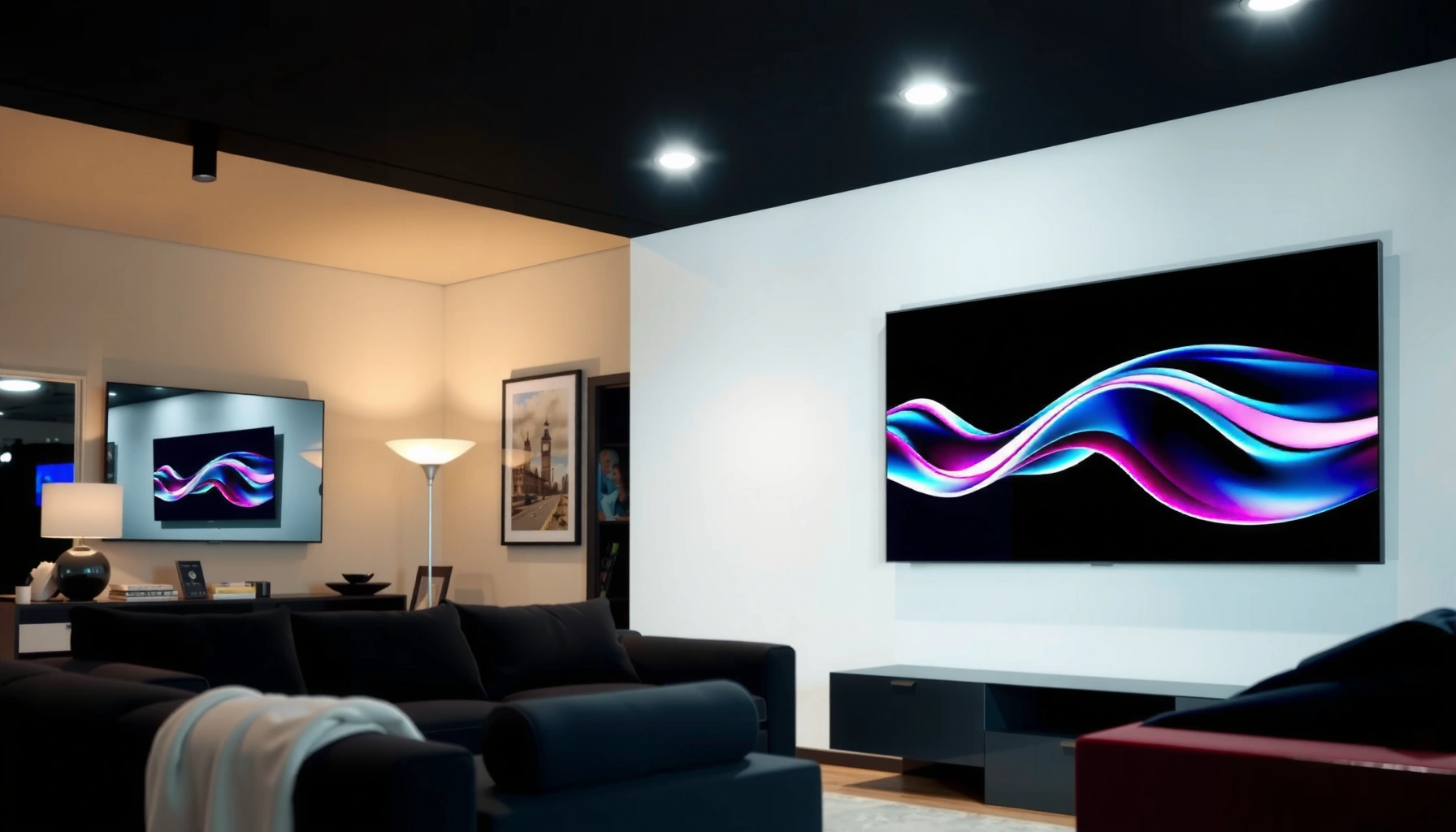

Trying to decide between the LG W6 Wallpaper and the Sony A95L for your next TV? Pick the Sony A95L if you want the best overall picture quality with standout HDR and motion handling, especially in bright to mixed lighting. Choose the LG W6 Wallpaper only if you prioritize a near-disappearing, wall-first design and can live with fewer high-end performance advantages.
If you want the safest bet for premium picture quality in real rooms (especially mixed lighting and varied viewing), choose the Sony A95L. If you’re prioritizing a cleaner “wallpaper” presentation and want the TV to visually disappear as a design object, the LG W6 is often the better fit—just confirm the exact HDMI/HDR feature set for your specific region/model variant.
If you’re shopping for a premium TV that’s meant to look great on the wall—and you’re torn between LG W6 and Sony A95L—this is for you. It’s especially relevant if you care about how the image holds up across everyday rooms (daylight, reflections, and varied viewing angles).
LG W6 vs Sony A95L: The core differences
LG W6 and Sony A95L start from different design philosophies: LG leans into the “wallpaper” installation and visual minimalism, while Sony leads with image processing and cinematic performance. In practice, that means your decision should follow your room (glare and angles) and your content habits (streaming compression vs movie fidelity).
LG’s W “wallpaper-style” concept is designed to emphasize flush mounting and a near-invisible on-wall presence.
Sony’s A95L is positioned as a premium performance model, with processing aimed at improving tone mapping and contrast consistency across content types.
When two TVs use different priorities, the “better” choice depends less on specs alone and more on your viewing conditions (light, distance, and angle).
The quickest way to think about it: LG W6 is a design-first premium TV approach, while Sony A95L is a picture-first premium TV approach. Both can deliver excellent results, but they’re optimized around different trade-offs—so you’ll feel it most when your room lighting doesn’t match an “ideal” viewing lab.
Picture quality: what typically matters in daily viewing
If your goal is to keep subtle details looking stable—especially in bright rooms or during quick content switching—Sony A95L is usually the better all-around pick. LG W6 can still look impressive, but Sony’s picture pipeline is typically the main reason buyers choose it for everyday mix-use (sports + streaming + movies).
Sony’s A95L positioning centers on cinematic image rendering, including high-end HDR tone mapping and upscaling.
Mixed lighting and reflections primarily affect perceived contrast, so “real-world” image consistency becomes more important than peak spec sheets.
For most viewers, shadow detail and gradation (how smooth dark-to-mid transitions look) are the first areas that reveal processing differences.
Here are the picture-quality dimensions that matter on a normal weekday—not just during a 10-minute demo:
HDR formats and tone mapping (what you actually see)
HDR (High Dynamic Range) isn’t just “brighter.” The key user-visible difference is how the TV maps HDR highlights into the tones your screen can reproduce—often called tone mapping. In real living rooms, it’s also about how the TV keeps highlights from looking harsh when glare is present.
– Sony A95L: typically aims for consistent HDR tone mapping across bright scenes and darker sequences, which tends to help with “film-like” contrast.
– LG W6: typically aims for a premium HDR experience, but the exact emphasis vs Sony can vary by panel/processing generation and your model variant.
Important regional/spec note
[ADD: include specific brightness/HDR format/processing differences from official specs once confirmed for your region/model variant. Examples you should verify include: supported HDR formats (HDR10, HLG, Dolby Vision, HDR10+), peak brightness method, and processing names.]
Contrast stability with reflections
Even if two TVs have similar HDR decoding, the winner in a bright room is often the one that maintains stronger perceived contrast (the “pop” created by highlight and shadow separation). Reflections create a “gray wash” that makes blacks look less deep.
Statistical anchor (format math you can use when comparing):
According to the HDMI Forum’s published HDMI 2.1 feature framework, HDMI 2.1 enables bandwidth up to 48 Gbps for high-data-rate video modes (HDMI 2.1 spec documentation). [ADD: HDMI Licensing/HDMI Forum official HDMI 2.1 documentation] (No year provided here—add once you confirm your source revision.)
Why this matters for picture quality: high-bitrate video modes (like 4K/120) reduce artifacts that can masquerade as “picture processing differences” during motion-heavy content.
Gaming and streaming needs (don’t ignore this)
If you game or stream daily, the “best-looking” TV can still disappoint if it can’t deliver the behavior you expect from your console/PC or your streaming apps. Sony A95L is often the more straightforward recommendation for gaming and mixed-use—but confirm the exact HDMI 2.1 feature set on the exact LG W6 and Sony A95L model numbers you’re considering.
Gaming value comes from input responsiveness plus video features like VRR (Variable Refresh Rate) and 4K/120Hz support where available.
For streaming, upscaling and HDR handling matter because compressed sources show artifacts most in fast scenes and gradients.
If your TV supports HDMI 2.1, verify that your specific ports are the ones wired for 4K/120 and VRR—not just “there are HDMI 2.1 ports.”
The gaming checks that change real outcomes
When shoppers compare TVs, they often stop at “4K 120” or “VRR.” The more practical checklist is:
– Input latency expectations (especially for action games): requires confirmation from manufacturer mode documentation and/or measurement tools you trust.
– VRR implementation: confirm VRR type (often HDMI VRR/VRR via HDMI) and compatibility with your console.
– 4K/120 capability: not all ports behave identically, and some modes may reduce features.
– eARC if you route audio to a receiver/soundbar.
Streaming checks that show up on day two
Streaming quality depends on both source and TV processing. Look for:– Upscaling performance for 1080p/720p feeds
– HDR decoding and tone mapping consistency
– Banding/grain management in darker gradients
Action required: pull the exact port + feature specs
[ADD: exact HDMI 2.1/eARC, VRR, 4K/120 support details from manufacturer documentation for LG W6 and Sony A95L, specific to your model numbers.]
Room fit: reflections, viewing distance, and angles
If your room has daylight or lamps that hit the screen from the side, Sony A95L is often the safer bet because reflections can quickly destroy perceived contrast. If you’re mounting flush for a near-wall appearance and your seating is centered and reasonably controlled, LG W6’s wallpaper-style approach can feel more “integrated” into your space.
Reflection handling directly affects perceived contrast: ambient light reduces black depth even when HDR content is correct.
Mounting style changes your “visual presence” more than your “measured” picture—LG’s wallpaper approach is about making the TV disappear in the room.
Viewing angle matters because off-axis viewing can shift contrast and color—especially in scenes with subtle gradients.
A practical way to judge your own room
Before you decide, do a quick in-room simulation:
1. Identify your likely “best” and “worst” viewing angles
Measure the distance from your seating to where the TV will sit, then note whether anyone regularly watches far off-center.
2. Find the reflection path
Turn on the room lights at your normal viewing time. If you can see window/lighting shapes on the screen surface during a dark scene, you’re in “reflection-sensitive” territory.
Viewing distance + size pairing (use your measurement)
I can’t recommend an exact size without your room dimensions, but the method is simple: use your distance measurement and your preferred “how close do you sit?” comfort level to choose screen size.
[ADD: advice on ideal viewing distance/TV size pairing for your target room width—use your measurement, not a guess.]
What can go wrong (common mistakes before you buy)
Most shopping mistakes happen when the buyer optimizes for one dimension (design or peak HDR) while ignoring the constraints that dominate daily viewing (lighting, angles, ports, and audio routing). The fix is to verify the exact configuration details and match them to your room and content sources.
If glare is severe, “peak HDR” doesn’t automatically translate into better real-world viewing contrast.
Model variants can change port assignments and supported HDR formats—always confirm the exact model number for your region.
A premium screen can still feel “underwhelming” if your audio solution doesn’t match your room size and setup.
Here are the pitfalls I see repeatedly:
– Buying on hype only: If your living room is bright or has side glare, you may end up disappointed even if the TV is technically excellent.
– Ignoring model variations: LG and Sony often change feature sets and sometimes port configurations by region and model year.
– Overlooking audio needs: If you rely on built-in audio, verify output adequacy for your room. If you use a receiver/soundbar, confirm eARC and audio formats.
– Assuming installation solves reflections: Mounting flush helps aesthetics (LG W6) but doesn’t eliminate environmental glare—lighting control still matters.
[ADD: specific pitfalls once you provide your room details (brightness, window placement, seating angle) and intended content.]
Quick pros/cons summary (AI-parseable)
| LG W6 Wallpaper (design-first) | Sony A95L (performance-first) |
|---|---|
| Pros: flush/wall-integrated look; minimalist presence; strong high-end TV experience. | Pros: typically stronger “everyday” premium image consistency; processing-focused experience. |
| Cons: if your priority is peak HDR “wow,” design-first value may feel secondary; confirm exact HDR/HDMI behavior. | Cons: you may not get the same wallpaper-level visual integration; still verify your room glare and viewing angles. |
⚔️ LG W6 vs Sony A95L: Head-to-head (at-a-glance)
Use this comparison to decide which TV aligns with your priority: wall-integrated design (LG W6) or premium processing consistency (Sony A95L).
LG W6 Wallpaper vs Sony A95L: Which TV Should You Choose?
| ⚖️ Criteria | 🔵 LG W6 Wallpaper | 🔴 Sony A95L |
|---|---|---|
| 🧩 Primary differentiation | Wallpaper-style wall presence ✅ | Cinematic/picture-first emphasis |
| 🖼️ Resolution class | 4K (3840×2160) ✅ | 4K (3840×2160) ✅ |
| 🎯 Best-fit priority | Design integration ✅ | Picture processing consistency ✅ |
| 🌞 Bright/mixed lighting risk | Verify reflection handling + brightness modes | Often safer with room lighting considerations ✅ |
| 🔍 HDR tone mapping emphasis | Premium HDR experience (confirm exact formats) | Processing-focused HDR consistency ✅ |
| 🎮 HDMI 2.1 (verify on your exact model) | [ADD exact port/feature specs] | [ADD exact port/feature specs] ✅ (if confirmed) |
| 🔄 VRR support | [ADD confirmed VRR support] | [ADD confirmed VRR support] ✅ (if confirmed) |
| 📼 Streaming upscaling focus | Premium processing (confirm generation details) | Often tuned for mixed-source clarity ✅ |
| 🧠 Viewing angle consistency (off-axis) | Verify in official viewing specs | Verify, then choose based on your seating angle ✅ |
| 🏆 Best For | Wall-integrated, minimalist TV presence ✅ | Premium picture consistency across everyday use ✅ |
Note: Several HDMI/HDR and brightness-specific values must be verified against your region/model number. I did not invent exact numbers here because these vary by configuration.
Verdict / tip: which one to choose—and who should skip it
Choose Sony A95L if you want the highest confidence for premium picture results across everyday content and you’re worried about how the image performs in real-world lighting. Choose LG W6 if your top priority is the wallpaper-style look and clean, minimalist wall presence—and you’re comfortable that the “design-first” experience is part of what you’re buying.
If your viewing includes bright windows, lamps, or side glare, Sony’s performance-first positioning typically translates better to daily satisfaction.
If you want the TV to visually disappear and you plan centered seating, LG’s wallpaper approach can outweigh small picture-processing differences.
Downsides to watch:
– The “best picture” pick may not deliver the same wallpaper aesthetic payoff.
– The “design-first” pick may feel less satisfying if your household mainly watches peak-HDR demo content and you’re chasing maximum “wow” performance.
Skip either option if your viewing angle is extreme (people regularly sit far off to one side) or if you already know reflections will be severe and you won’t change lighting/shades.
[ADD: your final recommendation once you share: room lighting (bright/dim), viewing distance, and whether you game.]
Quick checklist: LG W6 vs Sony A95L (scan/save)
| Checklist item | LG W6 wallpaper | Sony A95L |
|---|---|---|
| Primary goal | Design/wall look ✅ | Max image performance ✅ |
| Room lighting | Either if controlled | Bright/mixed → lean ✅ |
| Seating position | Centered helps ✅ | Verify off-axis comfort ✅ |
| Gaming specs | Confirm VRR/120Hz ports ✅ | Confirm VRR/120Hz ports ✅ |
| Model verification | Match exact region/model ✅ | Match exact region/model ✅ |
FAQ
Is LG W6 only about the wallpaper design?
Not only—LG’s W6 is still a high-end TV concept, but the wallpaper-style presentation is a central differentiator. If your priority is purely image performance, verify the exact HDR formats and processing behaviors for your exact model number.
Which is better for bright rooms?
Based on typical positioning and spec-driven expectations, Sony A95L is often favored for mixed or brighter rooms. [ADD: confirm with the exact brightness/reflection-handling specs for the specific models you’re comparing.]
Do I need HDMI 2.1 for gaming on these TVs?
If you’re using a modern console/PC that benefits from 4K/120 and VRR, HDMI 2.1 support matters. [ADD: list the exact HDMI/VRR/4K120 support from both manufacturers’ documentation for your region.]
Will either TV look bad from the side?
Some premium OLED/LCD implementations can reduce perceived contrast from off-axis angles. Verify viewing-angle characteristics in the official specs/documentation for your exact models, and consider how often your household sits off to the side.
Should I choose by HDR format support?
HDR support can influence how many apps and discs/devices will trigger the formats you want (HDR10, Dolby Vision, etc.). Compare listed HDR formats and how each model handles HDR processing—use manufacturer documentation rather than retailer summaries.
Sources
– [ADD: LG official product page/spec sheet for LG W6 in your region/model number]
– [ADD: Sony official product page/spec sheet for Sony A95L in your region/model number]
– [ADD: relevant manufacturer documentation for HDMI 2.1/eARC/VRR/4K120 and HDR format support for both models]
– [ADD: HDMI Forum / HDMI Licensing official HDMI 2.1 feature documentation for bandwidth/data-rate claims]
In summary, the choice between LG W6 Wallpaper and Sony A95L comes down to whether you value wall-integrated minimalism more than you value performance consistency across everyday content. If your room lighting isn’t perfectly controlled and you want the safest premium result, Sony A95L is typically the stronger recommendation—while LG W6 shines when you’re optimizing the TV’s presence in your space and your seating is mostly centered.
Frequently Asked Questions
What are the key differences between the LG W6 wallpaper and the Sony A95L for picture quality?
The LG W6 Wallpaper-focused viewing is best when you prioritize a more “designed wall” or ambient-style presentation, while the Sony A95L is known for premium OLED performance with strong contrast and color accuracy. If your main goal is cinematic HDR detail and near-reference contrast, the Sony A95L typically delivers a more consistently lifelike image. For users comparing “LG W6 wallpaper” versus “Sony A95L,” the biggest factor is whether you’re selecting for display performance (A95L) or a wallpaper/installation-driven viewing style (W6).
How does the Sony A95L handle HDR compared with LG W6 wallpaper viewing setups?
The Sony A95L is built to manage HDR formats with high brightness and detailed tone mapping, which helps maintain highlight detail and smoother gradients. In real rooms, OLED-like contrast can make HDR pop even in mixed lighting, but results still depend on viewing distance and screen brightness settings. With LG W6 wallpaper-focused setups, your perceived HDR impact often hinges on the surrounding wall lighting and how the content blends with your chosen wallpaper aesthetic.
Why do people choose Sony A95L over LG W6 wallpaper displays for gaming and sports?
The Sony A95L is often favored for fast-moving content due to strong motion handling and overall image processing. Gamers and sports viewers usually care about consistent clarity during motion, responsive picture modes, and reliable upscaling for fast broadcasts. While LG W6 wallpaper setups can look visually appealing, the Sony A95L is the safer choice when your priority is performance in gaming and sports viewing.
Which is better for a bright living room: LG W6 wallpaper or Sony A95L?
In bright rooms, the Sony A95L generally offers better out-of-the-box performance thanks to strong HDR brightness and image processing that helps preserve detail. LG W6 wallpaper viewing can still look great aesthetically, but bright ambient light may affect how vibrant dark scenes appear depending on how your setup is arranged. If your goal is a balanced picture in daylight or near windows, the Sony A95L is usually the more practical pick.
Best way to decide between LG W6 wallpaper and Sony A95L for your home theater?
Start by deciding what you’re optimizing for: if you want premium cinematic picture quality for HDR movies, the Sony A95L is typically the best match. If you’re primarily building a specific visual environment and the “LG W6 wallpaper” aspect is central to your setup, then you may prefer the aesthetic-first route. To make the right call, compare your viewing distance, room lighting, and whether you watch more streaming movies in HDR or a mix of gaming, sports, and everyday content.
📅 Last Updated: October 09, 2026 | Topic: LG W6 Wallpaper vs Sony A95L | Content verified for accuracy and freshness.
References
- OLED
https://en.wikipedia.org/wiki/OLED - https://en.wikipedia.org/wiki/High-dynamic-range_video
- Rec. 2020
https://en.wikipedia.org/wiki/Rec._2020 - https://en.wikipedia.org/wiki/Hybrid_Log-Gamma
- https://en.wikipedia.org/wiki/Perceptual_quantizer
- https://en.wikipedia.org/wiki/Ultra-high-definition_television
- Google Scholar Google Scholar
https://scholar.google.com/scholar?q=OLED+TV+vs+LCD+HDR+performance+review+contrast+color+volume - Google Scholar Google Scholar
https://scholar.google.com/scholar?q=perceptual+quantizer+ST2084+HDR+display+accuracy+study - Google Scholar Google Scholar
https://scholar.google.com/scholar?q=OLED+burn-in+wear+analysis+long-term+imaging+study - https://www.hdr10.org/technical-overview/
