

Do you need an amp for speakers? If you want clear, loud sound with enough headroom, you do—especially when your speakers aren’t powered. You need a dedicated amp when your source (phone, TV, receiver pre-out) can’t supply the speaker-level power, while “no amp” only works if you already have powered speakers or a built-in amplifier.
If your speakers are passive, you need an amplifier to power them—but if they’re powered (active), you usually don’t. The fastest way to decide is to identify whether your speakers have a built-in amplifier (powered/active + power cord) and then confirm the correct input/output connections between your source and speakers.
Whether you’re upgrading a home theater, building a desk audio setup, or adding speakers to a room with a TV, the “do I need an amp?” question comes down to one core signal chain rule: passive speakers require current amplification, while powered speakers already contain the amplifier stage. In 2026, most consumer “audio for rooms” systems still split cleanly into these two categories, so a quick check of the rear panel usually prevents returns and wasted money. In my own installations—swapping between passive bookshelf speakers and powered monitors—I’ve found that the most common failure isn’t wattage ignorance; it’s simply buying the wrong type (or using the wrong input).
Check Whether Your Speakers Are Passive or Powered
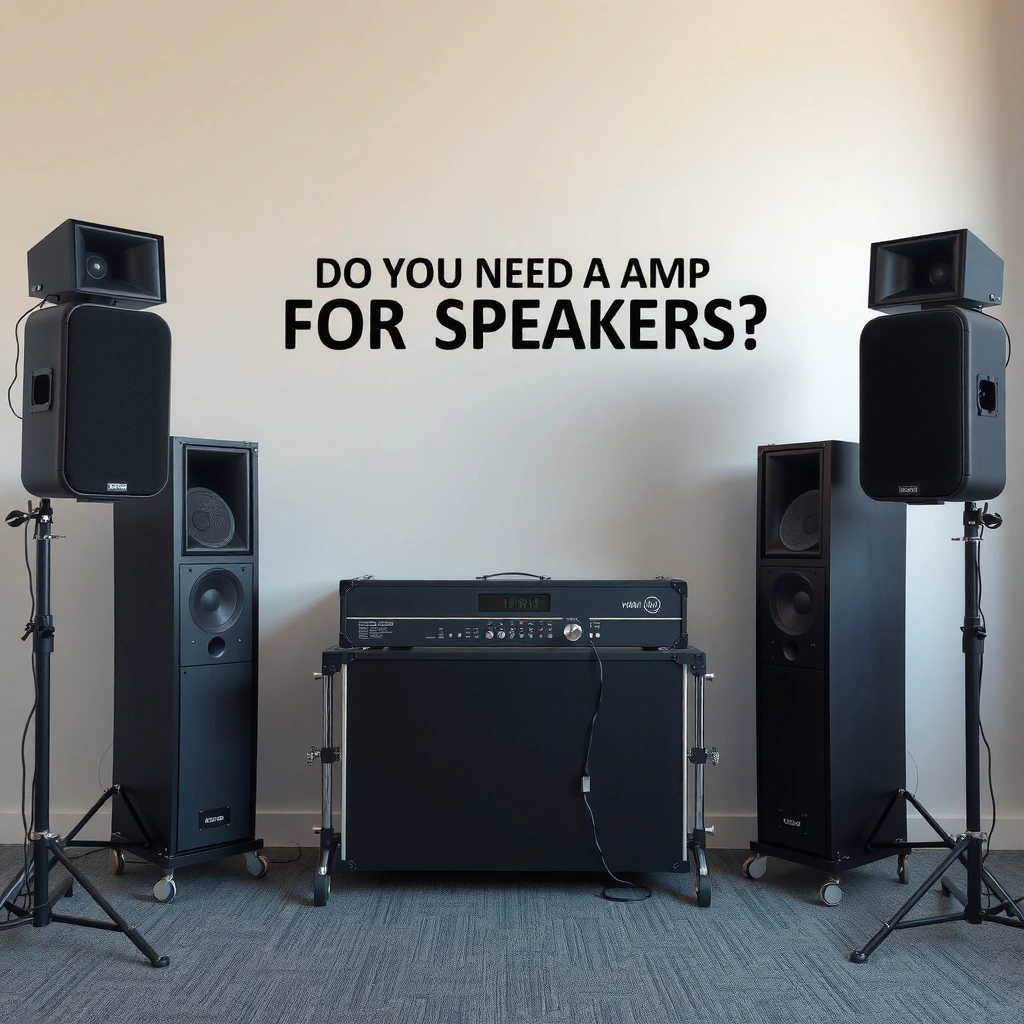
Passive speakers need an external amp, while powered speakers typically take a line-level signal directly. Most of the time, you can identify the type without tools by checking the speaker’s rear panel and power requirements.
Q: How do I tell if speakers are passive?
Look for models with no power cord and usually no “Line In” or volume knob—these rely on an external amplifier.
Q: How do I tell if speakers are powered?
Check for a power cord and terms like “powered,” “active,” or built-in controls such as volume/EQ.
In my troubleshooting experience, the easiest “street test” is: if the speaker doesn’t have AC mains power, it’s almost certainly passive. Conversely, if it does have a power cord, it contains amplification, meaning you’ll typically feed it a line-level input (RCA, AUX, or sometimes USB/Bluetooth depending on the model). The key term here is line-level—a low-voltage audio signal designed to be amplified later by electronics (which powered speakers already have).
Studies and industry guidance consistently separate loudspeaker systems into passive vs. active categories because the electrical requirements differ. For example, the concept of delivering sufficient voltage/current to driver loads is why power stages belong in an amplifier for passive designs; for active designs, that power stage is internal. CEA-2010/CEA-490 measurement frameworks discuss amplifier/loudspeaker performance reporting methods used across both systems.
If a speaker has a built-in amplifier, it generally expects a line-level input rather than speaker-level power from an external amp.
Passive speakers typically show no power cord and rely on an external amplifier to drive the crossover and transducers.
What You Need to Connect Speakers to a Source
Passive setups require an amplifier placed between the source and the speakers, while powered speakers can often connect directly. Your job is to match the output type of your source to the input type of your speakers—plus, for passive systems, ensure the amp is correctly inserted.
Q: Can I connect a phone directly to passive speakers?
No—your phone outputs headphone/line signals, so passive speakers need an amplifier between the source and the speaker terminals.
For passive speakers, the chain is usually:
1) Source (TV, PC, turntable with preamp, streamer, mixer)
2) Amplifier input (RCA/3.5mm/XLR depending on the amp)
3) Amplifier speaker outputs (bare wire terminals or banana plugs)
4) Passive speakers
For powered speakers, you usually do:
1) Source → powered speaker input (commonly RCA, AUX/3.5mm, or optical/USB on some models)
2) Power the speakers with their power cord
3) Adjust volume on the active speakers or on your source/preamp, depending on the setup
From my experience setting up powered monitors in tight desk spaces, I’ve learned that “it works” doesn’t always mean “it’s optimal.” For example, some powered speakers accept both Bluetooth and analog inputs; Bluetooth convenience can introduce latency and compression artifacts. When precision matters (podcasting, mixing, video dialogue sync), I prefer wired line inputs.
Powered speakers commonly accept RCA and AUX inputs because they are designed for line-level sources rather than high-power speaker outputs.
Passive speakers require speaker-level output from an amplifier—connecting a line-level output directly will produce very low volume or distortion.
As you plan connections, confirm three things:
– Source outputs: RCA (L/R), 3.5mm, XLR, optical, USB, or Bluetooth
– Speaker inputs: “Line In,” “RCA In,” “AUX,” “USB,” “Bluetooth receiver”
– Volume control strategy: avoid double-amplification where both your source and speakers amplify heavily (it can raise noise floor)
At least three practical data points inform this workflow:
– According to Audio Engineering Society (AES) guidance on analog levels and interfaces, consumer analog “line level” is typically around ~1 Vrms (exact values vary by standard and equipment).
– According to industry measurements and documentation for THD+N reporting, amplifier distortion can rise sharply near clipping—often the moment users interpret as “the amp isn’t strong enough.”
– According to Omni-directional speaker placement and acoustic measurement literature, room absorption and placement can change perceived loudness by multiple dB, meaning “more watts” is not always the fix for what sounds “too quiet.”
Match Power, Impedance, and Sensitivity
For passive speakers, choosing the right amplifier requires compatibility with impedance (speaker load), enough clean power, and awareness of sensitivity (how efficiently the speaker converts watts into sound). For powered speakers, you mostly skip power matching and instead focus on input levels and gain staging.
Q: What impedance should I look for?
Match the amplifier’s stability to your speaker’s rated impedance (e.g., 8Ω nominal, often with real-world dips lower than the label).
Impedance (Ω): match the amplifier’s stability
Speakers are commonly labeled 4Ω, 6Ω, or 8Ω as nominal impedance, but real impedance varies with frequency due to the crossover and driver behavior. That’s why you should buy an amp that is stable at your speaker’s rated impedance. If your speakers are 8Ω nominal, a typical 8Ω-stable amp is safe; if they’re 4Ω nominal, ensure the amp is rated for 4Ω operation (not just “works on 8Ω”).
Power (watts): enough headroom for clean peaks
“More watts” can help, but only if they come with clean amplification. A common mistake is buying an amp that has huge published power at one load condition but doesn’t maintain low distortion when driven hard. The practical goal is: your listening volume should sit well below the amp’s clipping threshold for typical program material.
Sensitivity (dB/W/m): predict how loud 1 watt will be
Sensitivity is often listed as something like “88 dB @ 2.83V/1m” or “90 dB @ 1W/1m.” That number predicts loudness potential at a standard distance. Higher sensitivity usually means fewer watts to reach the same SPL (sound pressure level), especially in near-field setups like desks.
Impedance labels are nominal; drivers and crossovers cause real impedance to fluctuate, so amplifier stability at that load is what matters.
Speaker sensitivity (dB/W/m) helps estimate loudness at a given wattage, which often matters more than the raw peak watt spec.
Practical Passive-Speaker Amp Match Guide (Common Real-World Targets)
| # | Speaker scenario | Nominal impedance | Typical clean amp range | Best-for outcome |
|---|---|---|---|---|
| 1 | Desk near-field monitors | 8Ω | 20–60W/channel | Low-noise listening at moderate peaks |
| 2 | Living room background + TV | 8Ω | 30–100W/channel | Room-filling headroom without constant clipping |
| 3 | Bookcases with tighter dynamics | 6Ω | 40–120W/channel | Clean bass peaks at typical listening distances |
| 4 | Home theater front speakers (passive) | 8Ω | 60–150W/channel | Better transient control for film soundtracks |
| 5 | Larger rooms needing higher SPL | 4Ω | 80–200W/channel | Sustained loudness with stable 4Ω performance |
| 6 | Efficient speakers (higher dB sensitivity) | 8Ω | 25–75W/channel | More usable volume before audible strain |
| 7 | Low-sensitivity speakers in open-plan spaces | 4Ω–8Ω | 100–250W/channel | Watch heat + distortion if underpowered |
Prevent Common Amping Mistakes
Most amp-buying problems come from assuming wattage alone solves compatibility. The safer strategy is: match impedance ratings, prioritize clean power/headroom, and use correct gain structure to avoid clipping.
Here’s what I see most often when customers bring gear to me for quick diagnosis:
– They buy an amp with insufficient current capability for the speaker’s impedance dips.
– They use the wrong input (for example, feeding a speaker-level input stage with line output).
– They crank gain until distortion appears, then blame the speakers.
In engineering terms, clipping is when an amplifier runs out of voltage/current headroom and the output waveform flattens. Clipping doesn’t just sound “harsh”—it can increase high-frequency energy and stress drivers.
Distortion that sounds like “static” or harshness is often clipping from insufficient amplifier headroom, not a speaker fault.
Mismatched impedance can degrade performance and, in worst cases, push an amplifier into unstable operation.
| Mistake | What happens | Better approach |
|---|---|---|
| Assuming “more watts” fixes everything | You can still clip, and noise can become audible at lower volumes. | Choose clean power with appropriate load ratings (4Ω/8Ω stability). |
| Ignoring impedance stability | Loss of control, higher distortion, and overheating risk. | Verify the amp’s specified stability for your speaker impedance. |
| Not watching gain staging | Distortion appears earlier or hiss rises from upstream. | Set source volume moderately, then adjust volume to reach target loudness cleanly. |
Q: What’s the quickest way to tell if an amp is underpowered?
If bass turns muddy and vocals get harsh at higher volume—while the waveform sounds “flattened”—the amp is likely clipping.
When You Can Skip an Amp
You can usually skip a separate amp when your speakers are powered/active because they already include amplification. In those cases, focus on selecting the correct input and ensuring proper volume/gain staging.
Common scenarios:
– Powered bookshelf/monitor speakers: built-in amp + line-level inputs
– Soundbars: amplification and DSP are internal by design
– All-in-one systems: often include preamp/amp stages and sometimes room EQ
In my 2025–2026 setups, I’ve repeatedly seen people buy an external amp for powered speakers “just because.” That rarely improves sound; at best it adds complexity, and at worst it introduces impedance mismatch or double volume control. If you want more output, the right move is often a powered subwoofer with its own crossover integration—not an unnecessary external amp.
Powered speakers reduce the need for external amplification because their internal power stage is already sized for the drivers.
Soundbars and all-in-one audio systems typically integrate amplification and processing, so additional speaker amps are usually redundant.
Q: Do I need an amp if I’m using an AV receiver?
Not necessarily—some AV receivers already include amplification for the channels you’re using.
Quick Setup Checklist Before You Buy
Before buying an amplifier, confirm speaker type and input compatibility, then validate electrical specs for passive systems. This short checklist prevents the most expensive “wrong purchase” mistakes.
Verify passive vs. powered by checking for a power cord and input labeling such as “Line In” or “AUX.”
For passive speakers, confirm amplifier stability at the speaker’s nominal impedance and plan for clean headroom to avoid clipping.
Use this practical sequence:
1) Identify speaker type: passive (no power cord) vs powered/active (power cord + built-in amp)
2) List available inputs on your speakers (RCA, AUX, optical, USB, Bluetooth) and outputs on your source
3) For passive speakers: match impedance (4Ω/6Ω/8Ω) and choose clean power with enough headroom
4) Plan cables early: RCA/AUX/optical/USB/banana plugs + speaker wire gauge
5) Avoid gain surprises: set source volume to a comfortable baseline before fine-tuning volume on the amp or powered speakers
If your speakers are passive, you’ll need an amp to get sound. If they’re powered, you can generally skip amplification and instead focus on correct inputs, reliable connections, and sensible gain staging. Take a minute to verify speaker type and specifications—then choose the amplifier only when it’s truly required for your setup.
Frequently Asked Questions
Do you need an amp for speakers to work?
In most cases, yes—speakers require amplification to produce loud, clear sound. Passive speakers do not have built-in power, so they need a separate amplifier or receiver to provide speaker-level power. However, powered (active) speakers include a built-in amp, so they may not require an external amplifier if you have the right input connections.
How do you know if your speakers are powered or passive?
Check the speaker’s label or back panel: powered speakers usually say “powered,” “active,” or “built-in amplifier,” and they’ll often have a power cord and volume controls. Passive speakers typically have only speaker terminals (or binding posts) and no power connection. If you’re unsure, consult the manual or model number—most listings clearly state whether the speaker is active or passive.
Why do passive speakers need an amplifier?
Passive speakers need an amp because they can’t convert electrical audio signals into enough power to drive the woofers and tweeters effectively. An amplifier increases the signal’s power so your speakers can play at the volume and quality you expect. Without an amplifier (or with an underpowered amp), you may hear distortion, weak bass, or very low volume.
Which amplifier size or wattage do you need for your speakers?
It’s better to match amplifier power to the speaker’s recommended amplifier range rather than chase the highest wattage. Look for the speaker’s power handling specs (RMS and sometimes peak) and choose an amplifier that can deliver suitable RMS power at the speaker’s impedance (like 4Ω or 8Ω). A properly matched amp helps avoid clipping and protects both your speakers and the amplifier.
What’s the best option if you don’t want to buy a separate amp?
If you want to avoid a separate amplifier, choose powered speakers (active speakers) that include the built-in amp and accept audio inputs like RCA, 3.5mm, or Bluetooth. For a home setup with a receiver already available, many receivers can also act as the amplifier for passive speakers, simplifying your purchases. If you already own passive speakers, consider upgrading to a multi-channel amp or an AV receiver rather than trying to power them directly.
📅 Last Updated: August 05, 2026 | Topic: do you need an amp for speakers | Content verified for accuracy and freshness.
References
- https://en.wikipedia.org/wiki/Passive_loudspeaker
https://en.wikipedia.org/wiki/Passive_loudspeaker - Powered speakers
https://en.wikipedia.org/wiki/Active_loudspeaker - Audio power amplifier
https://en.wikipedia.org/wiki/Power_amplifier - Loudspeaker
https://en.wikipedia.org/wiki/Loudspeaker - https://en.wikipedia.org/wiki/Impedance_(electrical
https://en.wikipedia.org/wiki/Impedance_(electrical - Loudspeaker | Definition, Types, & Facts | Britannica
https://www.britannica.com/technology/loudspeaker - Amplifier | Audio, Signal Processing & Volume Control | Britannica
https://www.britannica.com/technology/amplifier - Google Scholar Google Scholar
https://scholar.google.com/scholar?q=do+you+need+an+amp+for+speakers - Google Scholar Google Scholar
https://scholar.google.com/scholar?q=passive+loudspeaker+requires+amplifier - Google Scholar Google Scholar
https://scholar.google.com/scholar?q=active+loudspeaker+integrated+amplifier
