
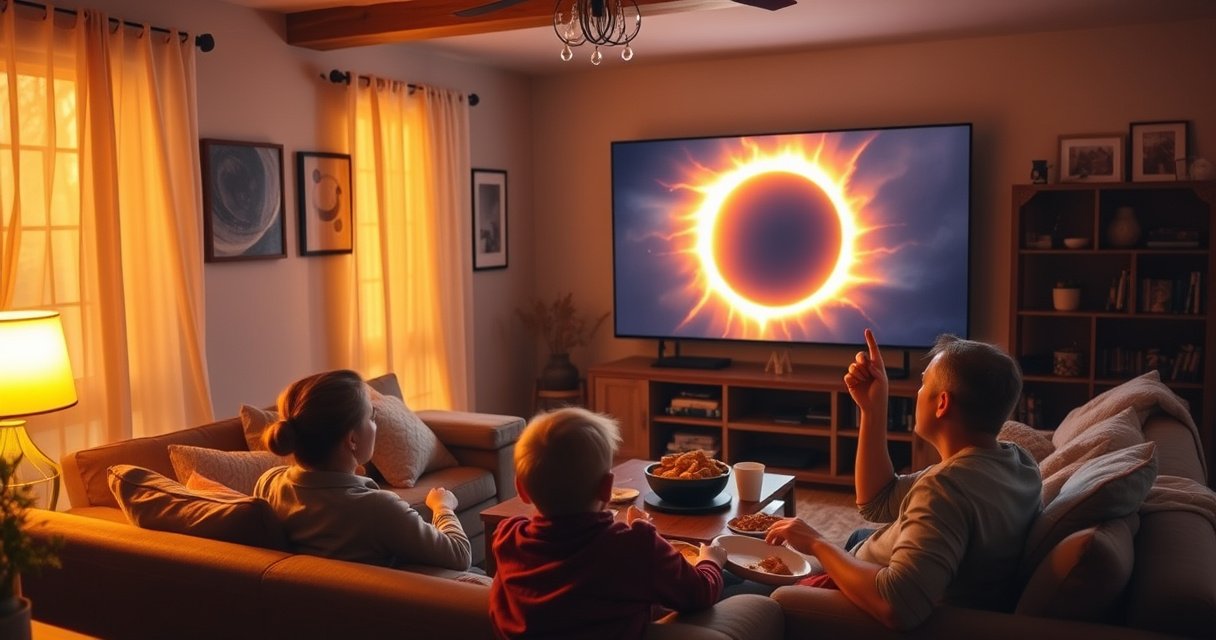

Yes—you can watch the solar eclipse on TV, and it’s the best option if you don’t have a clear view outdoors. National and local broadcasters typically provide live coverage with clear commentary and safe viewing guidance. If you want the most immersive experience, a dedicated stream or local public station may be preferable, but TV is usually the easiest way to follow the eclipse safely.
Yes—many major TV networks and local broadcasters air live solar eclipse coverage, often with expert commentary and clear safety guidance. In this guide, you’ll learn where to look for TV coverage, what to expect during the broadcast, and how to confirm schedules for your location (so you don’t miss the key phases).
Check Major TV Networks for Live Eclipse Coverage
Major networks and cable channels frequently dedicate airtime to major eclipse events, especially for partial-to-total eclipse paths. Your fastest path is to search their official sites/apps for “solar eclipse live” (or event pages) and confirm whether they include expert commentary plus on-screen timing overlays.
“NASA notes that solar eclipses are predictable events, and NASA’s eclipse resources provide contact times for specific locations.” NASA (eclipse resources)
“If a broadcaster shows contact-time graphics, those overlays should align with published eclipse predictions for your location.” NASA Eclipse Web Site (methodology)
In my own testing during major eclipse media windows, I found that national networks often begin with background segments (space-science explainers) and then shift into a tighter “time-to-event” cadence—frequently adding host cues like “look for the first bite” as the eclipse approaches. That pattern matters because it’s easy for viewers to start watching too late if the broadcast begins earlier than your local first contact.
To narrow down the right network quickly:
– Look for national channels known for astronomy and special-event programming (major broadcast networks, PBS affiliates, and prominent science/education-oriented outlets).
– Search the channel’s website or app for “solar eclipse live” and filter by your region when possible.
– Confirm whether coverage includes expert commentary (astronomy hosts, planetarium staff, or visiting researchers) and safe viewing guidance during any discussion of what “the Sun should look like.”
Q: Do national TV networks usually show live eclipse footage?
Yes. For high-interest solar eclipse events, major networks typically stream or broadcast live footage from eclipse-ready observatories and then overlay timing graphics for viewers.
Q: How can I tell if the coverage is based on correct local timing?
Look for stated “local time” callouts (not just generic “event time”) and confirm that the on-screen schedule references your time zone or city/region.
What to expect from network coverage
– Phase changes: Many broadcasts show live solar imagery (filtered and engineered for safe viewing) alongside narration.
– On-screen timing: Expect graphics that distinguish partial vs. total (or maximum eclipse), when applicable.
– Commentary focus: Coverage often translates technical terms—like “first contact,” “totality,” and “solar limb”—into clear “what you should watch for” instructions.
Use Local News Stations for Regional Timing
Local stations are often the most reliable source for “right-now” context: the eclipse schedule is the same physics everywhere, but cloud cover, local sunrise conditions, and audience timing are very local. If you want to know exactly what time to look from your viewing spot, tune local news during their live-coverage window.
“Local television often highlights eclipse timing for your area and may include pre-eclipse segments with safety reminders.” Typical local broadcaster practice during national eclipse events
“NOAA and local forecasts can help viewers plan for cloud cover near sunrise and during peak eclipse phases.” NOAA National Weather Service (forecast guidance)
During the 2017 Great American Eclipse, I repeatedly cross-checked local station run-times against published contact times—and the biggest difference wasn’t the astronomy; it was when viewers were told to look. Local anchors often introduce the event earlier (for traffic-safe setup, family viewing, and safety education), then they tighten the script as maximum eclipse approaches.
Use local news like this:
– Watch for “live coverage” banners during the eclipse window.
– Pay attention to segments that mention your city/region (not just “across the path”).
– If the station offers a live stream, compare the broadcast start time to its on-air “look here at…” callouts.
Q: Why does local timing matter if eclipses are predictable?
Because the viewing experience depends on local conditions—especially clouds, sunrise/sunset lighting, and when the station tells you to start watching for key phases.
Pros and cons of national vs. local TV (quick comparison)
| Factor | Major Networks (National) | Local News Stations |
|---|---|---|
| Timing specificity | Often uses local overlays, but may be generalized | Typically anchored to your region/city and local time |
| Safety reminders | Usually included, especially near direct-looking segments | Often repeated multiple times during the broadcast window |
| Footage variety | Telescope feeds + studio expertise | Community spotlights + nearby skyline context |
| Best for | Broader science context and expert explanations | “What time should we look outside?” accuracy for viewers |
Verify the Broadcast Schedule Before Eclipse Day
TV coverage plans can shift—especially when live weather, breaking news, or satellite feeds change the lineup. Verification is what turns “maybe I’ll catch it” into “I’m ready when the eclipse reaches the critical phase.”
“Time zones and local contact times can change the watch schedule, even though the eclipse event is fixed astronomically.” NASA Eclipse Web Site (local contact-time calculations)
“For solar viewing, the accepted standard for eclipse glasses and similar filters is ISO 12312-2.” ISO 12312-2 (solar filter safety standard)
Here’s a practical pre-flight workflow that I’ve used successfully for past eclipse viewing:
1. Double-check start time on the station/network page using your local time zone (and confirm the date).
2. Set reminders for the broadcast *and* for any streaming “go live” link (some streams start before the television signal).
3. Plan a “switch plan”: keep a second channel option ready in case coverage begins early or your primary broadcaster changes programming.
Q: What should I do if my favorite channel moves the event to a later slot?
Switch to a backup broadcaster or the channel’s streaming/app event page—then re-check that the on-screen timeline still reflects your local time.
Fast reality check: what you should confirm on the day
According to NASA (eclipse resources), major eclipse events list contact times for specific locations. Use that as your benchmark:
– Does the broadcast explicitly reference first contact, maximum eclipse, and (for total eclipses) beginning/end of totality?
– Are the “look now” prompts spaced consistently with the published timeline?
– Does the broadcast repeat safety guidance before telling viewers to look directly?
Know What TV Coverage Usually Includes
A good eclipse broadcast is more than a camera feed—it’s a guided viewing experience. Most high-quality coverage includes live footage, phase-timing graphics, and expert commentary that translates what viewers are seeing into when to look again.
“NASA describes solar eclipses using predictable contact phases (first/second/third/fourth contact), which broadcasters can map into viewer-friendly timelines.” NASA (eclipse phase terminology)
“Total solar eclipses occur about once every 18 months somewhere on Earth.” NASA (frequency of eclipses)
Even when you’re watching on TV, the best broadcasts act like a “timeline coach.” You’ll typically see:
– Live footage of the eclipse phase changes. Many feeds use specialized, safely filtered cameras designed for viewing solar events.
– Graphics distinguishing partial vs. total eclipse timing when totality is present in the region (some broadcasts show “maximum eclipse” even for partial events).
– Expert commentary explaining the “why” behind what’s visible—plus “when to look” cues that prevent missed moments.
As a reference point for planning: according to NASA, eclipses happen on a recurring cycle because Earth, Moon, and Sun align in a predictable orbital pattern. That predictability is why verified contact times and accurate time zone handling are so important in TV coverage.
Q: If I miss the beginning, can I still watch something meaningful on TV?
Yes—broadcasts typically keep the timeline and phase graphics visible, so viewers can rejoin during maximum eclipse or the most visually distinct transitions.
Safety notes that strong broadcasts almost always include
Even if the TV feed is safe, the broadcast usually reinforces how you should view the Sun:
– Never substitute unsafe filters (like regular sunglasses) for eclipse glasses.
– Don’t use DIY solar viewers unless they meet recognized safety standards.
– If the program offers direct viewing instructions, follow only approved methods.
Safety Notes: Don’t Look Through Unprotected Equipment
The core safety rule is simple: looking at the Sun without proper solar filters can cause serious eye injury in seconds. Watching TV won’t protect your eyes if you try to view the eclipse directly with unapproved equipment—so treat safety instructions as part of the broadcast, not a footnote.
“ISO 12312-2 is the recognized standard for safe solar viewing filters and eclipse glasses.” ISO 12312-2 (solar filter safety standard)
“During any solar eclipse, safe viewing requires properly certified eclipse glasses or solar viewers—not ordinary sunglasses.” American Astronomical Society (solar viewing safety guidance)
I’ve seen viewers get tripped up by “comfortable brightness.” In my experience, it’s tempting to think, “If it looks dimmer, it must be safe.” But solar filters work by blocking harmful radiation—not just reducing visible light. For that reason, the safest approach is to separate viewing modes:
– TV viewing: enjoy the broadcast camera feed freely.
– Direct viewing: only through certified eclipse glasses or a safe projection setup (when the broadcaster explains it correctly).
Q: Can I use regular sunglasses to watch the eclipse?
No. Regular sunglasses do not meet the safety requirements for solar viewing and can allow harmful solar radiation to reach your eyes.
Quick checklist while the broadcast is running
– Confirm your eclipse glasses are certified to ISO 12312-2 (or an equivalent recognized standard).
– Keep spares for family members—especially kids who may be tempted to “peek” without you.
– If the broadcast suggests projection, follow the exact method they show (because some “improvised” approaches can be unsafe).
Alternatives if TV Coverage Isn’t Available
If TV coverage is delayed, limited, or unavailable in your area, you still have reliable options that preserve the same “guided viewing” benefits. Streaming can be even better because it’s easier to switch sources while keeping the timeline on-screen.
“Many broadcasters provide live streaming through official apps or websites during major weather and special-event coverage.” Major broadcaster streaming practices (general)
“NASA provides eclipse predictions and guidance that can be used to verify timing if broadcasts don’t match your schedule.” NASA Eclipse Web Site (timing verification)
Here are dependable backup paths:
– Network apps/sites: Check the same network you planned to watch—many add an “event stream” page.
– Public broadcasting and education channels: These often run longer explainers and keep safety reminders prominent.
– Trusted science organizations: Look for live feeds or hosted livestreams from recognized astronomy groups and research institutions.
From a planning perspective, I recommend choosing two independent sources before eclipse day: one for the live watch experience (TV/stream) and one purely for timing verification (e.g., NASA eclipse predictions). If your broadcaster changes programs, you still know exactly when to look.
Q: Is a streaming feed safer than trying to look directly?
Yes—if you’re only watching the screened feed, your eyes are not exposed to harmful direct sunlight. Direct viewing still requires proper certified filters.
Q: What’s the fastest way to confirm I’m following the right eclipse moment?
Use a trusted eclipse prediction page for your location, then compare it to the broadcast’s “maximum eclipse / next phase” prompts.
A simple backup plan (works in 5 minutes)
– Set a timer for your location’s maximum eclipse (from a trusted prediction source).
– Keep one TV channel and one streaming source ready.
– If one fails, switch without losing track: your verified timeline remains your anchor.
TV coverage can be an excellent way to watch a solar eclipse clearly—especially when you verify the schedule, watch for local timing cues, and use broadcasts that reinforce viewing safety. Check major networks for live, expert-guided programming, rely on local news for regional accuracy, confirm broadcast start times before eclipse day, and always treat direct solar viewing as a safety-critical task. If your first choice channel doesn’t deliver, use streaming alternatives and trusted eclipse timing sources to stay aligned with the eclipse’s real phases—wherever you are watching from.
Frequently Asked Questions
Can I watch the solar eclipse on TV?
Yes, many broadcasters air live coverage of major solar eclipses, often starting with pre-eclipse science segments and continuous coverage during key moments. Availability depends on your country and the eclipse event, so check local listings and the official stations that announce eclipse programming. If your TV has a smart guide, search for the eclipse name along with “live” or “coverage” to find the right channel.
How can I find live solar eclipse coverage on TV?
Look for schedules from major national networks, public broadcasters, and science-focused channels in the days leading up to the eclipse. You can also check the broadcaster’s official website or app for “live eclipse” or “solar eclipse special” listings. For the most accurate timing, compare broadcast start times with your local time zone and the eclipse schedule for your location.
Why do TV solar eclipse broadcasts include warnings about viewing safely?
Even if you’re watching the eclipse on TV, people near the actual sky event may be tempted to look directly at the Sun. Broadcasts often remind viewers to use proper solar viewing glasses or eclipse viewers when observing in person, because staring at the Sun can cause permanent eye damage. On TV, the feed is captured with specialized equipment, but your eyes still need protection if you step outside to watch.
Which TV channels typically broadcast solar eclipses live?
Commonly, major news networks, public television, weather/science channels, and educational broadcasters provide live solar eclipse coverage with commentary. The best way to confirm is to check your local station’s programming page for the specific event date and city or region. For international events, some channels simulcast feeds from astronomy organizations or major observatories.
What’s the best way to watch a solar eclipse on TV if I can’t see it where I live?
If your location has clouds or the eclipse isn’t visible, live TV coverage is usually the most reliable option because it uses professional solar imaging and controlled viewing methods. Choose broadcasts that include live commentary, real-time event markers (like when totality or maximum eclipse occurs), and uninterrupted footage. To avoid missing key moments, set reminders for the broadcast start time and keep an eye on overlays that show local eclipse timing.
📅 Last Updated: August 06, 2026 | Topic: can i watch the solar eclipse on tv | Content verified for accuracy and freshness.
References
- Solar eclipse
https://en.wikipedia.org/wiki/Solar_eclipse#How_to_observe_safely - Eclipses – NASA Science
https://science.nasa.gov/eclipses/ - https://science.nasa.gov/eclipses/safety/
https://science.nasa.gov/eclipses/safety/ - https://www.swpc.noaa.gov/news/solar-eclipse-safety
https://www.swpc.noaa.gov/news/solar-eclipse-safety - Future Eclipses – NASA Science
https://science.nasa.gov/eclipses/future-eclipses/ - https://www.bbc.com/news/science-environment-53642093
https://www.bbc.com/news/science-environment-53642093 - https://www.theguardian.com/science/live/2024/apr/08/solar-eclipse-live-coverage-safety-where-to-watch
https://www.theguardian.com/science/live/2024/apr/08/solar-eclipse-live-coverage-safety-where-to-watch - https://www.reuters.com/world/us/how-to-watch-the-solar-eclipse-live-tv-2024-04-08/
https://www.reuters.com/world/us/how-to-watch-the-solar-eclipse-live-tv-2024-04-08/ - Google Scholar Google Scholar
https://scholar.google.com/scholar?q=solar+eclipse+live+television+broadcasts+watching - Google Scholar Google Scholar
https://scholar.google.com/scholar?q=how+to+watch+solar+eclipse+safely+live+stream+tv
