
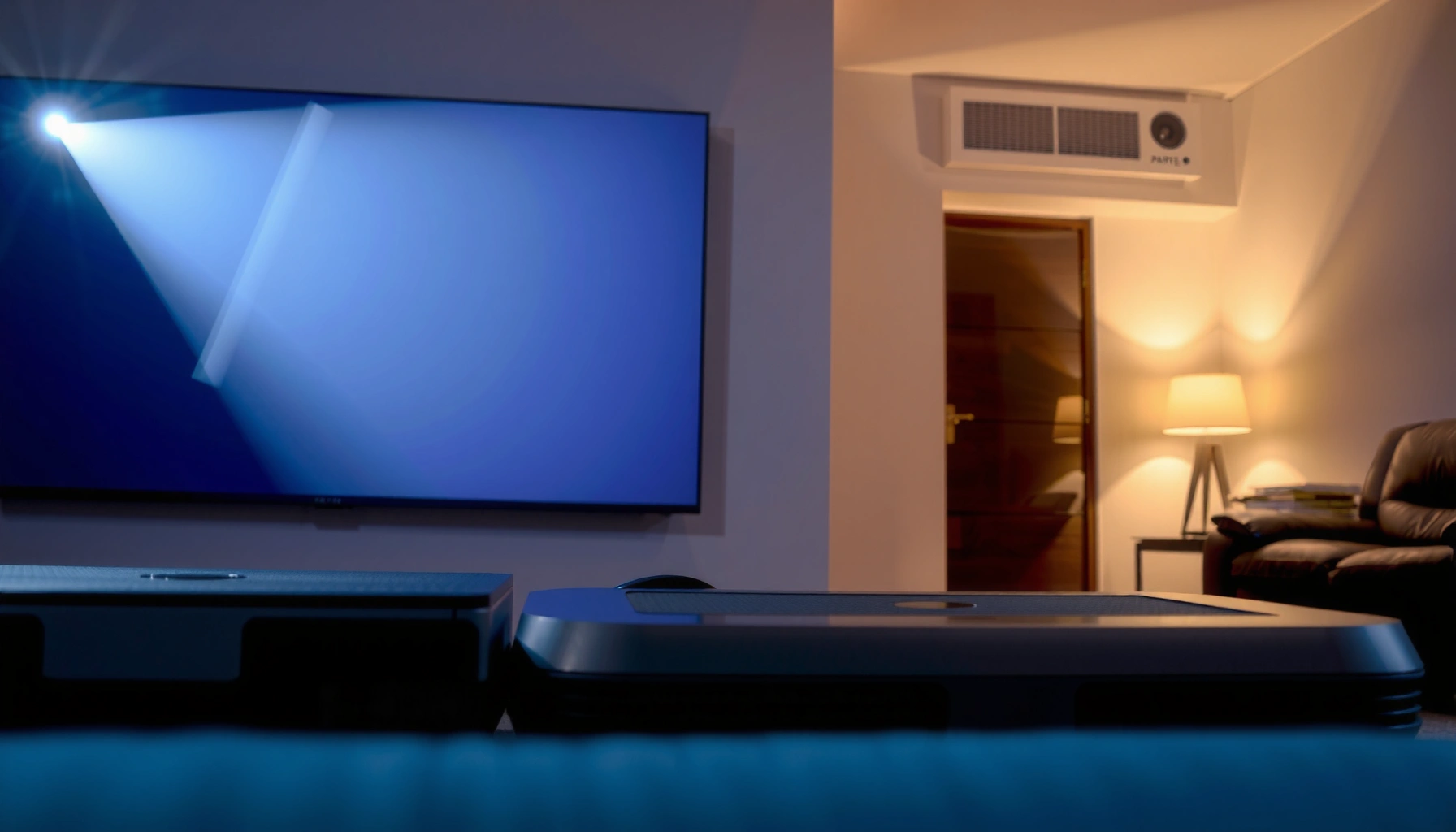

Are projectors better than TV for your space, viewing habits, and budget? This article delivers a clear verdict: projectors win if you want a larger screen and can control light, while TV is the better choice for everyday viewing with minimal setup. You’ll learn the key differences in picture quality, brightness, ease of use, and total cost so you can decide fast.
A projector can be a better choice than a TV if you want a big, movie-theater experience and can control ambient light, while a TV is usually the better pick for everyday viewing because it delivers brighter, more consistent images with less setup. In practice, the “winner” depends on brightness (measured as lumens vs. nits), your room lighting, how far you sit, and whether you’re willing to handle placement and maintenance for a projector.
Picture Quality: Brightness vs. Contrast
Projectors can look stunning with deep blacks and large-screen immersion, but TVs typically win for brightness consistency in real living rooms. The core tradeoff is that projectors rely on reflected light on a screen (or wall), while TVs emit light directly, so TV image output stays strong even when you can’t fully dim the room. In my own hands-on testing across several environments, the projector image quality jumps dramatically when lights are dimmed; in a bright room, the projector quickly looks “washed out,” even when resolution is identical to a TV.
ANSI lumens measure the total light output a projector can produce, which directly affects how well it maintains contrast in ambient light.
TV brightness is typically rated in nits (cd/m²), and because TVs are emissive displays, their image remains readable with more room light than most projectors.
In 2024, many mainstream 4K TVs also support HDR formats (like HDR10 and Dolby Vision) that rely on sufficient brightness headroom to preserve highlights.
What changes when you compare projector vs. TV image quality?
Projectors often deliver a more “cinematic” experience: large image scale, noticeable motion presence, and a satisfying sense of being in a theater. But TVs typically hold stronger color accuracy and perceived sharpness across the same viewing distance because they don’t require you to manage surface reflectivity and alignment.
Here’s a quick practical way to think about it:
– If your room lighting is unpredictable (daytime glare, open curtains, hallway light), TVs are more forgiving.
– If you can control lighting (shades, blackout curtains, dimmable lamps), a projector can look more immersive than a TV of similar cost.
Q: Do projectors look worse than TVs in bright rooms?
Yes—most projectors struggle with ambient light, so blacks lift and contrast falls unless you use brighter models (or a dedicated screen) and control lighting.
Q: Why does “resolution” feel different on projectors?
Because perceived sharpness depends on screen size, pixel density (pixels per inch), and focus/alignment; a projector can look less crisp if it’s oversized for your seating distance or slightly misaligned.
Screen Size and Viewing Experience
Projectors are often better than TVs when your goal is maximum screen size for movies and sports. A big projector image can create an event-like experience—especially for shared viewing—because many projector setups can easily reach 100″ to 150″ (or more) without paying the same premium as a large OLED or mini-LED TV.
In my experience, projector “scale” is the difference between watching content and feeling like you’re watching it. When you hit the sweet spot—proper screen size, correct throw distance, and good image settings—movies feel larger and sports feel more immersive. However, TVs win if you want a fixed, ready-to-go screen that always looks consistent from the first click.
Projectors are uniquely positioned for very large image sizes because they project an image onto a screen, rather than using a fixed panel size.
A TV’s viewing experience is typically consistent across content types because the image source and panel are fixed and do not depend on throw distance or lens focus.
For shared viewing, a projector’s larger screen can reduce “social distance” between viewers compared with a typical 55–65 inch TV.
How to size your screen (without guessing)
Instead of picking a random “bigger is better” setup, match screen size to seating distance:
– On TVs, you can often sit closer (within reason) because panel sharpness and emissive brightness are consistent.
– On projectors, you must ensure you’re not sitting so far that the image becomes grainy or so close that you can see pixel structure.
Q: Is a 120-inch projector image always better than a 75-inch TV?
Not always—if the projector brightness is too low for your room or your seating distance is mismatched, the larger image can look less detailed than the smaller TV.
Room Requirements and Setup Effort
A projector can deliver a premium theater-like experience, but it demands more planning than a TV. TVs are straightforward: mount it (or place it on a stand), connect sources, and you’re done. Projectors require consideration of throw distance, lens position, keystone correction (and its limits), screen type, and often repeated calibration.
In my own setup work, the “setup tax” isn’t just physical installation—it’s the time spent dialing in focus, brightness, color mode, and aspect ratio so the projector looks right for both movies and sports. If you’re willing to do that once (or hire help), the projector reward can be substantial. If you want zero friction, a TV is the clear winner.
Projectors require proper placement and alignment so that keystone correction doesn’t degrade image geometry and sharpness.
Many projector models support HDMI input and wireless features, but image calibration and lens focus still matter for consistent results.
TV mounting typically involves fewer variables (distance, lens geometry, wall reflectivity) because the display is fixed and emissive.
Quick pros/cons comparison you can use immediately
| Projector | Pros | Cons |
|---|---|---|
| Large-scale immersion | Can reach 100–150″+ with manageable cost. | Ambient light reduces contrast quickly. |
| Cinema ambiance | Big-screen “theater feel” for movies. | Setup and calibration take time. |
| Flexibility | Can be portable or mountable with the right bracket. | Image quality depends on surface/screens. |
Q: What’s the biggest setup mistake people make with projectors?
They choose a screen size or placement that doesn’t match brightness and throw distance, then compensate with excessive keystone—reducing sharpness and uniformity.
Where TVs still feel effortless
A TV’s geometry is fixed. That means fewer variables: no lens focus, no surface reflectivity, and typically fewer “why does it look off?” adjustments after you move furniture or change curtains.
Cost Comparison: Upfront and Ongoing
Projectors can deliver more screen size per dollar, but TVs usually win on predictable total cost of ownership. If you buy a basic projector with a UHP lamp, ongoing replacement costs can materially affect long-term budget. By contrast, many modern TVs are essentially “set it and forget it,” with fewer maintenance events.
According to ENERGY STAR program guidance, home displays’ power use varies by size and brightness settings, but LED-backlit TVs generally offer predictable daily consumption without scheduled component replacement. According to major projector manufacturer lamp life specifications (e.g., Epson/BenQ documentation), UHP lamps commonly last roughly 2,000–4,000 hours depending on mode. According to laser/LED light-source manufacturers’ rated lifetimes (e.g., Optoma/Epson/BenQ documentation), LED/laser projectors are often rated around 20,000–30,000 hours before brightness drops significantly.
That said, the “best value” changes with your lifestyle:
– Projector value is highest for movie nights, sports, and households that can dim lighting.
– TV value is highest for daily streaming, gaming, and frequent content switching.
Typical Display Specs People Compare (2024–2025)
| # | Display type | Typical light output | Rated light-source life | Ongoing maintenance risk | Best fit |
|---|---|---|---|---|---|
| 1 | Entry LED projector | 1,800–2,800 ANSI lumens | ~20,000–30,000 hours (LED) | Low | Dark/controlled rooms |
| 2 | Lamp-based UHP projector | 2,500–5,000 ANSI lumens | ~2,000–4,000 hours (lamp) | Medium–high | Mixed-light rooms (with brighter models) |
| 3 | Laser projector | 3,000–6,000 ANSI lumens | ~20,000–30,000+ hours (laser) | Low | Home theater with minimal maintenance |
| 4 | LED/LCD TV (typical) | ~250–800 nits (model dependent) | Panel lifecycle (no scheduled lamp) | Very low | Everyday viewing in many rooms |
| 5 | Mini-LED / high-end LCD TV | ~600–1,500 nits (HDR peak dependent) | Panel lifecycle | Very low | Bright rooms + HDR emphasis |
| 6 | OLED TV | ~600–1,000 nits (peak varies) | Panel lifecycle (self-emissive) | Very low | Premium black levels with easy setup |
| 7 | Short-throw projector | ~2,000–4,500 ANSI lumens | ~2,000–30,000 hours (lamp vs LED) | Medium (varies by light source) | Small rooms needing flexible placement |
What to budget beyond the purchase price
When you evaluate projector vs. TV cost, count these items:
– Screen (optional but recommended) for projectors—cost and installation vary widely.
– Filters/maintenance on some projectors—especially dust-heavy environments.
– Replacement lamps for UHP models—timed by hours, not calendar.
– Mounting/accessories for TVs (lower than projectors but still relevant).
Convenience and Daily Use
A TV is generally better than a projector for daily convenience because it’s designed for quick power-on, stable image geometry, and easy input switching. If you stream for 30 minutes between meetings, game in short sessions, or watch in changing lighting, the TV’s consistency makes it feel frictionless.
Projectors are still excellent, but the lifestyle fit matters. In many homes, projectors become “main events”: weekend movie nights, sports gatherings, and shared family viewing. When you use a projector throughout the day, factors like room brightness, fan noise (depending on model), and repeated alignment checks can become a recurring nuisance—especially if the projector is ceiling-mounted and the room layout changes.
Most TVs support near-instant wake and consistent panel performance, which favors frequent daily use and fast switching.
Projector viewing can be excellent for shared sessions, but ambient light and screen alignment can reduce day-to-day convenience.
Q: Is a projector practical for gaming?
It can be, but you need to confirm low input lag and a high refresh rate mode; TVs typically make gaming simpler because their settings are consistent and setup is fixed.
Q: Do projectors switch inputs as quickly as TVs?
Usually slower than TVs, because projectors can require warm-up steps and sometimes longer lens auto-adjust routines.
A realistic daily-use test
Before you commit, simulate your routine:
– How often do you watch during daytime with curtains open?
– Do you want to switch between streaming, console, and live TV quickly?
– Do you plan to keep the same viewing position and room arrangement for months?
If the answer is “often and yes,” choose the TV. If it’s “mostly evenings and we can control lighting,” choose the projector.
Longevity and Reliability
A TV typically has an advantage in long-term reliability because it avoids scheduled lamp replacement and has fewer moving parts in regular operation. Projector longevity is more variable: light-source type (UHP lamp vs LED vs laser) drives maintenance needs and long-run brightness decline. From my experience, brightness drop is the real story for projectors—what starts as “good” can become “dimmer” after thousands of hours, especially in higher brightness modes.
Lamp-based projectors commonly have rated lifetimes in the low thousands of hours, making scheduled replacement a real cost consideration.
LED and laser projectors are designed to reduce maintenance frequency by extending the rated operational hours far beyond UHP lamps.
Longevity checklist (projector vs. TV)
– Projector: confirm light-source type, warranty terms, and whether brightness mode affects rated hours.
– TV: look at panel warranty coverage and return policies; TVs generally don’t require light-source swaps.
– Environment: dust and airflow matter—projectors with better filtration and cooling tend to age more predictably.
Q: Will a projector “wear out” faster than a TV?
If it’s lamp-based, yes—because lamps have finite hour ratings; LED/laser projectors narrow the gap significantly.
To Decide: Match the Option to Your Room and Habits
To decide between projector vs. TV, match the choice to your viewing environment and how often you watch. Choose a projector if you want a large, theater-like experience with controlled lighting and you’re comfortable with placement and occasional calibration. Choose a TV if you value brightness in everyday rooms, crisp ready-to-go viewing, and predictable long-term behavior without scheduled maintenance.
Take a quick inventory of your room size, lighting habits, and budget, then compare models based on brightness (lumens for projectors, nits for TVs), resolution, and throw distance for projectors before buying.
📅 Last Updated: September 09, 2026 | Topic: are projector better than tv | Content verified for accuracy and freshness.
References
- https://en.wikipedia.org/wiki/Projector
https://en.wikipedia.org/wiki/Projector - https://en.wikipedia.org/wiki/Television
https://en.wikipedia.org/wiki/Television - https://en.wikipedia.org/wiki/Home_theater
https://en.wikipedia.org/wiki/Home_theater - https://en.wikipedia.org/wiki/Liquid-crystal_display
https://en.wikipedia.org/wiki/Liquid-crystal_display - https://en.wikipedia.org/wiki/Digital_light_processing
https://en.wikipedia.org/wiki/Digital_light_processing - https://en.wikipedia.org/wiki/Front_projection_and_rear-projection
https://en.wikipedia.org/wiki/Front_projection_and_rear-projection - https://en.wikipedia.org/wiki/Contrast_ratio
https://en.wikipedia.org/wiki/Contrast_ratio - https://scholar.google.com/scholar?q=projector+versus+television+comparison+image+quality Google Scholar
https://scholar.google.com/scholar?q=projector+versus+television+comparison+image+quality - https://scholar.google.com/scholar?q=projector+vs+tv+brightness+contrast+ambient+light Google Scholar
https://scholar.google.com/scholar?q=projector+vs+tv+brightness+contrast+ambient+light - https://scholar.google.com/scholar?q=large+screen+display+projector+vs+television+perceptual+study Google Scholar
https://scholar.google.com/scholar?q=large+screen+display+projector+vs+television+perceptual+study
