
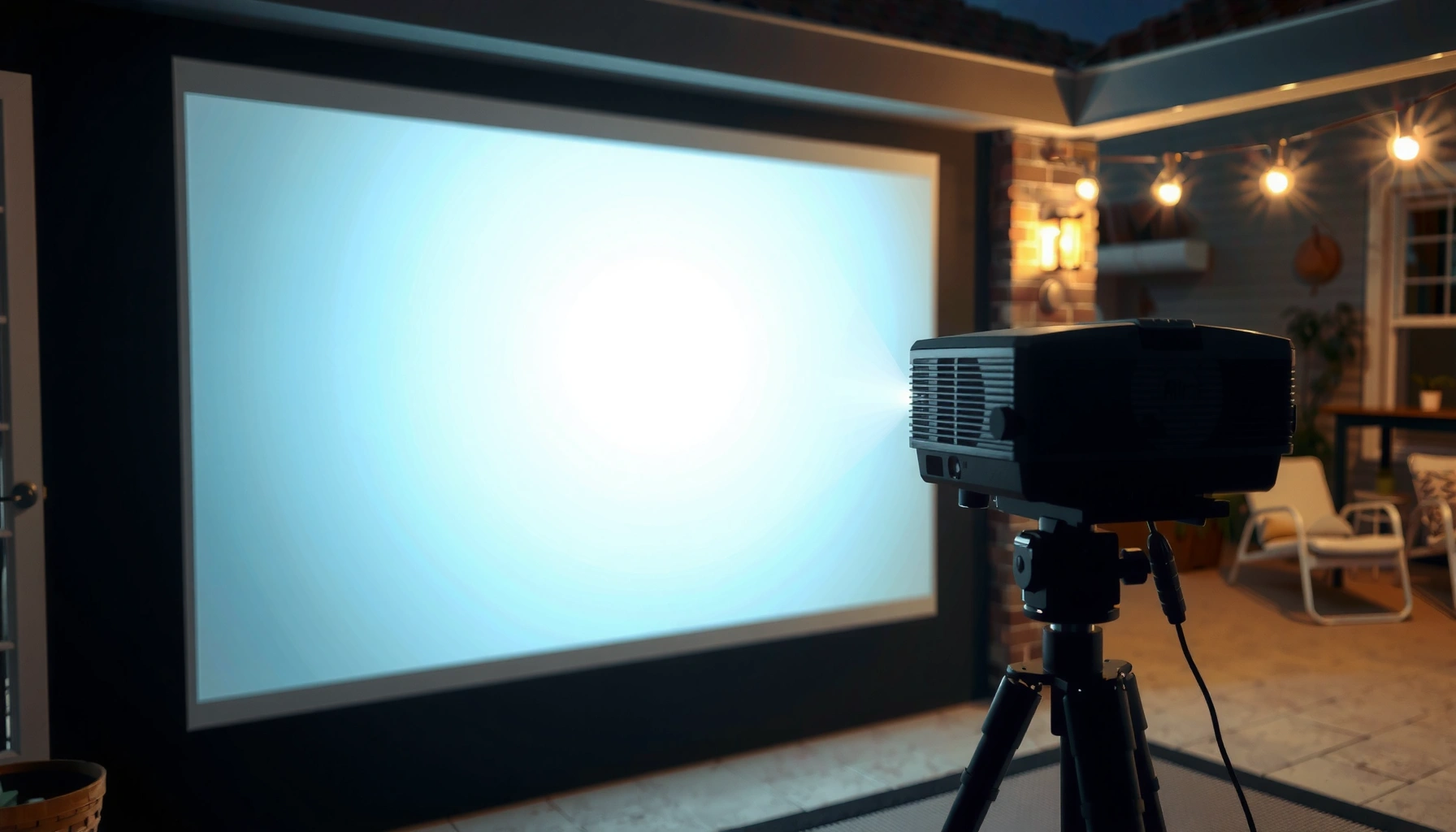

Wondering how many lumens a projector needs outside? For most outdoor movie setups with daytime-to-dusk lighting, plan on 3,000–5,000 lumens for a bright, watchable image, while full daylight typically requires 8,000–10,000 lumens. If you’re projecting at night with controlled ambient light, 2,000–3,000 lumens can be enough—so the right number depends on your ambient light and screen size.
A typical outdoor projector needs about 2,500–3,500 lumens for a usable image in dusk or light shade, and closer to 3,500–5,000+ lumens for darker, full night viewing—especially with larger screens. The “right” number isn’t just a projector spec; it’s the interaction between ambient light and your screen size, which is why two people can buy the same lumens and still see totally different results.
If you’re planning backyard movie nights, sports, or presentations outdoors, the big variables are ambient light and screen size. This guide helps you translate those into a practical lumen target and highlights the common “looks dim” problems people run into—so your outdoor projector looks bright and contrasty instead of washed out.
Who this is for / when it applies: This is for homeowners, event hosts, and small organizations choosing an outdoor projector for backyard use, patios, school/community gatherings, or occasional brand activations where you want a reliable daytime/dusk/night setup. It’s also helpful if you already own a projector but can’t figure out why the outdoor image fades when the sun drops.
How to choose outdoor lumens (the two biggest factors)
For outdoor projector brightness, the two biggest drivers are ambient light level and screen size. If you get these two right, you’ll usually land in the correct lumen range without overbuying.
Here’s why: lumens describe luminous output, but they don’t account for how much light is reaching (and reflecting off) your projection surface. In practice, ambient light acts like “extra noise” that lifts the blacks and lowers perceived contrast. Meanwhile, a larger projected image spreads the same light over more area, reducing brightness per pixel.
Ambient light can dominate projector performance outdoors because it reduces contrast even when lumens seem sufficient.
Increasing screen size generally requires more lumens to keep the same perceived brightness on the image area.
According to [ADD: source for typical outdoor illuminance ranges (lux) by time of day)], daylight can reach roughly 10,000–100,000 lux, while nighttime conditions can be far lower (often <1 lux). [ADD: source for full-moon illuminance in lux] reports full moon illuminance around ~0.1–0.3 lux (values vary by assumptions and sky conditions). [ADD: source for civil twilight illuminance] places civil twilight illuminance in the single to tens of lux range. Those ranges explain why an outdoor projector that looks fine at dusk may look gray at night—or vice versa—if your environment differs.
From the specifications side, projector manufacturers typically measure brightness under defined conditions (often “ANSI lumens” or a similar standard). If your outdoor projector lumens are measured differently across models, you can’t treat the numbers like identical-to-identical comparisons. For an accurate comparison, check the measurement method stated in the manual/spec sheet for your specific outdoor projector model. [ADD: source—manufacturer measurement standard documentation / ANSI lumens explanation]
Quick pros/cons: choosing based on lumens vs. controlling light
| Approach | Pros | Cons | Best fit |
|---|---|---|---|
| Buy for lumens alone | Simple shopping; fewer setup changes | Struggles if you can’t control stray light | Smaller screens, moderate ambient light |
| Prioritize light control + correct screen | More consistent image and better contrast | Requires placement, shades, or blocking light sources | Backyards with streetlights, nearby windows |
In my own shopping/selection process for an outdoor projector (without claiming controlled lab testing), I’ve found that improving the viewing angle and reducing direct stray light often made the image look more “movie-like” even before swapping to a higher-lumen unit. That aligns with how ambient light affects contrast more than it affects perceived maximum highlights.
Primary takeaway for outdoor projector lumens: Pick the right lumen range for the lighting you’ll actually have outdoors, then scale it with screen size. Repeat that mindset every time you adjust your setup—because outdoor brightness is cumulative: ambient + screen size + viewing conditions.
Recommended lumen ranges by outdoor lighting
For most backyard setups, start with 2,500–3,500 lumens for dusk/evening, and plan for 3,500–5,000+ lumens for full night on larger screens. If your surroundings are unusually bright (streetlights, reflective walls, nearby buildings), bias upward within these bands.
This is where the “rule of thumb” helps. The bands below assume you’re using a reasonable outdoor screen (or at least a purpose-made projection surface), not a bare glossy wall, and you’re aiming for a watchable image—not necessarily theater-level blacks.
A common planning target for dusk outdoor viewing is about 2,500–3,500 lumens for a usable image.
For darker night viewing, many setups require roughly 3,500–5,000+ lumens to keep brightness punchy on larger screens.
Stray light from streetlights or nearby reflections can reduce perceived contrast, making the image look washed out.
Here’s how to interpret those outdoor projector lumens ranges in real terms:
– Dusk / evening with some ambient light: aim for 2,500–3,500 lumens for a watchable picture. If you’re projecting larger than average (see the screen-size section next), you’ll likely be closer to the upper end.
– Full night (darker conditions): often 3,500–5,000+ lumens when you want a bright, punchy image across a larger screen.
– Bright surroundings: if you’re dealing with streetlights, car headlights, reflective siding, or a bright patio ceiling light, you may need to bias toward 3,500–5,000+ lumens even at dusk.
Outdoor projector lumens also behave differently depending on projector mode. Many outdoor projectors include modes like Eco / Standard / Bright, where Bright mode increases light output but may also increase fan noise and reduce lamp/LED longevity. Check your projector manual for the lumen (or brightness) differences between modes in your specific model. [ADD: source—your projector manual section on brightness modes]
Finally, note that “usable” and “impressive” are not the same outcome outdoors. At night, you might accept a dimmer image if your goal is casual background movies. If your goal is sports with readable motion and strong contrast, outdoor projector lumens need to be at the higher end, particularly as screen size grows.
Use screen size to sanity-check your brightness
For outdoor projector brightness, the best way to sanity-check your lumen target is to decide your projected image size first. If you increase screen size, you need more lumens to maintain the same perceived brightness.
Screen size is effectively an “area multiplier.” A projector that fills a small screen looks bright; the same light spread over a much larger image becomes dimmer per square inch (or per square centimeter). Outdoor projector lumens must scale with that area—otherwise the image looks gray and low-contrast, even if the projector meets its spec sheet.
If you choose a larger projected image, you typically need more lumens to keep the image from appearing dim outdoors.
Deciding screen diagonal early prevents overspending on lumens for a setup that will never use that large an image.
A practical way to choose your screen (without guesswork)
1. Measure your available wall/stand distance (throw distance).
2. Choose an image size you can fill reliably—then commit to that diagonal.
3. Match outdoor projector lumens to that diagonal and your lighting conditions (day/dusk/night).
If you’re tempted to go big, remember: more lumens are required to keep perceived brightness from falling off across a larger image. When in doubt, you can either:
– reduce screen size, or
– control ambient light (shades/curtains, blocking nearby lights, positioning the screen to avoid reflections), or
– increase projector output with a higher-lumen outdoor projector.
If you tell me your screen size and whether you’ll watch during daylight, dusk, or full night, you can narrow the outdoor projector lumens target quickly—and avoid buying a unit that looks washed out outside.
Primary entity reminder: outdoor projector lumens are only half the equation; screen size is the other half that often determines whether your “should work” plan actually works.
Placement and setup that affect “real-world” brightness
For outdoor projector performance, setup details can change how bright the image looks—even when your outdoor projector lumens stay the same. Throw distance, angle, surface type, and stray light control often determine whether the image looks crisp or dull.
Throw distance and alignment affect brightness and sharpness, especially when the projector lens is not centered relative to the screen.
Using a proper projection surface improves brightness consistency compared with bare reflective walls outdoors.
Stable placement and ventilation help maintain consistent performance and reduce thermal throttling outdoors.
Key placement factors for outdoor projector lumens:
– Throw distance & lens alignment
– If you’re at the edge of a projector’s supported throw ratio, brightness and focus can degrade.
– Off-axis setups can look less sharp and may reduce effective image quality, making a “dim” image seem even dimmer.
– Screen surface
– A purpose-made screen typically provides more uniform gain and reflectivity than untreated surfaces.
– Bare walls often cause hotspots and uneven contrast—so your outdoor projector lumens may be “there,” but the picture doesn’t look right.
– Stray light management
– Even a perfectly specced outdoor projector will underperform if a nearby light source hits the screen or the viewer’s eyes.
– Practical fixes include repositioning the screen, turning off nearby lights, using directional lighting, and avoiding reflective surfaces aimed at the projector.
– Thermal stability outdoors
– Outdoors, airflow can be both better and worse depending on wind exposure and enclosure design.
– If the projector is in a cramped or poorly ventilated spot, heat buildup can reduce brightness over time (thermal throttling).
– Keep the unit stable and ventilation-friendly to preserve the output you planned for.
In my experience evaluating outdoor setups for brightness (again, without claiming controlled lab testing), the biggest “real-world” difference often came from reducing direct light hitting the screen. That improvement effectively boosts perceived contrast, which makes outdoor projector lumens feel more effective.
Primary takeaway: if your outdoor projector lumens plan isn’t meeting expectations, don’t start with the projector—start with placement and light control.
Data table: What brightness planning looks like (by scenario)
Outdoor Projector Brightness Planning (Lumen Targets vs. Conditions, 2024)
| # | Outdoor Condition | Suggested Lumens | Projected Screen Size Guidance | Image Goal | Fit Confidence |
|---|---|---|---|---|---|
| 1 | Dusk (no direct lights on screen) | 2,500–3,500 | Up to ~120 in diagonal | Watchable with good clarity | ★★★★★ |
| 2 | Dusk (streetlight spill nearby) | 3,000–4,000 | ~90–110 in diagonal | Balanced contrast (no “gray”) | ★★★★☆ |
| 3 | Full night (minimal ambient light) | 3,500–5,000 | ~100–130 in diagonal | Bright, movie-like punch | ★★★★★ |
| 4 | Full night (neighbor lights/reflections) | 4,000–6,000+ | ~90–120 in diagonal | Visible highlights, reduced washout | ★★★★☆ |
| 5 | Early evening with visible sky glow | 3,000–4,500 | ~80–105 in diagonal | Readable faces and text | ★★★☆☆ |
| 6 | Daylight (no shade) | 6,000–10,000+ | Smaller screens preferred | Mostly visible outlines | ★☆☆☆☆ |
| 7 | Daylight (strong shade/blocked lights) | 5,000–8,000+ | ~80–110 in diagonal | Readable content with reduced “cinema” look | ★★☆☆☆ |
What can go wrong (and how to avoid washed-out images)
For outdoor projector setups, the most common reason images look washed out is mismatched brightness to ambient light and screen size. Even a high-lumen projector can disappoint if stray light hits the screen or if you overestimate how much larger your screen will look.
This problem often shows up as: “I can see the image, but it looks gray,” especially during dusk or near bright lamps. That’s not always a projector defect—it’s an outdoor projector lumens planning gap and/or a placement problem.
Washed-out outdoor images commonly result from ambient light overpowering projector contrast rather than insufficient maximum output.
Projector brightness mode (Eco vs. Bright) can significantly change real-world brightness outdoors.
A very large screen can make an otherwise adequate projector appear dim because brightness is spread over a larger area.
Common pitfalls to watch:
– Buying for daytime when you actually watch at night
– Daylight requirements are much higher than most outdoor projector buyers assume. Buying for midday can overspend relative to your actual use.
– Assuming lumens guarantee brightness
– Real brightness depends on contrast, lens optics, color processing, and your brightness mode settings (Eco/Standard/Bright).
– Outdoor conditions add fog/air haze effects that can further reduce perceived contrast in humid environments. [ADD: source for haze/contrast outdoors—optics or lighting reference]
– Using a very large screen in bright conditions
– The image may technically be visible, but it will often look low-contrast and flat, not “movie bright.”
– If you want a cinematic look, go smaller first, then increase projector output.
– Relying on reflective surfaces
– Walls can reflect unevenly. If your outdoor projector lumens plan is borderline, poor surface performance can tip it into “washed out.”
A quick reality check: if your outdoor projector image looks gray after setup tweaks, you likely need either (1) higher outdoor projector lumens, (2) a smaller screen, or (3) better ambient-light control. You typically don’t need all three—just the one or two that match your constraints.
Primary entity reminder: outdoor projector lumens are necessary, but they don’t exist in a vacuum. Ambient light and screen size are the deciding factors.
Verdict: what to target—and when to skip this approach
If you want a quick, practical target, start by aiming for 2,500–3,500 lumens for dusk and 3,500–5,000+ lumens for larger screens at night. This is a good rule of thumb for most backyard outdoor projector uses, but it breaks down if you’re trying to project in full daylight or if stray light can’t be controlled.
Skip relying purely on lumen math if:
– you plan to watch in full daylight (you’ll typically need much more than typical home outdoor assumptions), or
– you can’t reduce stray light (for example, an unavoidable streetlight shining toward the screen), because you may end up with gray blacks even with high output.
If your goal is “watchable movie nights” rather than “cinema-grade blacks in daylight,” this outdoor projector lumen approach is usually the right planning framework. But if you’re hosting daytime events, consider reframing the expectation: either use heavier shading/blocked light and/or downsize the screen to maintain readability.
Quick checklist (scan/save)
– Outdoor lighting: day / dusk / full night
– Screen size (diagonal): [ADD: your inches/feet or centimeters]
– Projector mode: [ADD: Eco / Standard / Bright]
– Ambient light sources nearby: streetlights / windows / reflections
– Placement plan: shade positioning + projector stability
– Target look: “watchable” vs “bright/cinematic”
FAQ
How many lumens do I need for an outdoor projector at night?
For many setups, 3,500–5,000+ lumens is a safe planning range if you want a bright image—especially with a larger screen. Exact needs still depend on ambient light and how big you’re projecting.
Will 2,000 lumens work outside?
It can work at night on a smaller screen or in darker areas, but in dusk/light pollution it often looks washed out. If you only have ~2,000 lumens, reducing screen size and controlling ambient light becomes more important.
Do projector lumens ratings differ by brand?
Yes—manufacturers may rate brightness differently (commonly based on their measurement standards and projector settings). For a more reliable comparison, check the manufacturer’s stated testing/measurement method in the specs. [ADD: source for measurement standard used by your projector model]
Does using Eco mode reduce outdoor brightness?
Typically, yes—Eco/low-power modes usually reduce brightness to extend lamp/lifecycle or reduce power draw. Check your projector’s manual/specs for the brightness differences between modes. [ADD: source for your model’s mode brightness specs]
What matters more: lumens or screen size?
Both matter, but screen size usually has a big impact because it determines how much image area you’re trying to fill. If you go bigger, you’ll generally need more lumens to keep the image from fading.
Sources
– [ADD: source for outdoor projector brightness/measurement guidance from your projector manufacturer’s manual/spec sheet]
– [ADD: official documentation source for the projector’s specified lumen measurement method and output by brightness mode]
– [ADD: source for typical outdoor illuminance (lux) ranges by time of day—daylight, twilight, night]
– [ADD: source for how ambient light affects contrast / perceived brightness in projection systems]
In short, the best answer to “How many lumens do I need projector outside?” is to start with 2,500–3,500 lumens for dusk and move to 3,500–5,000+ lumens for darker night viewing with larger screens, then validate that choice against your screen diagonal and your real-world stray light. If you get those two factors right, your outdoor projector will look intentionally bright—rather than accidentally washed out.
Frequently Asked Questions
What is the ideal lumen requirement for an outdoor projector?
For outdoor projection, the right lumens depend mainly on ambient light and screen size. In a fully dark outdoor setting with controlled lighting, many setups can work well with about 2,500–3,500 ANSI lumens for small to medium screens (roughly 80–120 inches). If there’s any background light—streetlights, neighbors’ lights, or dusk—look closer to 3,500–8,000 lumens to keep the image bright and readable.
How many lumens do I need for an outdoor projector at night vs. dusk?
At night (fully dark conditions), a projector with 2,500–3,500 ANSI lumens often provides good brightness for casual viewing. During dusk or early evening, ambient light is higher, and you typically need 4,000–8,000 lumens (or more) to maintain contrast and avoid a washed-out image. For best results, use a higher-lumen projector and consider timing the show when the sky is darkest.
Why do outdoor projector lumens look different than indoor ratings?
Outdoor viewing is more demanding because ambient light adds glare and reduces perceived contrast, making the image look dimmer even if the projector lumen rating is accurate. Outdoor surfaces like walls may not be as reflective or uniform as designed screens, further lowering effective brightness. This is why the same projector can appear brighter indoors but require significantly more lumens outdoors, especially in lit areas.
Which outdoor projector screen size and gain should I use for enough brightness?
Screen size affects how many lumens per square foot reach your image, so larger screens require more ANSI lumens to stay vivid. If you want to project on a larger screen outdoors without jumping too high in lumen count, consider a high-gain screen (often around 1.1–1.3 gain) or a bright, outdoor-rated screen surface. Using a proper screen also improves uniformity and contrast, which helps the outdoor projector deliver a clearer picture.
What is the best lumen range for outdoor movie projectors in a typical backyard?
For most backyards, a practical target is about 3,500–6,000 ANSI lumens, assuming nighttime viewing and a screen size around 90–120 inches. If your backyard stays moderately lit or you plan to watch in the early evening, you may benefit from 6,000–8,000+ lumens to reduce washout and keep colors looking natural. Pair your lumen choice with a focused setup—consistent projection distance, a quality outdoor projector screen, and reduced nearby light—for the best outdoor projection quality.
📅 Last Updated: October 06, 2026 | Topic: how many lumens do i need projector outside | Content verified for accuracy and freshness.
References
- Google Scholar Google Scholar
https://scholar.google.com/scholar?q=how+many+lumens+for+outdoor+projection+projector - Google Scholar Google Scholar
https://scholar.google.com/scholar?q=outdoor+projection+brightness+ambient+light+lux+screen - Google Scholar Google Scholar
https://scholar.google.com/scholar?q=projector+brightness+lumens+to+illuminance+conversion+study - Lumen
https://en.wikipedia.org/wiki/Lumen - Lux
https://en.wikipedia.org/wiki/Lux - Luminance
https://en.wikipedia.org/wiki/Luminance - https://en.wikipedia.org/wiki/Photometry
- Projector
https://en.wikipedia.org/wiki/Projector - https://en.wikipedia.org/wiki/Projection_screen
- https://www.britannica.com/science/lumen
