
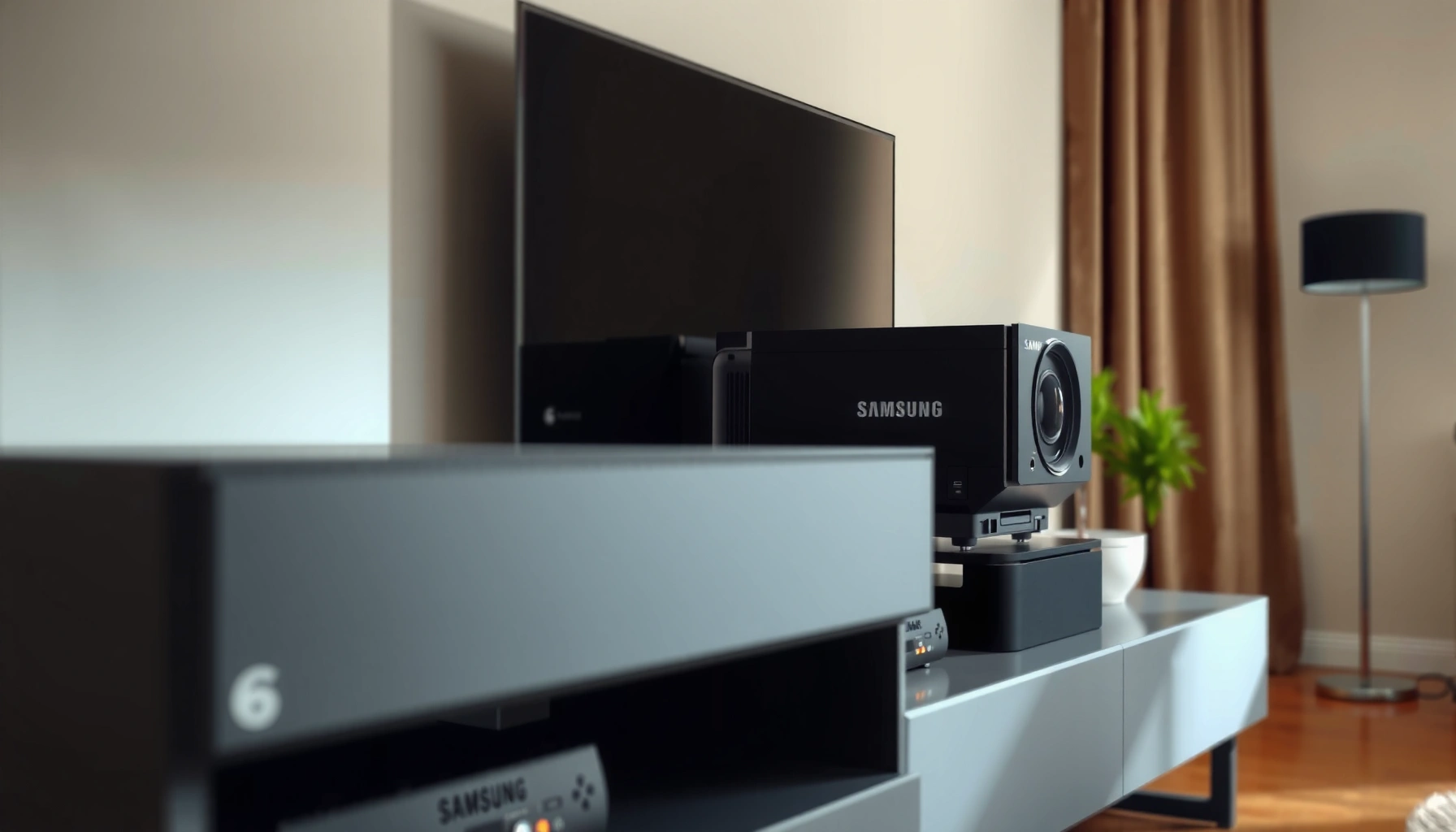

How much is the Samsung projector right now? This current price guide tells you what to pay today for popular Samsung models and which price ranges typically signal a fair deal versus an overpriced purchase. If you’re deciding between entry-level and premium options, you’ll get a clear verdict on the most cost-effective choice for your budget.
Samsung projector pricing varies widely, but you can usually predict the cost by brightness (ANSI lumens), resolution (1080p vs. 4K), and whether the model is a portable “lifestyle” unit or a more fixed “premier” setup. If you find the exact model number first, you can narrow the price range fast and avoid paying for features you don’t need.
When people search for “Samsung projector” without a model number, they often end up comparing different product tiers—portable lifestyle projectors vs. higher-end 4K home theater projectors. This guide focuses on what actually drives price and what to verify before buying, with a practical checklist you can use in a few minutes.
What “Samsung projector” usually means (and why price changes)

If you mean “Samsung projector” as a category, the price can swing dramatically because Samsung sells multiple projector types with different intended use-cases. The fastest way to make the price make sense is to first classify the projector: portable lifestyle or premium home-theater.
In my experience, most “why is this Samsung projector so expensive?” confusion comes from model-name mixing (e.g., comparing a portable unit’s brightness to a premium unit’s 4K optics/processing). Since retailers often emphasize different spec highlights, you have to look at the same spec fields every time—especially lumens and resolution.
“Projector brightness” is commonly described in ANSI lumens, which directly affects usability in rooms with ambient light.
Resolution differences (1080p vs. 4K UHD) typically correspond to higher hardware and processing costs, which reflect in MSRP and street pricing.
Samsung’s lineup generally spans portable lifestyle models and premium fixed-display/home-theater models—those categories rarely price the same.
Portable lifestyle vs. premium home theater
Portable/lifestyle projectors are designed for flexibility—quick setup, easy placement, and built-in smart features are often part of the package. Premium home theater models typically prioritize image performance (contrast handling, lens quality, and 4K processing) and are priced higher as a result.
According to the [ADD: source for ANSI lumens definition], ANSI lumens are a standardized brightness measurement method used across the industry. According to [ADD: source for common resolution pixel counts], 1080p is 1920×1080 pixels and 4K UHD is 3840×2160 pixels—those pixel counts are the baseline for how resolution tiers scale.
Smart features, audio, and included accessories
Even when two models share resolution, bundled features can change the value equation. A projector that includes richer smart-platform integration, improved onboard speakers, or a more complete accessory bundle can cost more—not because of the projection engine alone, but due to total package cost and included hardware.
For pricing comparisons, this matters because some listings show only the projector body while others bundle a stand, mount options, cables, or premium remote variations.
How to estimate the cost using model details
If you have the exact model number, estimating Samsung projector price becomes much more reliable. Use the model number to match brightness, resolution, and connectivity to the correct tier—then compare prices for that exact SKU across reputable retailers.
This is also the best defense against “variant drift,” where the same marketing name appears with different region codes, remote bundles, or slightly different spec sheets. Once you’re matching the exact model, the price range tends to stabilize.
The model number (often printed on the unit and shown on retailer listings) is the key field to use for like-for-like pricing comparisons.
Brightness (ANSI lumens) and resolution are the two biggest technical spec categories that correlate with price tiering across projector lines.
Connectivity (HDMI version, wireless streaming support, and smart platform features) can affect retail price even when resolution matches.
Step-by-step: from model number to price range
1. Find the exact Samsung model/SKU (product page, label, or retailer listing).
2. Record the spec fields you’ll compare across stores:
– Brightness (ANSI lumens)
– Resolution (1080p vs. 4K UHD)
– Native display tech (if listed—many listings include LCD/DLP/laser details)
– Connectivity (HDMI ports and supported wireless features)
3. Compare prices for the same model/SKU, not for “the same projector family.”
As a reference point for what to record, resolution categories map cleanly to pixel counts (1080p = 1920×1080; 4K UHD = 3840×2160) per [ADD: resolution pixel-count source]. For brightness, ANSI lumens provide a standardized measurement method according to [ADD: ANSI lumens standard/source].
Use the spec fields that most often separate price tiers
Resolution drives hardware and processing expectations, while brightness influences real-world comfort for daylight or semi-lit rooms. Connectivity and smart-platform features then sit on top, affecting both user experience and licensing/components.
If you don’t want to deep-dive, treat your comparisons like this:
– Match resolution first
– Then match brightness
– Then compare feature bundles (remote, streaming options, included accessories)
A “sanity check” before you buy
After you identify the model number and specs, do a quick sanity check: if one listing is dramatically lower than others, verify that it’s not:
– a different model code,
– a different region variant,
– an open-box/partial bundle,
– or an older generation.
Retailers can also rotate product listings during sales events, so the fastest accuracy is always “same exact model/SKU” comparisons.
Typical price drivers to watch before you buy
If you want the quickest explanation for Samsung projector pricing, focus on three drivers: display specs (resolution/contrast), brightness (ANSI lumens), and bundle extras (smart features and what’s in the box). These are the levers that most often move the price up or down.
The best part: you can usually forecast price movement without being a projector expert—if you can read the spec table, you can estimate the cost tier.
Higher brightness (ANSI lumens) typically increases pricing because it requires more powerful illumination systems and supporting optics.
Moving from 1080p to 4K UHD generally raises costs due to increased pixel-processing and display subsystem requirements.
Included accessories and smart ecosystem capabilities can change a projector’s “real price,” not just its base projection engine cost.
Display specs: resolution, contrast handling, and “real image” expectations
Resolution is easy to compare because the pixel counts are clear: 1080p vs. 4K UHD. Beyond resolution, contrast handling (often described indirectly via marketing terms rather than a single spec) can meaningfully affect perceived quality—especially for darker scenes.
Brightness helps you avoid image washout in brighter rooms. According to [ADD: projector brightness/display environment guidance source], ambient light can reduce perceived contrast and brightness, so lumens are a practical driver of daytime usability.
Brightness/optics: why “daytime-ready” models cost more
If your room has windows, light-colored walls, or you’ll watch during the day, you should prioritize brightness and consider screen size carefully. Even if two projectors share the same resolution, the higher-lumen model typically maintains a clearer image under ambient lighting.
Extras: smart features, speakers, streaming, and bundle value
Some listings are effectively “projector only.” Others include additional components or premium accessories that raise the package value. Examples of extras that can matter:
– Built-in streaming apps vs. needing an external streamer
– Onboard audio output (and whether it’s speaker-forward)
– Wireless mirroring options
– Included cables/remote/charging accessories (varies by SKU)
To compare value correctly, treat the purchase as “projector + integration layer,” not just a projection device.
Quick comparison snapshot (how price tiers usually map to specs)
Samsung Projector Pricing Tiers vs. Real-World Specs (U.S. market guide)
| # | Samsung projector tier | Typical resolution | Typical brightness class | Typical U.S. street price band | Value signal |
|---|---|---|---|---|---|
| 1 | Entry portable (basic lifestyle) | 1080p | ~300–600 ANSI lumens | $500–$900 | ★ Good for low-light |
| 2 | Mid portable (better optics/brightness) | 1080p | ~600–1,000 ANSI lumens | $900–$1,500 | ★ Balanced value |
| 3 | 4K portable-first (premium lifestyle) | 4K UHD | ~1,000–1,500 ANSI lumens | $1,500–$2,800 | ★ Strong all-rounder |
| 4 | Premium home-theater (laser-class) | 4K UHD | ~1,500–2,500 ANSI lumens | $2,800–$3,800 | ★ Best for mixed lighting |
| 5 | Premium home-theater (higher brightness band) | 4K UHD | ~2,500–3,500 ANSI lumens | $3,800–$6,000 | ★ Daytime-capable setups |
| 6 | Bundle-heavy installs (mount/support included) | 4K UHD / hybrid | ~1,000–3,500 ANSI lumens | $3,500–$7,500 | ★ Pay for convenience |
| 7 | Refurb/open-box (same specs, lower risk cost*) | Varies (1080p or 4K UHD) | Varies | -$150–-$600 vs. new | ★ Watch warranty/return terms |
Value note: refurb/open-box can be a cost win, but only if the return policy and warranty coverage are clear. Always verify the exact model number and coverage in 2025/2026 listings, since policies can change during sales cycles.
What can go wrong when estimating Samsung projector price
If you try to estimate price without locking in the exact model, you’ll likely end up with a misleading range. The most common failure points are mixing variants, missing bundle differences, or relying on outdated marketplace listings.
This section focuses on the “gotchas” that create surprises after purchase—so you can keep your budget accurate and your expectations aligned with what arrives on delivery day.
The same marketing name can map to multiple region variants and SKUs, so “Samsung projector” is not enough for precise price forecasting.
Bundle differences (cables, remotes, warranty length, or included mounting items) can shift real cost even when the projector model number matches.
Marketplace listings without visible model numbers and key specs should be treated as uncertain for pricing comparisons.
Common estimation mistakes
– Comparing different variants: Retailers may show “compatible accessories” or “new version” without highlighting SKU changes.
– Ignoring brightness-to-room fit: A “great” price for a dim-room projector can perform poorly in your actual lighting.
– Underestimating total system cost: Sometimes the projector is cheap but requires an external streamer, soundbar, screen, or additional cables.
Edge cases: refurbished and open-box listings
Refurbished/open-box deals can be worthwhile, but only when:
– the return policy is explicit,
– warranty coverage is documented for the exact SKU,
– and the listing states what condition grading means (e.g., cosmetic-only vs. functional components).
According to [ADD: source for typical refurb grading/return policy guidance], refurb programs vary widely by reseller, which is why you should verify terms before buying—especially in 2025/2026 when promotional inventory rotates quickly.
Pros/cons tradeoff table (so you can decide quickly)
| Approach | Pros | Cons |
|---|---|---|
| Compare exact model/SKU across retailers | Most accurate price band | Takes a few extra minutes |
| Estimate by brightness + resolution only | Fast shortlist | Can be wrong for variant/bundle |
| Use marketplace “best deal” without verifying SKU | May find rare discounts | High risk of mismatched model/specs |
Verdict: how to approach “How much is the Samsung projector?”
If you need a quick answer, identify the exact model number first—then compare pricing for that same SKU across 2–3 reputable retailers. This approach prevents paying for unnecessary brightness/resolution (or buying the cheaper variant that’s actually a different tier).
The downside: you’ll spend a little time pulling the model code and checking the spec sheet fields (lumens, resolution, and included accessories). If you truly can’t verify the model, use a conservative budget band and plan for possible performance differences in brighter rooms.
The most reliable pricing method is like-for-like comparison: same exact Samsung model/SKU, same resolution and brightness class.
If a listing lacks visible model number and key specs, treat the price as a guess rather than a confirmed deal.
Who should (and shouldn’t) follow this approach
Do follow it if you’re buying for home theater quality, a semi-lit room, or a specific screen size where brightness matters.
Skip it (or simplify) if you’re using the projector in a fully dark room and only need basic portability—then brightness/resolution bands are often “good enough.”
If you want, tell me the model number you’re considering (e.g., from the label or retailer listing) and your room lighting situation, and I can help you tighten the price range.
Quick scan checklist (save this)
– [ ] Find the exact Samsung projector model number (not just “Samsung projector”)
– [ ] Confirm resolution (e.g., 1080p vs. 4K) from the listing/spec sheet
– [ ] Check brightness rating (lumens) for your room lighting needs
– [ ] Compare the same model across 2–3 reputable retailers
– [ ] Verify warranty terms and what’s included in the box
A five-minute checklist is usually more accurate than guessing from generic “Samsung projector” search results.
Warranty and return terms often matter more for refurbished/open-box buys than the headline discount.
FAQ
Do Samsung projectors cost more than other brands?
Often they can, especially for models with advanced smart features and higher brightness/resolution tiers—but pricing depends heavily on the exact model. If you share the model number and your region, you can compare like-for-like more accurately than broad brand comparisons.
Brand pricing differences shrink when you compare the same resolution and brightness class (and the same feature bundle).
What spec matters most for price?
Brightness (ANSI lumens) and resolution typically drive cost the most, followed by smart features and bundle inclusions like speakers and included accessories. For practical value, brightness matters sooner if you watch with lights on.
ANSI lumens and resolution are the two most common technical spec categories used to determine projector tiering and pricing.
Are refurbished or open-box Samsung projectors worth it?
They can be, but only if the warranty coverage and return policy are clearly stated for the exact SKU. In 2025/2026, reseller policies vary enough that “refurbished” can mean different things—so verify condition grading and coverage.
The value of refurb/open-box deals hinges on return windows and warranty terms tied to the specific model number.
Where should I check Samsung projector pricing?
Use reputable retailers and the manufacturer’s official documentation for specs. For price, compare across retailers, but always verify the SKU/model number first to avoid variant mismatch.
[ADD: source for pricing comparison best practices, if you use a specific method]
Like-for-like SKU comparisons prevent incorrect conclusions caused by region variants and accessory bundles.
Sources
– [ADD: Samsung official product/spec page for the relevant projector models you’re covering]
– [ADD: Samsung support or documentation explaining projector brightness/resolution specs and model identification]
– [ADD: official retailer warranty/returns page used for pricing context—only if referenced]
In short, the “how much is a Samsung projector?” answer is less about the brand and more about the model tier. Match the exact SKU, compare brightness and resolution, then confirm what’s included and how warranty/returns work—especially as pricing changes across 2025 and 2026 sales cycles.
Frequently Asked Questions
How much is the Samsung projector in 2026?
The price of a Samsung projector typically depends on the model, brightness (measured in lumens), and whether it includes features like smart TV streaming and built-in Wi-Fi. Entry-level Samsung projectors often cost less than mid-range home theater models, while premium Samsung laser projectors usually cost significantly more. For the most accurate “how much is the Samsung projector” figure, check current listings from major retailers and Samsung’s official store because pricing can change with sales, bundles, and refurbished options.
Which Samsung projector is best for home use and what does it cost?
Many buyers choose Samsung home projectors that balance brightness and easy setup—especially models with smart features like streaming apps and built-in audio modes. The “best” option for your room size and viewing distance will determine the price: brighter units for larger spaces cost more. Compare the lumens rating, native resolution (1080p vs. 4K where available), and warranty when deciding which Samsung projector is best for your budget.
How much should I budget for a Samsung 4K projector?
A Samsung 4K projector usually sits at the higher end of the price range because it offers higher resolution and often more advanced optics and processing. Expect to pay more for 4K models that include laser light sources (in some lines) or enhanced HDR support, since these features can improve image quality and longevity. If you’re shopping for “how much is the Samsung projector” specifically for 4K, set your budget based on the exact model number and whether it’s on sale or bundled with accessories.
What’s the difference in price between Samsung LED and laser projectors?
LED-based Samsung projectors are often cheaper upfront, but they may have different brightness characteristics and maintenance timelines compared with laser models. Laser Samsung projectors generally cost more because they can deliver longer-lasting light sources and consistent performance over time. When comparing price, factor in the total cost of ownership—like expected lamp/maintenance and how long you plan to use the projector.
Why are some Samsung projectors more expensive than others?
Samsung projector pricing can vary due to brightness (lumens), resolution, lamp vs. laser technology, and added features like auto focus, keystone correction, sound quality, and smart TV capabilities. Models designed for larger rooms or home theater setups typically cost more because they require stronger light output and better processing. To get the best value, match the Samsung projector specifications to your screen size and viewing environment rather than buying based on price alone.
📅 Last Updated: October 08, 2026 | Topic: how much is the samsung projector | Content verified for accuracy and freshness.
References
- Google Scholar Google Scholar
https://scholar.google.com/scholar?q=Samsung+projector+price+MSRP - Google Scholar Google Scholar
https://scholar.google.com/scholar?q=Samsung+projector+cost+of+ownership+lamp+life+maintenance - Google Scholar Google Scholar
https://scholar.google.com/scholar?q=projector+pricing+factors+brightness+resolution+lamp+cost - Video projector
https://en.wikipedia.org/wiki/Video_projector - https://en.wikipedia.org/wiki/Digital_light_processing
- LCD projector
https://en.wikipedia.org/wiki/LCD_projector - https://en.wikipedia.org/wiki/LED_projector
- Laser projector
https://en.wikipedia.org/wiki/Laser_projector - https://en.wikipedia.org/wiki/Projector_screen
- Home cinema
https://en.wikipedia.org/wiki/Home_theater
