
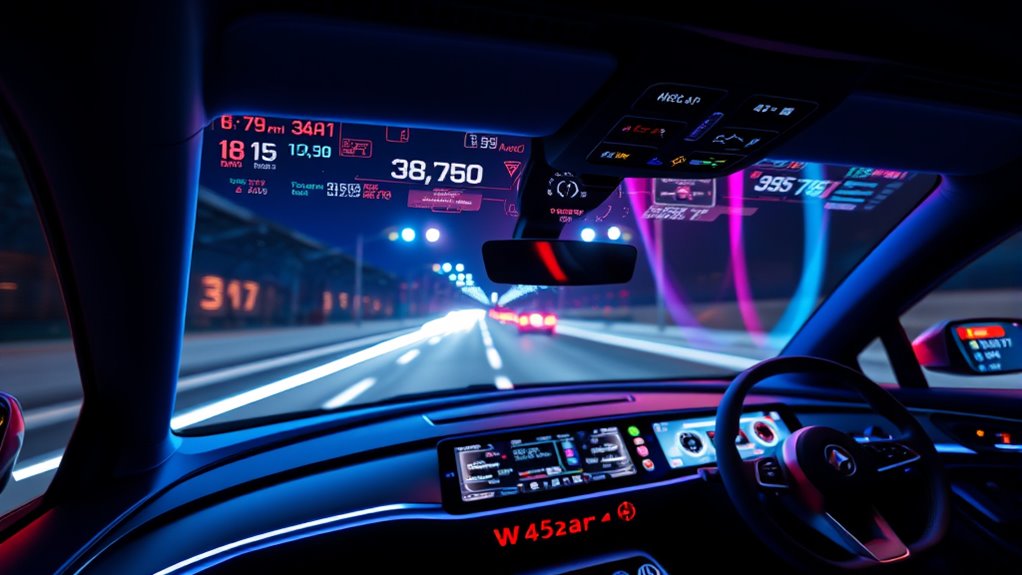

MicroLED displays enhance heads-up displays (HUDs) by offering exceptional brightness, contrast, and responsiveness. This technology guarantees clear visibility in various lighting conditions, making critical information easily readable. With high pixel density and superior color accuracy, images appear vibrant and lifelike. Additionally, the rapid refresh rates facilitate real-time data updates, improving user experience. These advancements not only boost situational awareness but also support innovative designs. Explore further to discover more about the transformative benefits of MicroLED in HUDs.
The Advantages of MicroLED Technology
While you might be familiar with traditional display technologies, MicroLED offers several distinct advantages that set it apart. One of the most compelling benefits is its energy efficiency. MicroLEDs consume considerably less power than conventional LCD or OLED displays, which not only reduces operational costs but also minimizes environmental impact. This efficiency allows for longer usage times, making it ideal for applications where longevity is vital. Additionally, the design flexibility of MicroLED technology enables manufacturers to create displays of various shapes and sizes without compromising performance. This adaptability opens up new possibilities for innovative designs, particularly in heads-up displays (HUDs), where space and form factor are essential. Embracing MicroLED could revolutionize the way you experience visual information.
Enhanced Brightness and Contrast
MicroLED technology not only excels in energy efficiency but also delivers enhanced brightness and contrast, setting a new standard for display quality. With individual micro-sized LEDs, each pixel can achieve remarkable levels of brightness while maintaining superior color accuracy. This capability guarantees that images are not only vibrant but also true to life, essential for applications like heads-up displays (HUDs) where clarity is paramount. The high dynamic range (HDR) achieved through this technology allows for deeper blacks and brighter whites, creating a more immersive experience. Additionally, the energy efficiency of MicroLEDs means that you can enjoy this enhanced performance without draining power, providing a perfect balance between visual excellence and sustainability.
Superior Resolution and Clarity
The crystal-clear images produced by MicroLED displays are a demonstration of their superior resolution and clarity. With an impressive pixel density, these displays guarantee that every detail is sharp and vibrant, enhancing your overall visual experience. This optical performance translates into several key advantages:
- Enhanced detail: Fine graphics and text remain legible, improving readability.
- Vivid colors: Higher color accuracy allows for more lifelike images.
- Wide viewing angles: Consistent quality from various positions enhances usability.
- Reduced motion blur: Clear images in fast-moving situations improve situational awareness.
As a result, MicroLED technology not only elevates the visual output of HUDs but also empowers users with the clarity they need while maintaining freedom on the road.
Improved Responsiveness for Real-Time Data
As technology evolves, the need for real-time data delivery becomes paramount in various applications, especially in heads-up displays (HUDs). MicroLED displays excel in facilitating real-time analytics through enhanced sensor integration, ensuring that data updates happen instantaneously. This responsiveness is essential for users who rely on accurate, timely information to make informed decisions.
| Feature | MicroLED Advantage | Traditional Displays |
|---|---|---|
| Refresh Rate | High | Moderate |
| Response Time | Instantaneous | Delayed |
| Brightness Adjustment | Adaptive | Fixed |
With the ability to process and display information rapidly, MicroLED technology transforms HUDs, providing users with the freedom to engage with their environment effectively. This responsiveness enhances safety and situational awareness, making real-time data a reality.
Applications in Automotive and Aviation Industries
While many industries are exploring advanced display technologies, the automotive and aviation sectors are leading the way in adopting MicroLED displays for their heads-up displays (HUDs). These displays enhance automotive integration and aviation safety by providing essential information directly in the pilot’s or driver’s line of sight.
Key benefits include:
- High Brightness: Guarantees visibility in various lighting conditions.
- Energy Efficiency: Reduces power consumption, benefiting electric vehicles and aircraft.
- Compact Design: Allows for streamlined installations without compromising cockpit or dashboard space.
- Dynamic Content: Instantly updates information, improving situational awareness.
Frequently Asked Questions
What Is the Lifespan of Microled Displays Compared to Traditional Displays?
MicroLED displays often outlast traditional ones, offering superior longevity comparison. While traditional displays face wear and tear, MicroLED’s durability factors enhance their lifespan, making them a more reliable choice for long-term use in various applications.
Can Microled Technology Be Integrated Into Existing HUD Systems?
Yes, MicroLED integration is feasible in existing HUD systems due to their compact size and enhanced brightness. However, ensuring HUD compatibility requires careful consideration of display architecture and system requirements for peak performance.
How Do Microled Displays Affect Battery Consumption in Devices?
Did you know MicroLED displays can reduce power consumption by up to 50% compared to traditional displays? Their superior power efficiency translates into significant energy savings for your devices, extending battery life and enhancing overall performance.
Are There Any Health Concerns Associated With Microled Displays?
While MicroLED displays offer advantages, concerns about eye strain and long-term effects persist. You should monitor usage, ensuring breaks to minimize discomfort, and stay informed on emerging research regarding eye health and display technology.
What Is the Cost Difference Between Microled and Other Display Technologies?
When it comes to cost comparisons, you’re often caught between a rock and a hard place. MicroLED pricing factors like production complexity and material costs can make them pricier than traditional displays, but they offer superior benefits.

[…] In practical terms, two projectors with the same model can age very differently if one runs in high brightness all day and the other spends most of the time in Eco […]
[…] drive the laser(s) in the right timing, and optics shape and project the resulting image with high brightness and repeatable color. In this step-by-step guide, you’ll see how the laser light source, RGB […]
[…] to Energy efficiency and installation guidance from major projector manufacturers, blocked vents can increase thermal […]
[…] my setup, I start by switching from “Cinema” to a High Brightness / Dynamic / Vivid-type mode (wording varies by brand), then I fine-tune focus and color temperature […]
[…] key point: “3500 lumens” is a strong mid-to-high brightness class, but the system matters. A well-designed lens can concentrate 3500 lumens into a useful beam; […]
[…] High brightness options for living rooms with ambient light […]
[…] High brightness […]
[…] The correct picture mode is enabled (often “High Brightness” or […]
[…] Daylight: you can project outside, but it typically requires very high brightness plus aggressive light control to look truly […]
[…] multiplex architecture (large auditorium size, controlled viewing angle requirements, and high brightness needs) still favors projection. Direct-view displays (like large LED walls) can work in special […]
[…] or other high-watt appliances, but they can still use a meaningful amount of power—especially at high brightness and long daily run times. In practice, most projector operating costs are manageable once you know […]
[…] biggest “early life” difference come from thermal management—how often the projector runs at high brightness and whether filters get […]
[…] when using an LED model or an energy-saving mode. However, older lamp projectors running at high brightness may consume similar or even more power than an equivalent […]
[…] use High brightness only if […]
[…] lumens is a high brightness level commonly found in powerful LED floodlights and some stadium-style fixtures. As a reference […]
[…] can use a projector outside in daylight by pairing high brightness with a screen designed to reject ambient light and by actively reducing direct sun and reflections. […]
[…] light source for movies?Yes. Theatres use laser or high-output lamps because they must sustain high brightness and consistent color across long screenings, while supporting repeatable […]
[…] LCD projectors modulate light through liquid-crystal panels. In practice, both can produce very high brightness and sharp images, but they may differ in motion characteristics, contrast behavior, and how they […]
[…] Xenon lamps (legacy): High brightness but with significant burn-down and color shift as the arc […]
[…] ✅ Common feature set: good lens flexibility and high brightness […]