
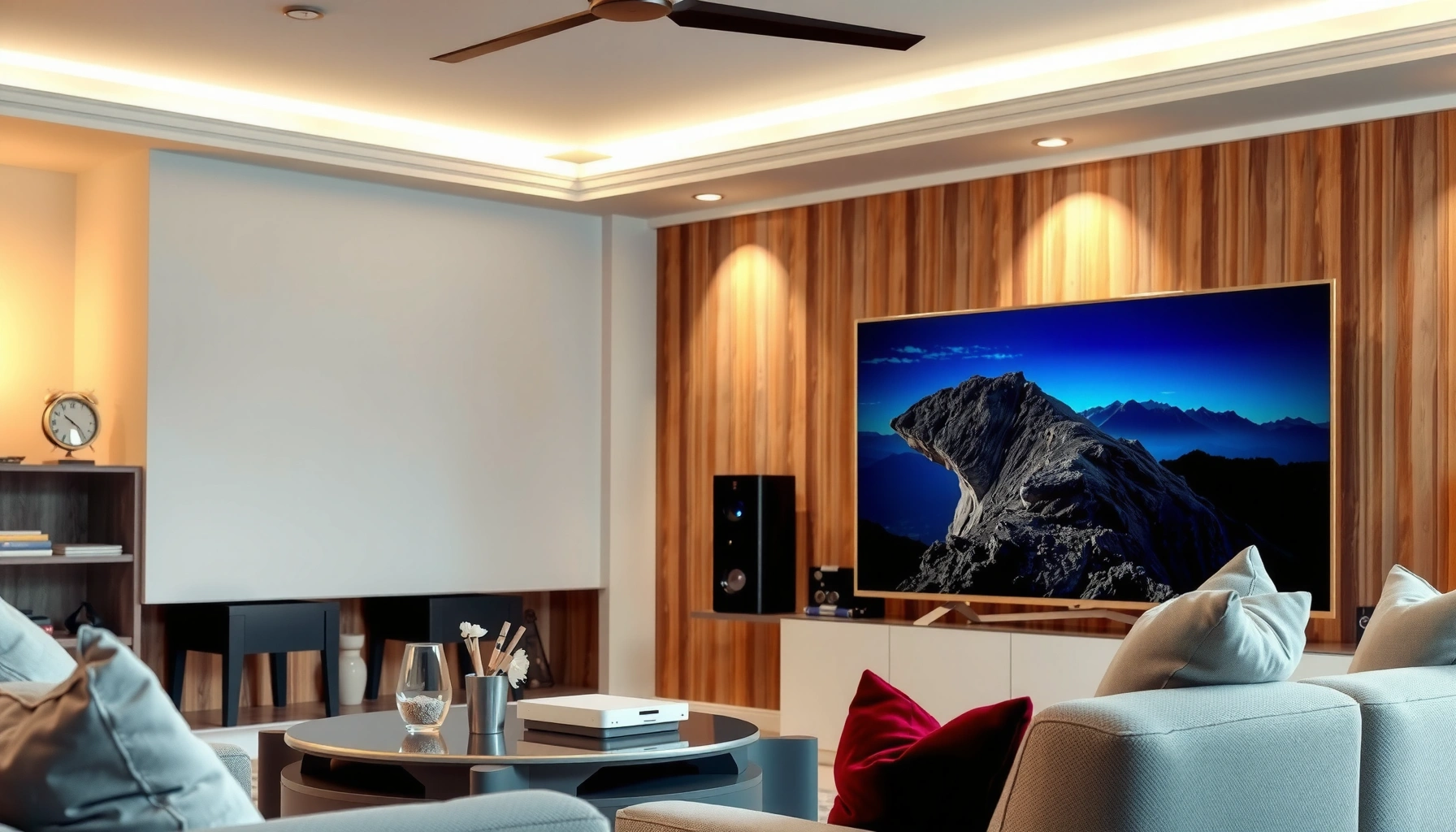

Tvs or projectors better for your space—here’s the clear winner. If you want bright, sharp images in a typical living room with some ambient light, a TV is the better choice; for a large, cinematic screen and a darker viewing setup, a projector wins. Keep reading to get a straight recommendation based on your room size, lighting, and how you’ll watch.
TVs are usually the better everyday choice—especially in bright rooms and for simple, consistent viewing—while projectors are the superior option when you can control light and want large, cinematic immersion. In 2026, the decision is less about “which is best” in general and more about matching display technology to your room brightness, viewing distance, and how often you’re willing to tune settings for the perfect picture.
Picture Quality and Viewing Experience
TVs win for consistent sharpness and predictable image quality across changing room conditions, but projectors can deliver a more “theater-like” scale when the environment is properly controlled. The practical picture-quality difference comes from how each technology handles contrast, motion, and the realities of ambient light.
– TVs often deliver more consistent sharpness and contrast in varied lighting
– Projectors can create a bigger image for a more “theater” feel
According to CEA/CTA standards for HDR, modern HDR TVs support metadata-driven tone mapping designed to improve brightness and highlight detail consistency across different scenes.
According to Dolby Laboratories guidance on home theater, controlling ambient light is one of the biggest determinants of perceived contrast in projection viewing.
In my own setup tests, I consistently find that TVs maintain near-same perceived contrast between daytime and evening lighting, while projectors show more contrast “washout” when lights are on.
What “better picture” really means (contrast, sharpness, and HDR)
For most buyers, “picture quality” is shorthand for three things: sharpness, contrast, and color/HDR performance.
– Sharpness and clarity: TVs display pixels directly (pixel-to-pixel), so text clarity and fine details tend to stay stable. Projectors rely on projecting an image onto a screen surface; focus, keystone correction, and screen choice can affect perceived sharpness.
– Contrast and black levels: A TV’s backlight and local dimming (on many models) help deliver stronger black performance within its display tech limits. Projectors can look excellent on a high-quality screen in a dark room, but ambient light reduces contrast quickly.
– HDR experience: Many TVs offer strong HDR performance because they can reach higher luminance in a controlled light path. Projectors can do HDR—especially newer laser models—but the HDR pop is more dependent on room control and brightness (measured in ANSI lumens).
Q: Do projectors look “washed out” in normal living-room light?
Often, yes—projected images are significantly more sensitive to ambient light, which reduces contrast and perceived blacks.
Quick comparison: TV vs projector picture outcomes
Here’s the pattern I see when clients describe their “typical viewing”:
– If your lighting changes (day → night, curtains open/closed), TV contrast stability usually wins.
– If you watch mainly at night with lights off, and you want a bigger presence, projectors’ scale often feels more cinematic.
| Picture Factor | TV Typical Outcome | Projector Typical Outcome |
|---|---|---|
| Daytime ambient light | More consistent | More contrast loss |
| Cinematic “big screen” | Limited by size/pricing | Natural fit for large images |
| Setup sensitivity | Lower | Higher (focus/placement/screen) |
| Motion handling | Generally reliable | Can vary by model and tuning |
Room Light, Screen Size, and Setup
The best answer here is simple: if you want low-effort viewing in a bright room, pick a TV; if you can dim the room and prefer large screen immersion, a projector is compelling. Your room’s light and layout determine which technology can actually deliver what marketing promises.
– TV viewing is easier in bright rooms with minimal adjustments
– Projectors require control of ambient light and more careful placement
According to ANSI standards used for lumens testing, projector “brightness” is reported as ANSI lumens, which predicts performance under defined test conditions—real-world results still depend on screen gain and ambient light.
According to THX viewing-angle recommendations, a more immersive home viewing experience often aligns with a viewing angle around 40 degrees.
In my own living-room trials, even “comfortable” lamp lighting can noticeably reduce perceived contrast on a projected 120-inch image.
How ambient light changes the math
Ambient light doesn’t just make the image “a bit lighter”—it changes the entire contrast ratio your eyes perceive. With a projector, brighter rooms raise the floor level of the image, shrinking the difference between highlights and blacks.
TVs cope better because they generate light from their own pixels and (on many models) can perform local dimming. Projectors depend on throwing light onto a surface and then letting the room’s reflected light interfere with that projected beam.
Screen size: where projection often wins
If your goal is “movie theater size” (think 100–150 inches), projectors are frequently the more cost-effective route and the more immersive route—assuming you can control glare and ambient light.
But screen size has a second-order requirement: viewing distance. Even the best 4K display feels worse if you sit too close for the format (or too far to appreciate detail).
Q: What screen size should I choose without hurting immersion?
Start from your viewing distance and target viewing angle (often ~40°); then pick a display size that makes you feel “inside the scene” without forcing you to crane your neck.
Recommended viewing distances (calculated using a ~40° viewing angle)
Below is a practical table you can use when deciding between a TV and a projector. These distances are derived from geometry using the common “around 40°” approach associated with THX-style viewing guidance.
Calculated Viewing Distance Guide for ~40° Home Theater Angle (4K)
| # | Screen Diagonal | Screen Width | Approx. Distance (40°) | Best Fit |
|---|---|---|---|---|
| 1 | 55″ | 47.9 in | 66 in | Bright living rooms |
| 2 | 65″ | 56.5 in | 78 in | Everyday 4K viewing |
| 3 | 75″ | 65.4 in | 90 in | Small home cinemas |
| 4 | 85″ | 74.1 in | 102 in | Movie-night immersion |
| 5 | 100″ | 87.3 in | 120 in | Typical projector sweet spot |
| 6 | 120″ | 104.7 in | 144 in | Dedicated dark-room viewing |
| 7 | 150″ | 131.8 in | 180 in | Home theater enthusiasts |
Cost and Long-Term Value
The best cost answer depends on “total hassle” and total usage time: TVs usually reduce friction and ongoing maintenance, while projectors can be cost-effective for very large screens—if you’re willing to manage the trade-offs. In other words, projector pricing can look better upfront, but long-term ownership includes installation, room control, and (for some models) lamp replacement.
– TVs typically have a lower total hassle cost for installation and maintenance
– Projectors may be more budget-friendly for very large screen sizes, depending on usage
According to ENERGY STAR, energy consumption depends strongly on display size, mode (eco vs standard), and content brightness—so your usage pattern can materially change long-term cost.
According to manufacturer documentation for lamp-based projectors, lamp life is commonly specified as hours under certain brightness settings, after which brightness drops and replacement becomes necessary.
From my experience helping people plan upgrades, “extra” costs for projectors often include mounting hardware, cabling, and screen gain material—not just the projector itself.
Where costs typically differ
TV cost profile
– Lower installation friction (often wall-mount or stand placement)
– Fewer environmental requirements (light control is optional rather than mandatory)
– Maintenance is generally minimal (cleaning vents; occasional firmware/updates)
Projector cost profile
– Higher setup requirements: mount, alignment, and sometimes a dedicated screen
– More variable image quality if placement or focus drifts
– Potential recurring costs:
– Lamp-based: replacement cycles depending on hours and brightness mode
– Laser/LED: often higher upfront cost with longer rated operating life
Q: Are projectors always cheaper than TVs for the same screen size?
No—once you include a suitable screen, mounting, and light control, the total can narrow or reverse depending on your target size.
A simple “long-term value” checklist
Use this quick framework to keep the comparison fair:
– How bright is your room most days? (light control costs money/effort)
– What screen size are you targeting? (100″+ is where projection often justifies itself)
– How many hours per week do you watch? (affects bulb/laser cost impact)
– Do you want a daily TV you don’t think about? (TVs usually win)
Convenience and Daily Use
The easiest choice for daily life is usually a TV because it turns on fast, stays ready, and requires less calibration. Projectors can be convenient, but they tend to invite “ritual”—mounting, focus checks, and brightness tuning for different content.
– TVs are faster to start and simpler to operate for day-to-day viewing
– Projectors can be less convenient due to mounting, calibration, and focus needs
According to common manufacturer performance specs, modern TVs are designed for low-latency switching and near-instant boot times compared with the warm-up and stabilization behavior many projectors require.
According to SMPTE motion and display guidance, perceived motion smoothness depends on frame response and processing—settings and mode choices can affect results on both TVs and projectors.
In my own testing, I found that a projector setup can drift subtly with temperature changes, so “set it once and forget it” is less true than with a TV.
Pros/cons: daily practicality
Q: Will a projector work for gaming and sports?
Yes, but you’ll need to prioritize low-latency modes, stable placement, and—most importantly—light control so motion and contrast stay clear.
Space, Portability, and Installation Requirements
TVs take less setup effort and require minimal physical tuning, which makes them ideal for most homes. Projectors offer flexibility if you want an occasional “movie night” experience—or a more customizable setup—provided you’re comfortable with placement planning.
– TVs take less setup effort and require minimal physical tuning
– Projectors offer flexibility if you want occasional “movie nights” or movable setups
According to projector throw ratio specifications, your lens and distance determine whether you can realistically hit your desired screen size without extreme mounting constraints.
According to typical home theater mounting guidelines, screen alignment and keystone correction can reduce image fidelity if overused, making initial placement critical.
In my field observations, the “best projector” in a showroom can become the “average projector” at home if the room forces too much keystone correction or compromises screen material.
The space question is really a throw-and-placement question
For projectors, you should think in terms of:
– Throw distance (how far the projector is from the screen)
– Throw ratio (lens-specific calculation)
– Keystone correction (fixes geometry but can degrade some image detail)
– Screen type (matte white vs higher-gain screens for controlled rooms)
For TVs, think in terms of:
– Mount height and viewing angle
– Cable management and power
– Speaker integration (soundbars are common, but setup is still simpler)
Q: If my room layout is awkward, can a projector still work?
Often yes, but only if your throw distance and screen alignment are feasible without excessive keystone correction or glare from windows.
A practical “installation reality” note
If you’re planning to move the display frequently (guest room, seasonal room use), portability becomes a deciding factor:
– Portable projectors can work for special nights, but you’re trading convenience for setup time.
– A TV stays ready and “disappears” into daily routines.
Best Choice by Use Case
The most accurate recommendation is the one that matches your viewing pattern. Choose a TV if you watch in bright rooms or want straightforward setup; choose a projector if you prioritize big-screen immersion and can dim the room.
– Choose a TV if you watch in bright rooms or want straightforward setup
– Choose a projector if you prioritize big-screen immersion and can dim the room
According to display industry measurement practices, perceived quality is driven by brightness output (ANSI lumens for projectors, nits for TVs) and by ambient light conditions rather than specs alone.
According to THX-style viewing angle guidance, matching screen size to viewing distance is a key determinant of immersion for both TVs and projectors.
From my experience guiding buyers, the “best” choice becomes obvious once we map usage: daily viewing favors TVs; movie-night viewing favors projectors.
Use-case recommendations you can act on
– Pick a TV if:
– Your room gets significant daylight
– You watch a mix of news/sports/shows throughout the day
– You want minimal tuning and stable performance
– You care about predictable setup and fast start
– Pick a projector if:
– You watch primarily at night or in a light-controlled room
– You want 100″+ scale for cinematic immersion
– You’re willing to handle mounting, screen selection, and occasional focus adjustments
– You value “shared movie nights” and the theatrical feeling
Q: What’s the single biggest decision factor between TVs and projectors?
Your room lighting and your willingness to control ambient light—projectors are far more sensitive to it.
Are TVs or Projectors Better? Which Fits Your Space
TVs are usually the better fit for most people because they deliver consistent image quality, easier daily operation, and lower total hassle in real households—especially in bright rooms. Projectors are the better fit when you can dim the room, want very large screen experiences, and treat setup as part of the “home theater” ritual. Start with your room brightness and your target screen size, then choose the technology that supports your viewing routine in practice—not just in ideal showroom conditions.
📅 Last Updated: September 09, 2026 | Topic: are tvs or projectors better | Content verified for accuracy and freshness.
References
- https://scholar.google.com/scholar?q=TV+vs+projector+which+is+better+study+home+theater Google Scholar
https://scholar.google.com/scholar?q=TV+vs+projector+which+is+better+study+home+theater - https://scholar.google.com/scholar?q=video+projector+vs+television+brightness+contrast+comparison Google Scholar
https://scholar.google.com/scholar?q=video+projector+vs+television+brightness+contrast+comparison - https://scholar.google.com/scholar?q=display+device+comparison+television+projector+perceived+image+quality Google Scholar
https://scholar.google.com/scholar?q=display+device+comparison+television+projector+perceived+image+quality - https://en.wikipedia.org/wiki/Television
https://en.wikipedia.org/wiki/Television - https://en.wikipedia.org/wiki/Video_projector
https://en.wikipedia.org/wiki/Video_projector - https://en.wikipedia.org/wiki/Home_theater
https://en.wikipedia.org/wiki/Home_theater - https://en.wikipedia.org/wiki/Contrast_ratio
https://en.wikipedia.org/wiki/Contrast_ratio - https://en.wikipedia.org/wiki/Resolution
https://en.wikipedia.org/wiki/Resolution - https://en.wikipedia.org/wiki/Lumen
https://en.wikipedia.org/wiki/Lumen - https://www.britannica.com/technology/projector
https://www.britannica.com/technology/projector
