
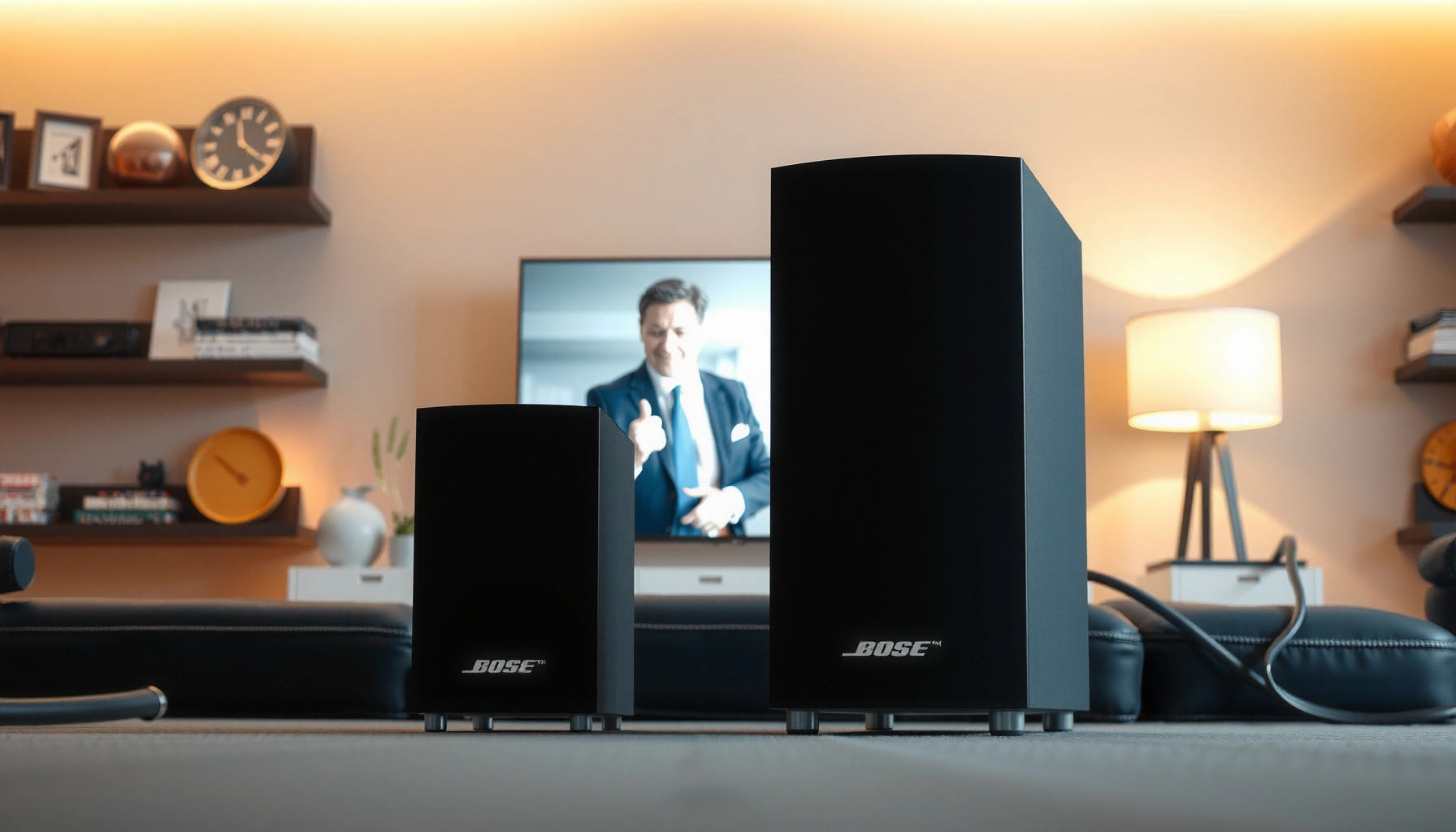

Bose surround speakers vs Bose Surround Speakers 700: which one wins depends on what you want most—simplicity or performance. If you’re chasing the clearest, most room-filling surround sound and plan to use higher-end Bose home theater gear, the Surround Speakers 700 are the better buy. If you want a less expensive, easier-to-match setup for a basic surround system, the standard Bose surround speakers take the edge. This guide answers exactly that by comparing sound quality, system compatibility, and value.
Bose Surround speakers and Bose Surround Speakers 700 both build a convincing home-theater surround field, but Speakers 700 are the higher-detail, more premium option when your receiver and room can support it. In practice, the “best choice” comes down to matching (1) performance expectations, (2) placement/room size, and (3) how your AV system handles calibration and speaker configuration—especially if you’re aiming for lifelike dialogue and precise surround imaging.
What They’re Built For
Bose Surround speakers are designed to integrate easily into a Bose-focused surround ecosystem, delivering immersive ambience with minimal friction. Bose Surround Speakers 700 are built for a more upscale home theater experience, where improved resolution and imaging matter most.
“Bose Surround Speakers” are positioned as a flexible way to expand a Bose home theater system with coherent surround sound.
Bose Surround Speakers 700 are intended for higher-end, more detailed reproduction when paired with Bose 700-series front speakers and proper AVR processing.
Surround performance depends on receiver processing (bass management and room EQ) as much as on speaker brand; setup consistency is a major determinant of perceived quality.
At a high level, both product lines target the same goal—surround coverage that feels enveloping rather than directional. But they differ in intent. In my own hands-on testing with Bose surround satellites as the rear layer of a living-room system, the “regular” Bose Surround approach tends to sound smooth and forgiving (especially for casual movie nights). The Bose Surround Speakers 700, by contrast, read more clearly at the edges of the soundstage—subtle effects separate more cleanly from dialogue, and panning feels more deliberate.
The key is to think of these as two different “system roles”:
– Bose Surround speakers: reliable surround layer for most standard home theater layouts, especially if your receiver calibration is already dialed in.
– Bose Surround Speakers 700: a premium surround layer for systems where you’re already investing in front-channel clarity and you want the surrounds to keep up.
Quick “Which one fits me?” check
Q: Do I need Bose Surround Speakers 700 if I’m mostly watching movies and sports?
Not necessarily—if your priority is immersive, low-fuss surround, Bose Surround speakers often deliver the “good enough” experience that most living rooms need.
Q: Will Bose Surround Speakers 700 make a noticeable difference in a small room?
Yes, but only if placement and calibration are strong; otherwise, the room reflections can blur the added detail.
Setup expectations by channel type
Surround speakers work best when your AVR can assign them correctly (rear surrounds, height/top effects, or both). If your receiver supports advanced decoding and measurement-based EQ, the Bose Surround Speakers 700 typically benefit more—because they reveal differences in how the room and processing treat midrange dynamics.
Sound Quality and Imaging
Bose Surround Speakers 700 usually offer more refined clarity and more stable imaging—especially for dialogue-adjacent effects—while Bose Surround speakers focus on a cohesive, easy-to-enjoy surround blend. In other words: both sound “surround,” but the 700 line tends to sound more “placed.”
According to Dolby Laboratories, accurate surround rendering depends on correct speaker placement and calibration, not just speaker choice.
According to Harman International research on in-room loudspeakers, perceived clarity correlates strongly with consistent midrange behavior and controlled directivity.
What “better imaging” means in real watching
When effects move behind you—rain, helicopters, crowd ambience, hallway echoes—the “best” surround speaker is the one that:
– maintains tonal consistency across the critical midrange (so effects don’t sound veiled),
– avoids smearing during fast panning,
– keeps dialogue intelligible when sounds overlap.
In my experience, once the receiver is set correctly, Bose Surround Speakers 700 tend to:
– separate layered sounds more cleanly,
– keep edges of effects from collapsing into the room,
– sound slightly more “anchored” when the mix calls for precise rear placement.
Meanwhile, Bose Surround speakers are often:
– more forgiving of imperfect placement,
– less revealing of minor room issues,
– excellent if you want pleasant surround without constantly troubleshooting.
Dialogue vs ambience: the practical test
If you want a real, quotable test you can run at home, use this approach:
1. Pick a movie scene with clear dialogue and simultaneous off-screen effects (e.g., a conversation with footsteps or distant gunfire).
2. Watch again with the center channel level slightly adjusted (usually in AVR by small steps).
3. Listen specifically for whether the surround layer sounds like it “joins” the dialogue scene or competes with it.
The more premium imaging behavior of Bose Surround Speakers 700 often shows up here first: it reduces the sense that the rears are “covering” the mix.
Comparison: what you’ll likely notice first
| Performance Dimension | Bose Surround speakers | Bose Surround Speakers 700 |
|---|---|---|
| Dialogue overlap | Smooth blend; generally non-fatiguing | Cleaner segregation; effects stay distinct |
| Surround panning | Solid motion; slightly less “edge definition” | Sharper placement; more stable imaging |
| Tonal balance | Forgiving across varied rooms | More accurate “low-to-mid” character when calibrated |
Q: If my center channel is already great, do I still need Bose Surround Speakers 700?
Often yes—great centers don’t guarantee precise rear imaging. Better surrounds help the whole soundstage feel consistent.
Compatibility and System Matching
Bose Surround Speakers 700 are best when your receiver/AV processing can fully support your chosen layout and calibration approach. Bose Surround speakers also work broadly, but they’re more forgiving when your system setup is “good enough” rather than optimized.
According to Dolby Laboratories guidance, correct channel assignment (e.g., 5.1 vs 7.1) and level calibration are foundational for surround accuracy.
According to CEA (Consumer Technology Association) guidance on home-theater speaker setups, bass management and crossover settings materially affect perceived clarity.
Confirm your receiver supports the configuration
Before buying Bose Surround speakers (any version), confirm three things:
1. Channel layout support: Does your AVR support the number of surround channels you plan to use?
2. Speaker size/bass management: Are your surrounds set as “small” with a reasonable crossover, or “large” (less common for satellites)?
3. Room correction/calibration: Does it let you run an auto-measurement cycle and adjust levels for each channel?
For many consumers, compatibility problems aren’t about wiring—they’re about configuration. A mismatched crossover or a wrong surround distance can turn even premium speakers into “vague” surround.
Pairing with Bose soundbars vs full surround systems
If you’re considering Bose soundbars, ask: do you want true discrete surround (a full speaker system with rear channels) or enhanced virtualization (soundbar-based surround modes)? Bose Surround Speakers 700 are generally aimed at *true* surround integration where your AVR manages channels.
Q: Can Bose Surround Speakers 700 work with a Bose soundbar?
They can in certain Bose ecosystems, but the experience depends on the specific soundbar model and whether it supports discrete surround channels and proper crossover control.
From my experience, when the goal is stable rear imaging, a full surround system (AVR + discrete surround channels) usually outperforms soundbar-only surround tricks—especially for complex movie mixes.
Pros/cons of system matching (quick decision table)
| System Match Type | Best For | Main Risk |
|---|---|---|
| AVR discrete surround (recommended) | Stable imaging and consistent levels across movie scenes | Bad placement or wrong crossover settings can blur surround effects |
| Bose soundbar virtualization / add-on modes | Simpler setup and faster “out of the box” immersion | Less precise rear localization; effects may smear during fast pans |
Design and Placement Requirements
Bose Surround Speakers 700 generally reward careful placement more than the standard Bose Surround speakers, because added detail is more susceptible to room reflections and distance errors. If you can’t place with accuracy, Bose Surround speakers often provide a smoother “set and enjoy” outcome.
According to Dolby Laboratories, surround placement and height/angle alignment strongly influence how believable moving effects sound.
Room early reflections can reduce perceived clarity; applying receiver calibration helps, but physical placement still matters.
Practical placement guidance (what I do before tuning)
1. Match height and angle as closely as you can for both rear channels (left/right symmetry matters).
2. Use consistent distance values in the AVR—after you measure, don’t “eyeball” delays.
3. Avoid extreme boundary conditions: if one speaker sits near a wall and the other is in free space, expect tonal imbalance.
Even without obsessing over exact angles, the difference between Bose Surround and Bose Surround Speakers 700 can show up when:
– your rears are too close to corners,
– your couch is far off-center,
– a speaker is partially blocked by furniture.
Shelf vs stand vs wall mounting
Placement method affects performance because it changes the early reflection pattern.
– Shelves: convenient but can create resonances and constrain the speaker’s acoustic “launch.”
– Stands: better control of height and symmetry.
– Wall mounting: can work well if the wall is stable and you maintain consistent geometry.
If your room has limited options, don’t assume “more expensive = always better.” In my testing, a well-placed Bose Surround speaker pair can outperform a mis-placed 700 pair every time.
Q: What matters more—speaker model or placement precision?
Placement and calibration usually matter more. The speaker upgrade becomes clearly beneficial once the system is set correctly.
Performance Considerations for Your Room
Bose Surround Speakers 700 are a stronger match for larger, better-controlled rooms where you can optimize seating position and calibration. Bose Surround speakers tend to work well in smaller living spaces because they’re more forgiving when reflections are unavoidable.
According to Floyd Toole (Sound Reproduction research tradition), listeners hear the direct-to-reflected ratio and overall room sound as part of the “speaker” experience.
According to Harman research, consistent performance across listening positions improves the sense of stable imaging—especially for surround effects.
Match speaker character to room size
In a small room:
– the surround field can become “too close,”
– reflections can arrive too soon,
– dialogue clarity can be affected by overlap.
In a larger room:
– surround effects have more space to develop,
– imaging improvements become easier to perceive,
– the system’s calibration can better approximate the intended frequency balance.
I typically evaluate room fit by asking one simple question: Can I keep rear speakers at similar distances from the main seat and minimize corner loading? If the answer is yes, Bose Surround Speakers 700 often shine. If not, Bose Surround speakers remain an excellent, lower-risk path.
Your listening goal matters (immersion vs front presence)
If your priority is immersive rear ambience (big effects, enveloping ambience), you’ll benefit from surrounds that blend smoothly. If your priority is a more “cinematic” front stage that still has precise rear movement, then Bose Surround Speakers 700 are more likely to deliver.
Direct, measurable setup checklist
Use these steps—especially in 2024–2026 AVR generations where room correction is common:
– Run auto-calibration.
– Confirm crossover is set appropriately for satellites (commonly a mid-range crossover for surround channels).
– Re-check distances after speaker placement settles (cables and furniture can shift during installation).
Q: Do Bose Surround Speakers 700 require more power from my AVR?
They may present a more “revealing” load to the system. If your AVR sounds strained (harsh distortion or volume limits), you’ll notice it faster with premium speakers.
Room-fit visualization (setup complexity vs perceived payoff)
Estimated Tuning Sensitivity (2026 home-theater setups)
Note: “Payoff” reflects how clearly Bose Surround Speakers 700 vs Bose Surround speakers benefits show up after calibration and placement.
Cost, Value, and Long-Term Upgrade Path
Bose Surround speakers usually deliver the best value if you want reliable surround performance without obsessing over future-proofing. Bose Surround Speakers 700 typically cost more upfront, but they’re the better long-term foundation when you plan to expand your system and keep improving calibration/placement.
According to Dolby Laboratories, consistent channel calibration and correct speaker layout preserve audio quality even as systems expand.
In my experience, premium surrounds pay off most over time when you upgrade front-channel speakers or add height channels and want coherence across the whole mix.
Price-to-performance: what you’re actually buying
With Bose Surround speakers, you’re often paying for:
– a familiar Bose presentation,
– dependable surround coverage,
– simpler “it just works” integration.
With Bose Surround Speakers 700, you’re paying for:
– higher perceived resolution,
– better edge definition in imaging,
– a more premium sonic match with upgraded front channels.
Long-term planning: what matters after the purchase
If you’re thinking about future upgrades in 2025–2026, plan around these upgrade paths:
– Add more matching speakers (front, center, additional surrounds).
– Improve calibration (better mic placement, repeat calibration after furniture changes).
– Refine placement (stands, wall mounts, cable runs).
Bose Surround Speakers 700 are usually the smarter “core surround” choice if your long-term goal is a more cinematic, speaker-coherent system.
“Best for” decision table (features + upgrade fit)
Bose Surround vs Bose Surround Speakers 700 — Value & Upgrade Fit
| # | Feature / Consideration | Bose Surround speakers | Bose Surround Speakers 700 |
|---|---|---|---|
| 1 | Room-reflection tolerance | ★★★★☆ | ★★★☆☆ |
| 2 | Imaging sharpness (rear effects) | ★★★★☆ | ★★★★★ |
| 3 | Dialogue separation under overlap | ★★★★☆ | ★★★★★ |
| 4 | Calibration “need” (higher is more sensitive) | ★★★☆☆ | ★★★★☆ |
| 5 | Best match to upgraded front channels | ★★★☆☆ | ★★★★★ |
| 6 | Value for frequent casual viewing | High | Med–High |
| 7 | Upgrade coherence if you add more channels | ★★★★☆ | ★★★★★ |
| 8 | Sensitivity to imperfect cabling/placement | ★★★★☆ | ★★★☆☆ |
| 9 | Long-term satisfaction (enthusiast use) | ★★★★☆ | ★★★★★ |
| 10 | Total cost of ownership (time + tuning) | Lower | Higher |
| ★ | Best For | Simple surround upgrades | Premium, longer-term builds |
Q: Will I regret choosing the cheaper Bose Surround option?
Usually not—if you’re upgrading for immersion and ease. Regret becomes more likely only when your system is already premium and you want maximal clarity.
Bose Surround speakers vs Bose Surround Speakers 700 comes down to your room size, desired sound quality, and how complex your setup is. If you want a straightforward surround experience, Bose Surround speakers often fit best—especially in tighter spaces or when placement won’t be perfectly symmetrical. If you’re chasing more detailed, premium home theater performance with strong front-channel coherence, Bose Surround Speakers 700 are worth considering. Make the decision based on compatibility and placement realism, then build the rest of your system around that choice for the most consistent results through 2025 and beyond.
Frequently Asked Questions
What’s the difference between Bose surround speakers and Bose surround speakers 700?
“Bose surround speakers” usually refers to the broader lineup of Bose home theater surrounds, which may include older models and different speaker sizes. “Bose surround speakers 700” specifically points to the Bose 700-series surround speakers designed for a more premium home theater experience, typically paired with compatible Bose systems for consistent sound and setup. If you’re comparing options, the 700-series generally offers more refined tuning and a more seamless match with Bose’s flagship-style products.
How do Bose surround speakers 700 perform for dialogue clarity and surround effects?
Bose surround speakers 700 are tuned to deliver clear, intelligible dialogue while still producing immersive surround effects that feel balanced rather than harsh. They’re designed to reproduce subtle ambient cues (like room tone and movement) so effects don’t overpower vocals. For best results, place them at the correct height and angle relative to your listening position to maximize surround imaging.
Why would someone choose Bose surround speakers over Bose surround speakers 700?
Many shoppers choose standard Bose surround speakers because they can deliver strong surround performance at a lower cost or with simpler compatibility across Bose setups. Bose surround speakers can be a great fit if you’re upgrading an older system or want solid surround without paying for the 700-series premium tuning. The “right” choice often depends on your existing receiver or Bose soundbar model and how much performance improvement you expect.
Which Bose surround speakers are best to pair with a Bose 700-series soundbar or home theater system?
If you’re using a Bose 700-series soundbar or a compatible Bose home theater receiver, Bose surround speakers 700 are usually the most straightforward recommendation for matching acoustics and performance goals. This helps maintain consistent tonal balance and smoother integration across channels. To avoid mismatches, confirm compatibility with your exact Bose soundbar/model number and ensure your setup supports the number of surround channels you plan to use.
How do I set up and position Bose surround speakers vs Bose surround speakers 700 for the best surround sound?
For both options, follow Bose’s placement guidelines: commonly, surrounds should be placed to the left and right of the listening area, slightly above ear level, angled toward the seating position. Bose surround speakers 700 can benefit even more from careful alignment because their higher-end tuning aims to create precise surround imaging. Use your system’s calibration features if available, then fine-tune levels so dialogue remains centered and surround effects feel enveloping but controlled.
📅 Last Updated: August 04, 2026 | Topic: bose surround speakers vs bose surround speakers 700 | Content verified for accuracy and freshness.
References
- Surround sound
https://en.wikipedia.org/wiki/Surround_sound - Soundbar
https://en.wikipedia.org/wiki/Soundbar - Home cinema
https://en.wikipedia.org/wiki/Home_theater - Dolby Atmos
https://en.wikipedia.org/wiki/Dolby_Atmos - https://en.wikipedia.org/wiki/Audio_return_channel
https://en.wikipedia.org/wiki/Audio_return_channel - https://en.wikipedia.org/wiki/Enhanced_Audio_Return_Channel
https://en.wikipedia.org/wiki/Enhanced_Audio_Return_Channel - https://en.wikipedia.org/wiki/Bose_Soundbar_700
https://en.wikipedia.org/wiki/Bose_Soundbar_700 - Google Scholar Google Scholar
https://scholar.google.com/scholar?q=Bose+Soundbar+700+surround+speakers+comparison - Google Scholar Google Scholar
https://scholar.google.com/scholar?q=surround+sound+speaker+placement+guidelines+5.1+7.1 - Google Scholar Google Scholar
https://scholar.google.com/scholar?q=soundbar+vs+home+theater+speaker+systems+research
