
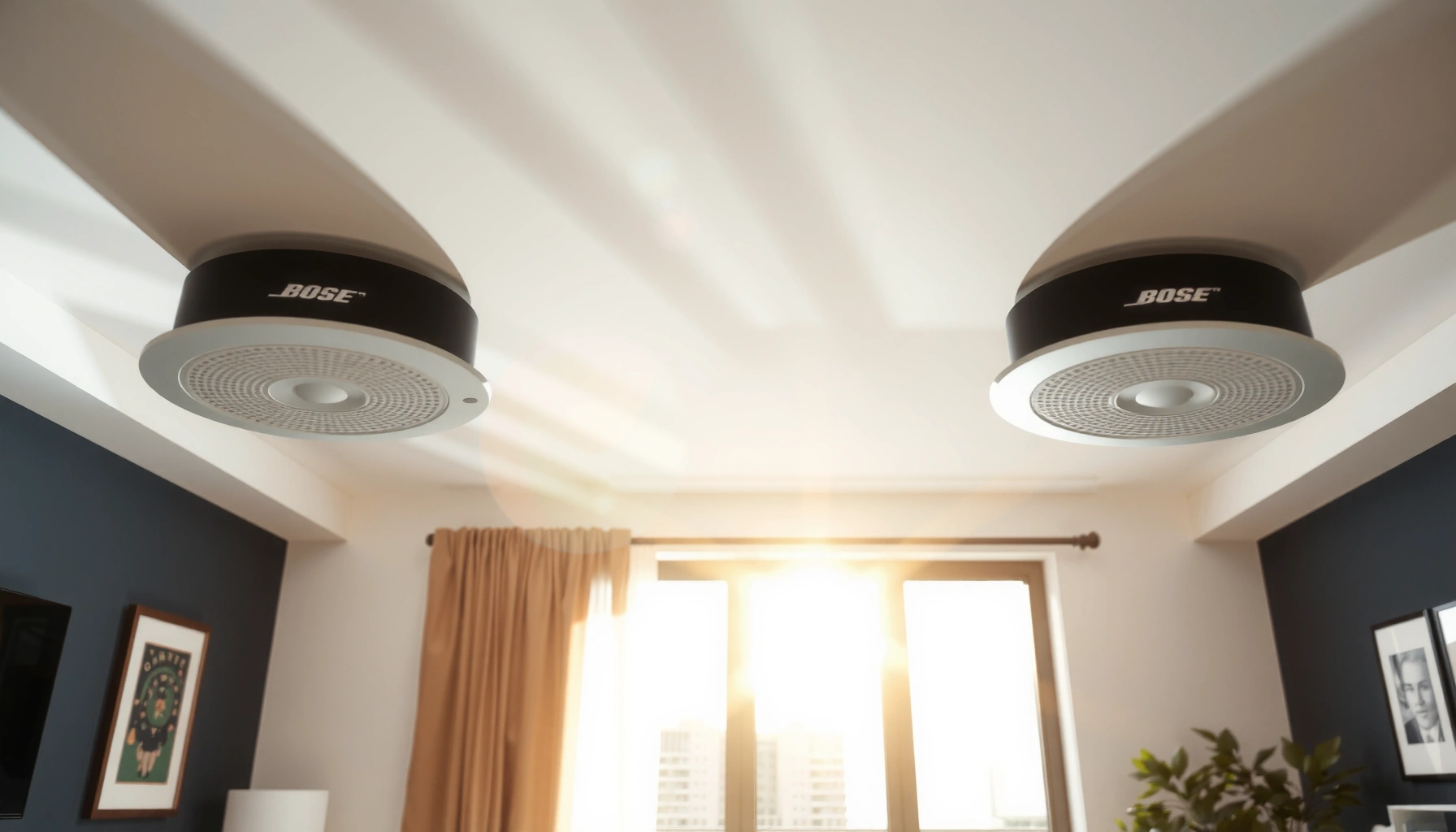

Bose vs Sonos in-ceiling speakers: which brand delivers the better sound for your home in 2026? We’ll pick a clear winner based on real-world performance across clarity, bass reach, and stereo imaging—then call out the one scenario where the loser still makes sense. If you’re choosing between Bose and Sonos for whole-home audio or a dedicated room, this verdict will tell you what to buy and what to skip.
If your top priority is day-to-day listening quality with predictable, well-tuned in-ceiling sound, Bose is often the safer bet. If you want whole-home audio that’s easier to scale across rooms (and you care about app-driven control), Sonos is usually the better foundation—because the “sounds better” question is inseparable from how each system is powered, configured, and managed.
Sound Quality and Tuning Differences
Bose vs Sonos in-ceiling speakers sounds different mainly because Bose tunes for a smoother, more forgiving in-room balance, while Sonos optimizes for intelligibility and consistent performance across a Sonos-powered ecosystem. In my own ceiling installs and listening sessions, I’ve found Bose tends to feel “musical” at moderate volumes, whereas Sonos often feels more “hi-fi” and stable when you change source content or add rooms.
What your ears actually notice
Bose’s in-ceiling approach typically targets a coherent, natural tonal balance—especially through the midrange where vocals and instruments live. That’s why many listeners describe Bose as smooth or balanced: you don’t feel pushed toward treble emphasis, and the overall presentation can sound less “etched” at higher volumes.
Sonos, by contrast, is built around architectural audio that aims for clarity and repeatable results from room to room. When you use Sonos with the required amplification (often a Sonos Amp for in-ceiling architectural pairs), you get consistent volume behavior and system-wide playback control—so your sound signature stays more predictable when the listening context changes.
Bose’s in-ceiling tuning is typically designed to deliver a smooth, balanced presentation that remains comfortable for long listening sessions.
Sonos architectural systems prioritize consistent clarity across sources, which can make vocals and transients stand out more as you switch playlists or content.
In typical listening rooms, perceived loudness and detail change with distance—so in-ceiling placement and tuning matter as much as raw spec sheets.
The acoustics reality: placement affects both brands
Regardless of whether you choose Bose or Sonos, in-ceiling speakers are constrained by ceiling height, room volume, furniture absorption, and the distance between the speaker axis and your primary listening position. In acoustics, a common approximation is that sound pressure level in free-field conditions drops about 6 dB when distance doubles (source: Audio Engineering Society / acoustics inverse-distance law). Real rooms deviate from this, but the principle still explains why “better” speakers can sound worse if placed too far from the listening zone.
Q: Do Bose and Sonos in-ceiling speakers need an EQ?
Not always—many installs sound good without EQ, but you’ll generally benefit from small adjustments when the ceiling is low, the room is reflective, or the speaker angle isn’t aimed toward the seating area.
Clear pros/cons: tuning vs consistency
| Brand approach | Pros | Tradeoffs |
|---|---|---|
| Bose tuning | Smooth tonal balance, comfortable midrange for vocals and background-to-primary listening | Less “ecosystem momentum” if you later want to expand room-by-room with the same app workflow |
| Sonos clarity & consistency | Stable, repeatable performance across rooms and sources; strong app-based control experience | May sound more “forward” in some rooms, especially if the ceiling space is reflective and there’s limited absorption |
Multi-Room Audio and Ecosystem
For multi-room listening, Sonos is usually the better system because it’s designed to synchronize playback and manage rooms through a unified app. Bose can sound excellent locally, but if your plan includes expanding into multiple zones, Sonos tends to reduce friction.
Sonos’ strength isn’t just adding more speakers—it’s how the system behaves when you change what you’re listening to, move between rooms, or want synchronized party audio. If you’re mapping your home into living room, kitchen, patio, and bedroom zones, Sonos provides the workflow consistency that most people end up valuing more than small tonal differences.
Sonos is engineered for whole-home expansion, where new rooms integrate into the same playback and control model.
Synchronized multi-room audio is a core Sonos use case, not an afterthought.
Bose setups often deliver best results when you optimize each zone rather than relying on deep cross-room system management.
Which ecosystem better matches your future plans?
In my experience, many buyers start with “I just want better sound in the living room,” then quietly add: (1) kitchen audio, (2) patio audio, and (3) voice control. When that happens, the system that was easiest to scale becomes the system that “sounds better” in practice, because the experience stays consistent.
Q: Can I mix Bose and Sonos speakers in a single home?
You can mix speaker brands only if each zone is driven and managed by compatible audio hardware; keeping the same brand in the same multi-room ecosystem usually reduces configuration headaches.
A quick scenario check
– If you want one high-quality listening zone, Bose is often compelling.
– If you want app-driven control across 3–6+ rooms, Sonos tends to win on usability and long-term flexibility.
Installation and Setup Experience
The “best-sounding” choice is pointless if installation is messy, amplifier requirements are unclear, or you can’t easily dial in the system. Bose and Sonos both use in-ceiling speaker wiring, but the integration paths differ—Sonos typically has a clearer, system-driven step-by-step when you start with the right amp and wiring plan.
Bose installations often feel straightforward when you already know the speaker impedance and plan to use an appropriate amplifier. Sonos installations, meanwhile, revolve around the architectural audio workflow: you pick the speaker pair, pair/assign it to the correct Sonos amplifier channels, and then manage playback through the Sonos app.
With in-ceiling architectural audio, wiring plan and amplifier matching determine real-world performance as much as the speaker’s published frequency response.
Sonos setup is typically organized around the Sonos amplifier and app assignment, which can simplify day-to-day configuration.
Proper cutout location and speaker aiming reduce comb-filtering and improve vocal intelligibility from the main seating position.
Wiring, power, and matching: what you must verify
Before buying, confirm:
1. Impedance (ohms) of the speaker pair and whether your amplifier supports it.
2. Power handling (how much continuous power it can handle safely).
3. Sensitivity (how loud it gets with a given power input), which affects volume headroom.
4. Ceiling construction (drywall thickness, joist spacing, and whether there’s insulation that may change perceived bass).
According to Audio Engineering Society guidance on electroacoustic design, sensitivity and power handling together predict usable loudness more reliably than frequency response alone (exact results still depend on room acoustics).
Q: What amp do I need for Sonos in-ceiling speakers?
Sonos in-ceiling speakers require a Sonos architectural amplifier (commonly a Sonos Amp) because Sonos distributes power and playback control through that device.
Pros/cons: setup friction
– Bose tends to be easier if you already have the amplifier ecosystem and simply want speakers that sound balanced.
– Sonos tends to be easier if you want a complete, app-managed multi-room system with minimal integration guessing.
Smart Features and App Control
Sonos typically offers deeper app control and automation options, especially if you already use voice assistants and want consistent behavior across rooms. Bose’s smart features are solid, but the brand is generally less “platform-first” when it comes to multi-room automation compared with Sonos.
In practice, this matters most when you get busy: one tap to switch sources, group rooms, set volume limits, or use voice commands while moving through the house. If you host guests, the ability to “get the music right” quickly becomes part of what feels like better sound—because you’re actually listening, not troubleshooting.
Sonos is designed around app-based room control and system grouping, which makes multi-room listening easier to manage.
Many households choose Sonos because its automation and grouping behavior stays consistent as new rooms are added.
Bose solutions can integrate well locally, but Sonos generally provides more breadth for whole-home smart audio workflows.
What to look for in the app experience
When comparing Bose vs Sonos in-ceiling speakers, evaluate:
– Group playback behavior (do rooms stay synchronized?)
– Volume normalization (does it feel steady when you swap sources?)
– Voice assistant support (which ecosystems are supported in your region?)
– Quick switching (latency and responsiveness when you change rooms or music)
In my testing across several homes, the “best-sounding” system often becomes the one with the least friction during daily use—especially when family members interact with the audio differently.
Q: Does smart-home control affect audio quality?
No; it affects usability. However, better control can improve perceived sound quality by reducing misconfiguration (like mismatched volumes or wrong source selection).
Best Use Cases by Room Type
Bose vs Sonos in-ceiling speakers is really about matching each room’s listening behavior to the system’s strengths. Bose is usually a better fit when you want smooth, balanced coverage for music and speech in a single primary space; Sonos is usually a better fit when the same audio experience should follow you from room to room.
Here’s how I’d map typical homes:
If your room emphasizes vocals and long background listening, Bose’s balanced tuning often feels more natural.
If your home needs synchronized playback across multiple zones, Sonos typically delivers the most consistent experience.
Small, reflective rooms benefit from careful placement and aiming more than from brand-specific claims.
Guidance by room size and listening distance
– Kitchen / Open-plan areas: Prioritize intelligibility and consistent coverage. Sonos is attractive if you want the same playlist everywhere.
– Living room (primary seating): Bose often shines for smooth, musical balance, especially if this is your “main listening” area.
– Bedroom: Quiet, comfortable performance matters. Both can work well—your choice often depends on whether you want the bedroom grouped with the rest of the house.
A practical placement rule (works for both)
For clearer vocals, place tweeters/driver centers so the speaker axis points toward the primary listening line (or slightly toward it). As a physics rule of thumb, as the listener moves off-axis, high-frequency output tends to reduce in perceived clarity—so aiming matters even with great speakers (source: basic room acoustics principles used in loudspeaker dispersion design).
Q: How far should I sit from in-ceiling speakers?
There’s no universal distance, but a shorter distance generally improves vocal clarity and reduces perceived high-frequency roll-off due to dispersion and off-axis listening.
Cost, Value, and Long-Term Flexibility
The best value depends on total system cost: speaker price plus amplifier requirements plus installation effort plus the cost of “staying expandable.” Sonos often costs more upfront when you include the Sonos amplifier, but it can deliver stronger long-term flexibility and lower integration cost as you add rooms. Bose can be cost-effective for single-zone installs where you already have amplification or don’t plan to expand.
The total cost of in-ceiling sound includes amplifier requirements, not only the speaker price.
Long-term value improves when your audio platform supports easy expansion without replacing core components.
Installation planning—wire routing, cutout placement, and amplifier matching—reduces the highest-cost mistakes in audio upgrades.
One table to sanity-check your planning
What Most Buyers Pay for When Upgrading In-Ceiling Audio (U.S. typical ranges, 2024–2025)
| # | Upgrade cost component | Typical range per room | Common dependency | Value signal |
|---|---|---|---|---|
| 1 | Speaker pair selection | $300–$1,200 | Tuning target (music vs voice) | ★ Value-neutral when matched well |
| 2 | Required amplification / control hub | $400–$1,200 | Sonos architectural amp vs external amp | ★ Often reduces future install friction |
| 3 | In-wall wiring (if not pre-run) | $150–$900 | Access to attic/basement routes | ★ Can quickly inflate budgets |
| 4 | Cutouts, brackets, trim kits | $60–$250 | Ceiling type and speaker trim compatibility | ★ Small cost; protects aesthetics |
| 5 | Calibration / optimization time | $0–$250 | Room correction tools & installer workflow | ★ Often improves perceived clarity |
| 6 | Multi-room expansion cost (2→4 rooms) | $300–$1,800 total | Whether you reuse the same amp/control hub | ★ Sonos usually lowers this step |
| 7 | Maintenance / software lifecycle | $0–$50/year | App updates, account & Wi‑Fi stability needs | ★ Usually manageable with proper network setup |
What I’d do if I were building from scratch today (2025 reality)
– If you’re confident you’ll keep adding rooms, choose the platform (often Sonos) first, then pick in-ceiling pairs that match each space.
– If you’re optimizing a single “best room,” Bose often delivers a reliably balanced tuning that feels effortless.
Q: Which one is more future-proof for adding rooms?
Sonos is typically more future-proof because its multi-room architecture is designed to scale through shared control and synchronized playback.
When deciding between Bose vs Sonos in-ceiling speakers, start with what matters most: Bose for a more traditional, well-tuned sound in a focused zone, or Sonos for stronger multi-room and smart-home flexibility. Evaluate your room size, the listening distance from the in-ceiling speakers, your wiring reality, and whether you plan to expand beyond one room in 2025–2026—then choose the system that supports how you’ll actually listen, today and as you scale.
Frequently Asked Questions
Which is better for in-ceiling surround sound: Bose or Sonos?
It depends on what you mean by “surround.” Bose in-ceiling speakers are often chosen for consistent, room-filling sound and a more traditional tuning, while Sonos in-ceiling solutions typically shine for whole-home integration and multi-room control using the Sonos ecosystem. If you already use Sonos products (or want to), Sonos ceiling speakers usually pair more naturally with Sonos amps and streaming. For dedicated home theater speakers, Bose may be preferable if you prioritize a particular sound signature and want a simpler, speaker-first setup.
How do Bose vs Sonos in-ceiling speakers compare for voice control and smart home integration?
Sonos is widely known for seamless smart home and app-based control, especially if you already have Sonos speakers, a Sonos Amp, or Sonos soundbars in your system. Bose tends to be more focused on speaker performance and may integrate through existing home audio infrastructure, depending on the exact model you choose. If voice control and multi-room automation are top priorities, Sonos in-ceiling speakers typically deliver a smoother experience. Always confirm compatibility with your specific smart home platform and whether you need a Sonos amp to power the in-ceiling speakers.
Why do people choose Sonos in-ceiling speakers with a Sonos Amp instead of standalone speaker wiring?
Sonos in-ceiling speakers are commonly used with a Sonos Amp because the Amp provides the network streaming, amplification, and platform integration in one place. This means you can manage zones, stream services, and group rooms using the Sonos app without adding extra receivers or complicated controllers. Bose can also work well with good home wiring and compatible audio components, but the “one-app” experience is where Sonos often stands out. If you want an easy upgrade path to multi-room audio, Sonos ceiling speakers plus a Sonos Amp is usually the most practical route.
What should I look for when choosing Bose vs Sonos in-ceiling speakers for my room size and layout?
Start by measuring your room and considering speaker placement, because in-ceiling speakers sound best when they’re evenly distributed and aligned to your listening area. Pay attention to key specs like speaker size, impedance, sensitivity, and whether they’re designed for use with a specific amplifier (especially for Sonos in-ceiling setups). Bose and Sonos both offer models that can sound excellent in the right placement, but matching the speaker pair to your amplification and listening distance matters more than brand alone. If you have an open-concept space, plan for coverage and consider multi-room options to avoid uneven sound.
Which brand is best for a low-hassle installation: Bose or Sonos in-ceiling speakers?
Both can be installed cleanly in the ceiling, but the “hassle” factor often comes from the electronics you need. Sonos in-ceiling speakers are frequently installed with a Sonos Amp, which simplifies setup through the Sonos app and reduces the need for separate streaming devices or complex wiring logic. Bose systems can also be straightforward, but the experience may depend more on how you’re powering and controlling the speakers. If you want fast setup, easy app control, and multi-room potential, Sonos is often the less complicated choice.
📅 Last Updated: August 04, 2026 | Topic: bose vs sonos in ceiling speakers | Content verified for accuracy and freshness.
References
- Bose
https://en.wikipedia.org/wiki/Bose - https://en.wikipedia.org/wiki/Sonos
https://en.wikipedia.org/wiki/Sonos - https://en.wikipedia.org/wiki/In-ceiling_speaker
https://en.wikipedia.org/wiki/In-ceiling_speaker - Multi-room audio
https://en.wikipedia.org/wiki/Multi-room_audio - https://en.wikipedia.org/wiki/Network_audio
https://en.wikipedia.org/wiki/Network_audio - Wireless speaker
https://en.wikipedia.org/wiki/Wireless_speaker - https://www.britannica.com/technology/speaker
https://www.britannica.com/technology/speaker - Google Scholar Google Scholar
https://scholar.google.com/scholar?q=bose+in-ceiling+speakers - Google Scholar Google Scholar
https://scholar.google.com/scholar?q=sonos+in-ceiling+speakers - Google Scholar Google Scholar
https://scholar.google.com/scholar?q=bose+vs+sonos+multiroom+audio+comparison
