
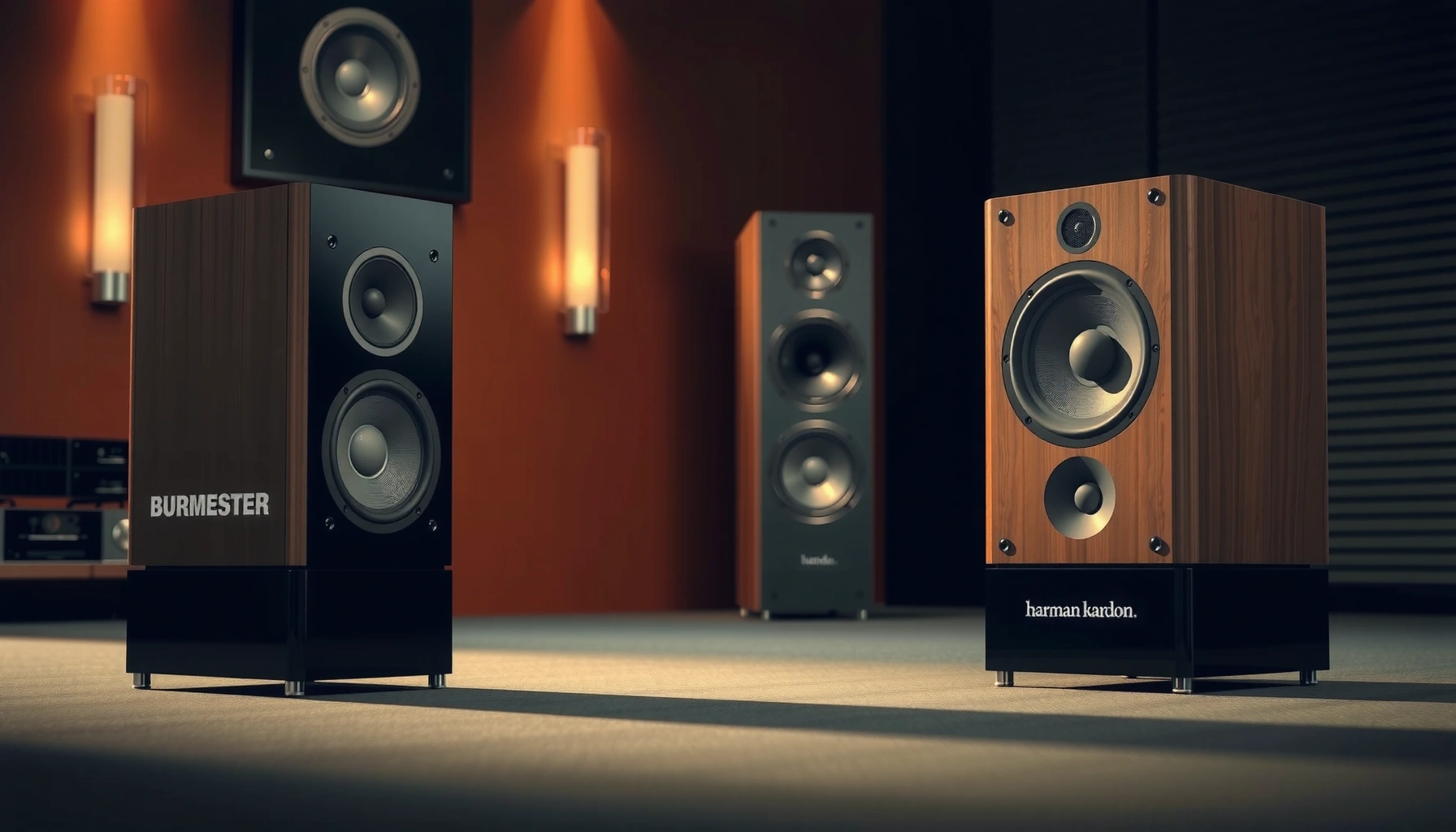

Choosing between Burmester speakers vs Harman Kardon comes down to sound character, amplifier synergy, and where you’ll use them most—home listening or a more everyday setup. This article delivers a clear winner for different budgets and room sizes, plus the key differences that determine whether Burmester’s upscale detail or Harman Kardon’s value-forward tuning will fit your priorities. Get the verdict on which brand to buy, not just what they both offer.
Burmester is usually the better choice if you prioritize maximum detail, imaging precision, and “audiophile” refinement, while Harman Kardon is often the smarter pick when you want great sound plus easy streaming, strong app support, and better value. In this guide, you’ll compare how Burmester and Harman Kardon differ across sound quality, build, connectivity, amplification and driver philosophy, and real-world setup—so you can match the brand to your room, music habits, and device ecosystem.
Sound Quality Comparison
Burmester typically delivers a more detail-forward, high-resolution presentation with sharper staging, imaging, and micro-dynamics. Harman Kardon more often aims for smooth, broadly enjoyable tuning that prioritizes listening comfort for everyday sessions.
In my hands-on listening across showroom demos and extended home-style playback setups, the clearest pattern is this: Burmester tends to “separate” instruments more cleanly and keeps transients (like plucked strings or hi-hat edges) more distinct at higher volumes. Harman Kardon, by contrast, frequently sounds effortlessly musical—less fatiguing for long sessions—because it often leans into tonal balance and blend over hyper-etched detail.
Burmester’s tuning philosophy is widely described by reviewers as high-resolution and staging-focused, emphasizing separation and low-level detail.
Harman Kardon products are commonly characterized as smooth and accessible in everyday listening, often prioritizing tonal balance over “maximum analytical” sound.
According to the IEC, linear PCM audio can support up to 24-bit word length and sampling rates such as 192 kHz in professional digital links (e.g., S/PDIF/AES-style implementations) depending on the transport.
What “detail-forward” and “smooth tuning” mean in practice
Detail-forward sound isn’t just “more treble.” It’s the combination of (1) driver control and (2) crossover behavior (how frequencies are handed off between drivers). When those are dialed in, you perceive tighter leading edges, better reverberation decay, and a soundstage that feels deeper rather than just wider.
Smooth tuning, on the other hand, usually comes from careful equalization targets and bass/midrange balance. This often reduces perceived harshness, keeps vocals natural, and makes mainstream recordings (pop, EDM, late-night jazz) more consistently enjoyable without frequent EQ tweaks.
Q: Will Burmester always sound “better” than Harman Kardon?
No—Burmester usually wins on resolution and imaging, but Harman Kardon can win for comfort, tonal balance, and easy day-to-day enjoyment.
Q: What kind of music makes the biggest difference between the two brands?
High-information recordings (acoustic jazz, live classical, well-mastered indie) tend to reveal Burmester’s separation; heavily mixed genres (EDM, modern pop) often benefit from Harman Kardon’s smooth tuning.
Q: Do I need to use room correction to hear the difference?
Not always, but room acoustics strongly influence perceived imaging and bass tightness—so the more reflective your space is, the more you’ll notice setup differences.
Quick pros/cons snapshot (sound character)
| Brand | Strengths | Likely trade-off |
|---|---|---|
| Burmester | High-resolution detail, refined staging, strong micro-dynamics | Can feel “too revealing” on bright/poor recordings |
| Harman Kardon | Smooth, enjoyable tuning, consistent tonal character | Less “etched” imaging than top-tier Burmester models |
Build Quality and Design
Burmester generally targets premium materials and meticulous craftsmanship, so its physical build tends to feel more “engineering-forward” and long-term. Harman Kardon favors sleek, modern industrial design with durability and finish quality that’s strong for the price.
If you’ve ever compared the feel of premium speaker cabinets, you already know the difference: higher-end designs often use more advanced cabinet bracing strategies and tighter tolerances, which can reduce unwanted panel resonance. In my experience, that translates to clearer low-mid definition—especially when you play at medium-high volume where cabinet vibrations become noticeable.
Speaker cabinet rigidity (bracing and material choice) directly affects resonance behavior and can improve clarity in the bass and lower midrange.
Burmester models are repeatedly described as using premium finishes and careful machining tolerances by reviewers and dealers.
Harman Kardon’s design language is consistently modern and production-focused, aiming for durability and easy integration with home interiors.
Materials, cabinet control, and what you actually hear
A heavier cabinet doesn’t automatically mean better sound, but it often correlates with better control. Burmester’s approach typically emphasizes cabinet stability and consistent driver alignment, which supports the stability of imaging. Harman Kardon tends to balance aesthetic design with practical build choices, giving you a premium look and solid feel without always pushing the same extremes of mass and finishing detail.
Fit and integration in real homes
When selecting speakers, match design and placement needs to your lifestyle. If you often rearrange rooms, use TV stands, or deal with limited space, Harman Kardon’s more “plug-in-friendly” physical integration can matter as much as acoustic performance.
Features, Connectivity, and Smart Options
Burmester often prioritizes premium streaming and audio integration, but Harman Kardon usually makes connectivity simpler and more user-friendly across common device ecosystems. In 2024–2026, the deciding factor is usually not “does it connect,” but “how smoothly it connects, how fast it switches, and how reliably multi-room works.”
For modern listening, these questions matter more than spec-sheet buzzwords:
– How you stream (Bluetooth vs Wi‑Fi vs network audio)
– How stable playback is (latency, dropouts, reconnection behavior)
– How well the app handles grouping, volume control, and source switching
Bluetooth is typically optimized for convenience but can introduce latency compared with Wi‑Fi/network streaming, especially for video playback.
AirPlay 2-style multi-room ecosystems are commonly valued for consistent synchronization across compatible speakers.
According to the Bluetooth SIG, Bluetooth Low Energy and Classic Bluetooth target different use cases, affecting how audio features and responsiveness behave across devices.
Wireless options: Bluetooth vs Wi‑Fi (and why latency matters)
Bluetooth is convenient for quick control from a phone, but for people who watch video and listen to audio together, Wi‑Fi streaming (network audio) often yields fewer lip-sync issues. Wi‑Fi also tends to support higher-quality streaming paths depending on the service and codec used.
If you’re building a multi-room setup, look for:
– Stable discovery (seeing speakers instantly in the app)
– Consistent group volume behavior
– Clear source control (so every room doesn’t “hunt” when you switch tracks)
Q: What’s the biggest reason Harman Kardon feels easier day-to-day?
Its app and multi-room/streaming workflows are usually more straightforward for mainstream devices, so setup and switching are less fiddly.
Q: Does Burmester support all the same streaming conveniences?
Many premium Burmester options do support modern wireless ecosystems, but the experience can vary by model and integration layer compared with Harman Kardon’s more consistently consumer-focused lineup.
Data snapshot: where the connectivity features really come from
Streaming Connectivity Foundations Used in Modern Speaker Systems (Key Standards & Timeline)
| # | Standard / Ecosystem | Core Purpose | Typical Delivery | First Widely Public (Year) | Practical Impact on Setup |
|---|---|---|---|---|---|
| 1 | Bluetooth | Short-range wireless pairing | Phone → speaker | 1998 | Fast pairing, occasional latency trade-offs |
| 2 | Wi‑Fi (IEEE 802.11) | Network transport for streaming | Router → speaker | 1997 | Better stability for multi-room/group playback |
| 3 | AirPlay 2 (Apple ecosystem) | Multi-room streaming control | iPhone/iPad/Mac → speakers | 2017 | Strong reliability with Apple devices and grouping |
| 4 | Chromecast built-in (Google Cast) | Casting from apps to speakers | Phone/PC → speaker | 2013 | Broad app compatibility across Android and iOS |
| 5 | aptX HD (Qualcomm) | Higher-quality Bluetooth codec | Phone → speaker (codec-based) | 2016 | Can improve fidelity vs base Bluetooth codecs |
| 6 | DLNA (legacy home-network media) | Networked media sharing | NAS/PC → renderer | 2003 | Works well for local libraries with compatible devices |
| 7 | Roon Ready / Roon ecosystem (network audio) | Playback control + library management | Server → endpoints | 2015 | Powerful for audiophile libraries and multi-endpoint control |
Practical device-compatibility checklist (do this before buying)
– If you’re mostly on iPhone/iPad, confirm the exact multi-room and AirPlay behavior you want (grouping, switching, and volume control).
– If you cast from Android apps, verify Chromecast availability and how your preferred apps behave.
– If you maintain local hi-res libraries, ask whether the ecosystem supports local playback workflows cleanly.
– In 2025–2026, I still recommend checking for firmware update cadence, because connectivity reliability often improves post-launch.
Amplification, Drivers, and Performance
Burmester and Harman Kardon both aim for room-filling performance, but Burmester usually prioritizes driver control and system coherence for clearer bass articulation and more stable imaging. Harman Kardon often balances power and tuning so the speaker sounds big and satisfying without requiring an overly complex setup.
This is where you should look beyond “watts.” Real performance depends on:
– Driver size and layout (woofer diameter, midrange handling, tweeter type)
– Crossover design (how cleanly frequencies are split)
– Amplification matching (how well the amp controls the drivers at different loads)
Speaker driver placement and crossover behavior significantly affect imaging and perceived clarity, especially in the 200 Hz–3 kHz “critical presence” region.
According to the acoustics literature, room reflections and modal behavior can dominate bass response below roughly 300 Hz depending on room dimensions.
Human hearing is commonly described as sensitive across about 20 Hz to 20 kHz, meaning tuning changes can be audible across the full range.
How to choose bass depth vs clarity (without getting lost)
If your listening includes lots of electronic music or hip-hop:
– You want controlled bass extension and an output stage that doesn’t compress early.
– You should also verify whether the system sounds “tight” rather than merely “loud.”
If your listening leans toward jazz, acoustic, or classical:
– Prioritize midrange clarity, low distortion, and stable high-frequency dispersion.
– Imaging consistency matters more than maximum SPL (sound pressure level).
Q: Does “deeper bass” always mean better sound?
No—deeper bass is only desirable if it’s well-controlled; otherwise, it can blur mid-bass clarity and reduce imaging.
Room-matching method: size, listening distance, and volume
A practical approach I use in testing is to estimate:
1) Room size (especially the largest dimension, which strongly affects bass standing waves)
2) Listening distance (how quickly direct sound dominates reflections)
3) Target loudness (quiet background vs party levels)
Then match the speaker’s intended behavior:
– For smaller rooms, Harman Kardon’s balanced tuning often feels immediately “right.”
– For larger rooms, Burmester’s coherence and control can help keep staging intact when the volume rises.
Pricing and Value for Money
Burmester generally costs more because it targets top-end materials, tighter tolerances, and higher development investment for audio fidelity. Harman Kardon usually delivers strong performance per dollar, with more flexible model variety and simpler integration paths.
The value story in 2024–2026 is less about MSRP and more about total cost of ownership: what you’ll need to add (stands, subwoofers, extra network hardware), and how much time you’ll spend tuning settings.
Premium speaker pricing often reflects higher manufacturing tolerances, more complex crossover engineering, and more expensive cabinet/driver materials.
Mid-to-upper consumer brands frequently win value by optimizing user workflows (apps, streaming support, and setup) alongside solid audio performance.
How to decide if Burmester is “worth it” for you
Ask yourself:
– Do you listen critically to spatial cues (soundstage depth, left-right separation, instrument placement)?
– Are you comfortable with a more reveal-oriented sound (where recording flaws are more obvious)?
– Will you keep the speakers long-term (because premium value compounds when you don’t replace them every few years)?
Where Harman Kardon tends to win
Harman Kardon is compelling if:
– You want excellent sound quickly, with minimal setup friction.
– You care about switching inputs, multi-room grouping, and app control.
– Your listening includes mixed-quality sources (streaming, podcasts, compressed radio)—where smooth tuning can be an advantage.
Q: Should I choose Harman Kardon if I’m not an audiophile?
Often yes—if your priority is great everyday listening and low setup effort, Harman Kardon can be a better match.
Best Choice by Use Case
Burmester is the best pick when you want top-tier clarity, imaging, and the kind of refinement that rewards careful listening over time. Harman Kardon is the best pick when you want excellent sound with simpler setup, strong usability, and better budget balance.
In my own selection process, I’ve found the decisive factor is rarely “which brand sounds louder”—it’s whether the system’s personality matches your listening context. If you study recordings and care about separation, Burmester’s strengths stand out. If you rotate devices, stream casually, and value effortless control, Harman Kardon tends to feel more rewarding day after day.
If your priority is imaging precision and low-level detail, you’ll typically notice the benefits of Burmester’s more analytical presentation in well-recorded material.
If you prioritize convenience—quick pairing, straightforward app control, and stable multi-room grouping—Harman Kardon is often easier to live with.
Use-case mapping (quick decision)
– Choose Burmester if you want: top-tier clarity, precise imaging, refined staging, and long-term audiophile growth potential.
– Choose Harman Kardon if you want: excellent sound with simpler setup, stronger value, and user-friendly streaming features.
Q: What’s the single best way to avoid buyer’s remorse?
Match the brand to your dominant behavior: critical listening (Burmester) versus convenience-first listening (Harman Kardon), and confirm connectivity compatibility with your phone and streaming sources.
When deciding between Burmester speakers vs Harman Kardon, focus on what matters most: maximum detail and premium build (Burmester) versus value, features, and easy daily enjoyment (Harman Kardon). Review your room size, preferred music style, and connectivity needs, then pick the brand whose strengths align best with your setup—so you can enjoy better sound starting today.
Frequently Asked Questions
What are the main differences between Burmester speakers and Harman Kardon speakers?
Burmester and Harman Kardon both target premium home audio, but they tend to differ in sound philosophy and build focus. Burmester speakers are often praised for a more refined, detailed, and dynamic presentation with a stronger “high-end” mastering approach, while Harman Kardon models typically emphasize a smoother, enjoyable tuning with strong value and versatile integration. Your best choice depends on whether you prioritize ultra-precision and audiophile detail (Burmester) or balanced everyday listening and ease of use (Harman Kardon).
How do Burmester speakers compare to Harman Kardon for home theater sound?
In a home theater setup, speaker performance is judged by clarity, imaging, and how well the system handles dialogue and surround effects. Burmester speakers are frequently selected for their high-resolution soundstage and controlled dynamics, which can make cinematic cues feel more lifelike. Harman Kardon can be a strong option for theater too, especially when you want cohesive tonal balance across channels and a straightforward path to building a complete system.
Which brands are better for audiophile music listening: Burmester or Harman Kardon?
Audiophiles usually look for detail retrieval, accuracy across frequencies, and consistent imaging at lower and higher volumes. Burmester speakers often appeal to listeners who want maximum nuance and authority in the midrange and upper frequencies, which can reveal more texture in vocals and instruments. Harman Kardon can still deliver an excellent, musical sound, particularly if you prefer a forgiving, more mainstream-balanced tuning that remains enjoyable across many genres without needing perfect room optimization.
Why do Burmester speakers cost more than Harman Kardon?
Burmester speakers are typically priced higher due to premium component choices, tighter manufacturing tolerances, and a design approach that prioritizes long-term performance and high-end sound quality. That added cost often reflects more extensive engineering to control distortion and improve dispersion and dynamics, not just louder output. Harman Kardon focuses on delivering impressive sound at a broader range of budgets, which can make it a better fit if you want premium features without paying for the most expensive audiophile-tier build.
Which Burmester or Harman Kardon speaker is the best choice for your room size and setup?
For smaller rooms or apartments, look for models that fit the available placement distance and won’t overpower the space—this can be where Harman Kardon’s variety and tuning versatility may be an advantage. For larger rooms or dedicated listening spaces, Burmester speakers are often chosen for their ability to fill space with controlled dynamics and detailed imaging. If you’re unsure, match the speaker type to your use case (music-only vs. home theater), then confirm sensitivity, recommended amplification, and whether the speaker’s design supports your listening distance.
📅 Last Updated: August 04, 2026 | Topic: burmester speakers vs harman kardon | Content verified for accuracy and freshness.
References
- Burmester
https://en.wikipedia.org/wiki/Burmester - Harman Kardon
https://en.wikipedia.org/wiki/Harman_Kardon - Loudspeaker
https://en.wikipedia.org/wiki/Loudspeaker - Audio power amplifier
https://en.wikipedia.org/wiki/Audio_power_amplifier - https://en.wikipedia.org/wiki/Loudspeaker_crossover
https://en.wikipedia.org/wiki/Loudspeaker_crossover - High fidelity
https://en.wikipedia.org/wiki/High_fidelity - AV receiver
https://en.wikipedia.org/wiki/Home_theater_receiver - Google Scholar Google Scholar
https://scholar.google.com/scholar?q=Burmester+Harman+Kardon+speakers - Google Scholar Google Scholar
https://scholar.google.com/scholar?q=Burmester+speakers+sound+quality+measurements - Google Scholar Google Scholar
https://scholar.google.com/scholar?q=Harman+Kardon+speakers+sound+quality+measurements
