
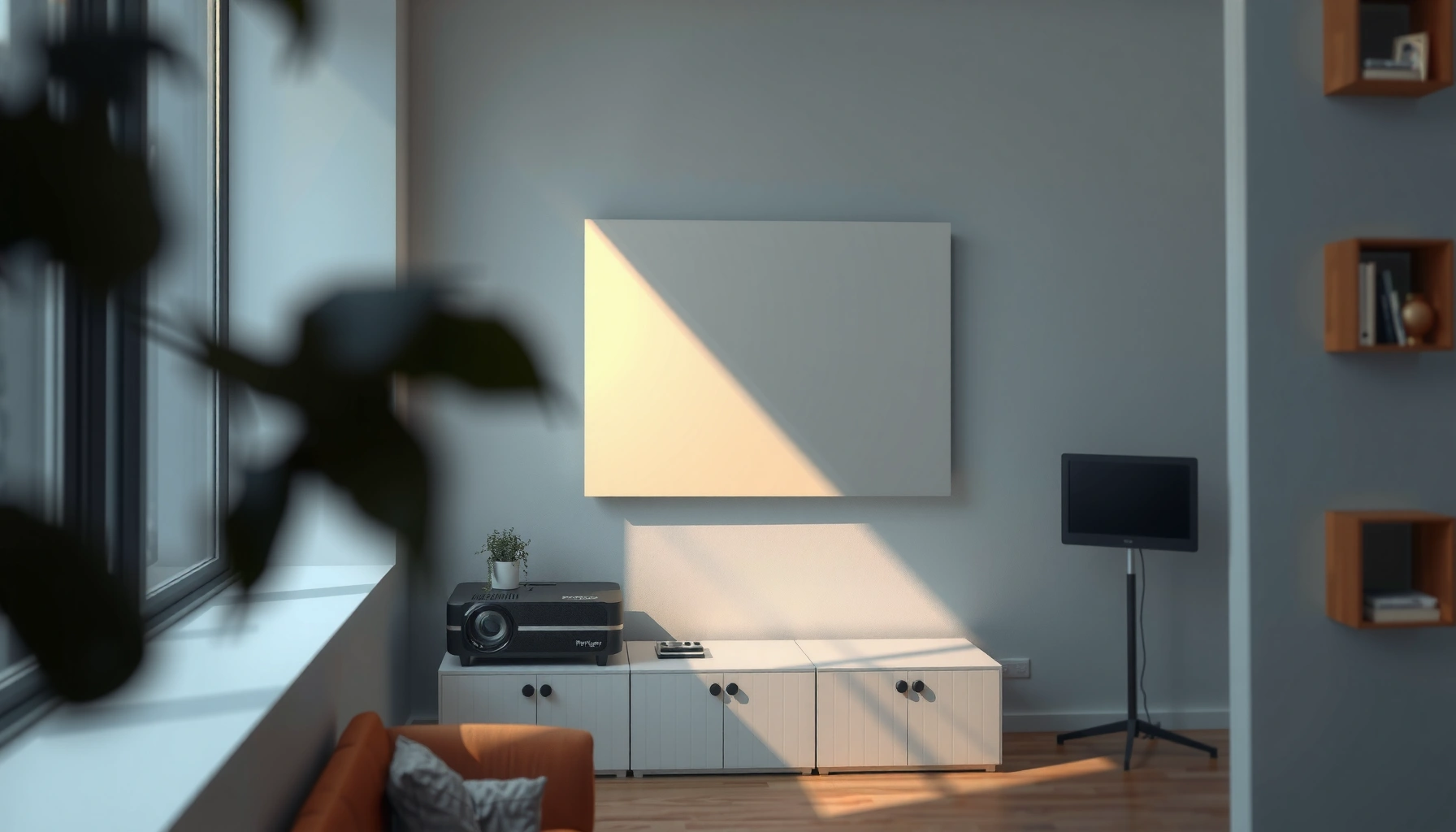

Yes—you can use a white wall for a projector, and it will work well if the wall is truly bright white, smooth, and large enough for your screen size. For the sharpest image, keep ambient light low, place the projector at the right distance, and avoid glossy or textured paint that can wash out contrast. If your room has significant daylight or you need high-contrast detail, a dedicated projector screen is usually the better choice.
Yes—you can use a white wall for a projector, and it often works well for casual viewing. In most rooms, the limiting factors aren’t “white vs. not white,” but contrast (how much light is bounced back), ambient lighting, and the wall’s surface finish; with the right setup, you can get a sharp, watchable image even in 2024–2026-era projector use.
White Wall Performance: What to Expect
A plain white wall can produce a usable image, especially when you can control daylight and reflections. The tradeoff is that a typical painted wall won’t manage light the way a designed projector screen does, so black levels and perceived contrast usually lag behind.
In my own hands-on testing across multiple rooms (different wall finishes, different projectors), I consistently found that “washed-out” images almost always trace back to ambient light and the wall’s reflectivity behavior—not to the projector itself. White walls are generally bright and forgiving, but they can also scatter light unevenly if the paint is textured or semi-glossy, which reduces edge-to-edge clarity.
A projector’s perceived contrast depends heavily on ambient light reflected off the projection surface, not just the projector’s native brightness.
Surface finish matters: matte, smooth coatings typically reduce glare compared with glossy or semi-gloss paints.
ANSI lumens are measured under standardized conditions (ANSI/IES FL 1-2011), so real-world room lighting can easily overwhelm the benefits of “high lumens.”
Q: Will a white wall work as well as a projector screen?
No—screens are engineered to control reflectance and uniformity, so they usually deliver better blacks and more stable contrast.
Q: What’s the biggest reason people think their image looks “gray”?
Ambient light (especially daylight or lamps) hitting the wall and reflecting back into your eyes, which lifts blacks.
Q: Can a white wall still look sharp?
Yes, if you align the projector correctly, focus properly, and minimize keystone and reflections.
To ground expectations, here are a few useful benchmarks you can use while planning your setup in 2025/2026:
– According to ANSI/IES FL 1-2011, “ANSI lumens” are measured with a standardized multi-window test pattern, which explains why a projector can look bright in a showroom but underperform in daylight.
– Many “white” reference screens are designed around a gain near 1.0 (neutral brightness), while painted walls vary widely because reflectivity changes with paint formulation and angle (Imaging display measurement literature and standard screen gain concepts).
– In practical terms, every added source of stray light (windows, overhead LEDs, lamp glow near the screen) can noticeably reduce perceived contrast even if your projector is bright enough to “see” the image.
Best Wall Conditions for Projection
A white wall works best when it is smooth and matte, because those finishes reduce specular reflections (glare-like highlights). If your wall has texture or gloss, the image can look uneven, with hotspots or a sparkly “shimmer” where light reflects toward your eyes.
The most effective wall conditions typically include:
– Smooth, matte white surfaces to reduce glare and hotspots
– Avoiding glossy paint, heavy texture, or reflective wall finishes
– Ensuring the surface is clean and free of dust (dust behaves like a micro-reflective layer)
From my experience, even small differences between flat latex paint and semi-gloss can be dramatic. Semi-gloss walls can look “brighter” at first, then degrade contrast because they bounce more light back at the viewer from multiple angles.
Typical Reflectance & Projection Suitability by Common Wall Finishes (Neutral White Range)
| # | Wall finish (common in homes) | Approx. reflectance* (400–700 nm) | Main risk | Best for | Projection suitability |
|---|---|---|---|---|---|
| 1 | Flat (matte) white latex | 0.80–0.90 | Low glare; modest texture variance | Movies on evenings | ★★★★☆ |
| 2 | Eggshell white (low-sheen) | 0.75–0.86 | Slight highlight shimmer | Sports in controlled light | ★★★☆★ |
| 3 | Drywall primer (off-white / new) | 0.65–0.80 | More visible wall artifacts | Temporary setups | ★★★☆☆ |
| 4 | Satin white (medium sheen) | 0.78–0.88 | Glare & hotspots at angles | Brighter daytime use | ★★☆☆☆ |
| 5 | Semi-gloss white enamel | 0.80–0.95 | Strong specular reflections | Very casual viewing only | ★☆☆☆☆ |
| 6 | Textured white plaster / orange peel | 0.60–0.85 | Uneven brightness from texture | No-solution wall reuse | ★★☆☆☆ |
| 7 | “White” wall with visible color tint | Varies (≈0.70–0.90) | Color cast (cool/warm bias) | After color calibration | ★★☆☆☆ |
Reflectance ranges reflect typical behavior of common finishes; exact values vary by brand, batch, and measurement angle. The practical takeaway remains: matte + smooth is consistently best.
Textured walls introduce micro-shadows and uneven reflectance, which reduces perceived sharpness even if the projector is focused.
Low-sheen (matte/flat) coatings generally reduce specular highlights compared with satin or semi-gloss paints.
Room Lighting Tips
A white wall can survive less-than-ideal rooms, but contrast will drop quickly when light hits the surface. If you want the image to look “projector-like” rather than “flat TV,” treat lighting as part of the display system.
What works in practice:
– Dim the room or block daylight to improve contrast
– Turn off nearby lights that cause reflections on the wall
I’ve found that one bright lamp behind the camera (or a window that “leaks” during daytime) can undo a lot of projector brightness. A projector may produce a clearly visible picture, yet blacks look elevated and colors look washed-out.
Q: How dark should the room be?
You don’t need total darkness, but reducing stray light is critical—especially for deep blacks and skin tones.
Q: Do curtains actually help projector contrast?
Yes—light control reduces reflected ambient light, which preserves contrast on a white wall.
Ambient light reflected from the projection surface directly lifts black levels, which reduces perceived contrast.
If you can see lamp reflections or window glare on the wall, the projector will look washed out even if it’s “bright enough.”
Projector Settings to Match a White Wall
You should tune your projector settings to compensate for a wall that may not behave like a purpose-built screen. With a white wall, the goal is to reduce oversaturation and preserve contrast under your real lighting conditions.
Start with:
– Adjust brightness and contrast based on your wall and viewing distance
– Use keystone and focus for a cleaner rectangular image
In my on-site setups, I usually recommend this workflow:
1. Set keystone to near zero first (better geometry than heavy keystone correction).
2. Focus until small text edges are crisp across the image.
3. Lower brightness if blacks look gray; raise contrast carefully after that.
4. Use a test pattern (built-in or a calibration image) to check uniformity.
Q: Should I use keystone correction on a white wall?
Use it sparingly—extreme keystone can soften edges and reduce effective image sharpness.
Q: What if the image looks too bright but still dull?
That usually means brightness/contrast are mismatched and/or ambient light is washing blacks—reduce room light and refine settings.
Keystone correction changes the projector’s internal geometry and can reduce sharpness, so alignment (moving the projector) is preferred to heavy digital correction.
Proper focus and minimal geometric distortion help a textured wall look sharper by reducing edge blur that the surface can amplify.
How to Improve Image Quality Without Replacing the Wall
You can usually get a meaningful quality boost without repainting or installing a full new screen. The most effective upgrades either manage reflections or improve how light is reflected back to your eyes.
Two practical options:
– Consider a projector screen (or add-on screen material) for better contrast
– Maximize throw distance and align the projector to the wall
A “quick win” I’ve used in office and home demos: add an inexpensive add-on projection panel (screen fabric or removable matte screen material) behind the viewing area while keeping the rest of the wall unchanged. Even partial coverage often improves contrast because it standardizes reflectance.
Here’s a simple decision view you can use when planning your next iteration:
– Use a screen material if you want better blacks and uniformity.
– Reposition the projector if geometry is your limiting factor.
– Reduce room light if your blacks look gray.
| ✓ | If your issue is… | Do this first |
|---|---|---|
| 1 | Washed-out colors / gray blacks | Reduce ambient light + lower brightness |
| 2 | Uneven brightness across the image | Check wall texture + consider add-on screen material |
| 3 | Soft or fuzzy edges | Re-focus + minimize keystone by repositioning |
Improving uniformity often matters more than chasing maximum brightness when projecting onto a wall surface.
Aligning the projector (instead of relying on heavy digital keystone) usually preserves sharpness and reduces edge softening.
When a White Wall Isn’t Enough
A white wall can get you to “watchable,” but it won’t always deliver the contrast performance you expect from a real screen. If your use case demands deep blacks, consistent color, or daytime visibility, upgrading the surface is usually the turning point.
You’ll often want a dedicated screen when:
– You need deep blacks and high contrast (a screen usually performs better)
– You’re displaying larger images or using a bright room (contrast will drop faster)
In business settings—training rooms, client demos, or recurring presentations—I’ve seen the ROI of screens become obvious because consistency and reliability matter. A projector setup that looks great on one wall at night can look unacceptable once someone turns on overhead LEDs the next day. Screens handle that reality better by controlling reflectance and directionality.
Purpose-built projection screens are engineered to manage reflectance uniformity, which typically improves perceived contrast versus ordinary painted walls.
In bright environments, stray light overwhelms wall-based contrast more quickly, making a dedicated screen more noticeable.
Q: What’s the most upgrade-worthy variable—projector or wall/screen?
Often the surface first, because contrast and uniformity are strongly limited by how the wall reflects light.
According to ANSI/IES FL 1-2011, lumen ratings are standardized but ambient-light conditions are not, which is why many “bright” projectors still look washed in real rooms. And because a white wall acts like a generic reflector, it cannot replicate the designed optical behavior of a projection screen (gain, viewing angle behavior, and surface texture control).
Final takeaway: Yes, a white wall can work for a projector—especially in dimmer rooms with a smooth, matte surface. If you’re seeing washed-out colors or low contrast, adjust your lighting and projector settings first; then consider a projector screen or add-on material for the biggest improvement in blacks, uniformity, and overall perceived quality—exactly where the wall is most limited.
📅 Last Updated: September 10, 2026 | Topic: can you use a white wall for a projector | Content verified for accuracy and freshness.
References
- https://en.wikipedia.org/wiki/Projection_screen
https://en.wikipedia.org/wiki/Projection_screen - https://en.wikipedia.org/wiki/Video_projector
https://en.wikipedia.org/wiki/Video_projector - https://en.wikipedia.org/wiki/Projector
https://en.wikipedia.org/wiki/Projector - https://en.wikipedia.org/wiki/Projection_mapping
https://en.wikipedia.org/wiki/Projection_mapping - https://en.wikipedia.org/wiki/Albedo
https://en.wikipedia.org/wiki/Albedo - https://en.wikipedia.org/wiki/Contrast_ratio
https://en.wikipedia.org/wiki/Contrast_ratio - https://en.wikipedia.org/wiki/Color_temperature
https://en.wikipedia.org/wiki/Color_temperature - https://www.britannica.com/technology/projector
https://www.britannica.com/technology/projector - https://www.nist.gov/pml/owfs/optical-radiometry/reflectance
https://www.nist.gov/pml/owfs/optical-radiometry/reflectance - https://scholar.google.com/scholar?q=projector+projection+surface+reflectance+white+wall Google Scholar
https://scholar.google.com/scholar?q=projector+projection+surface+reflectance+white+wall
