
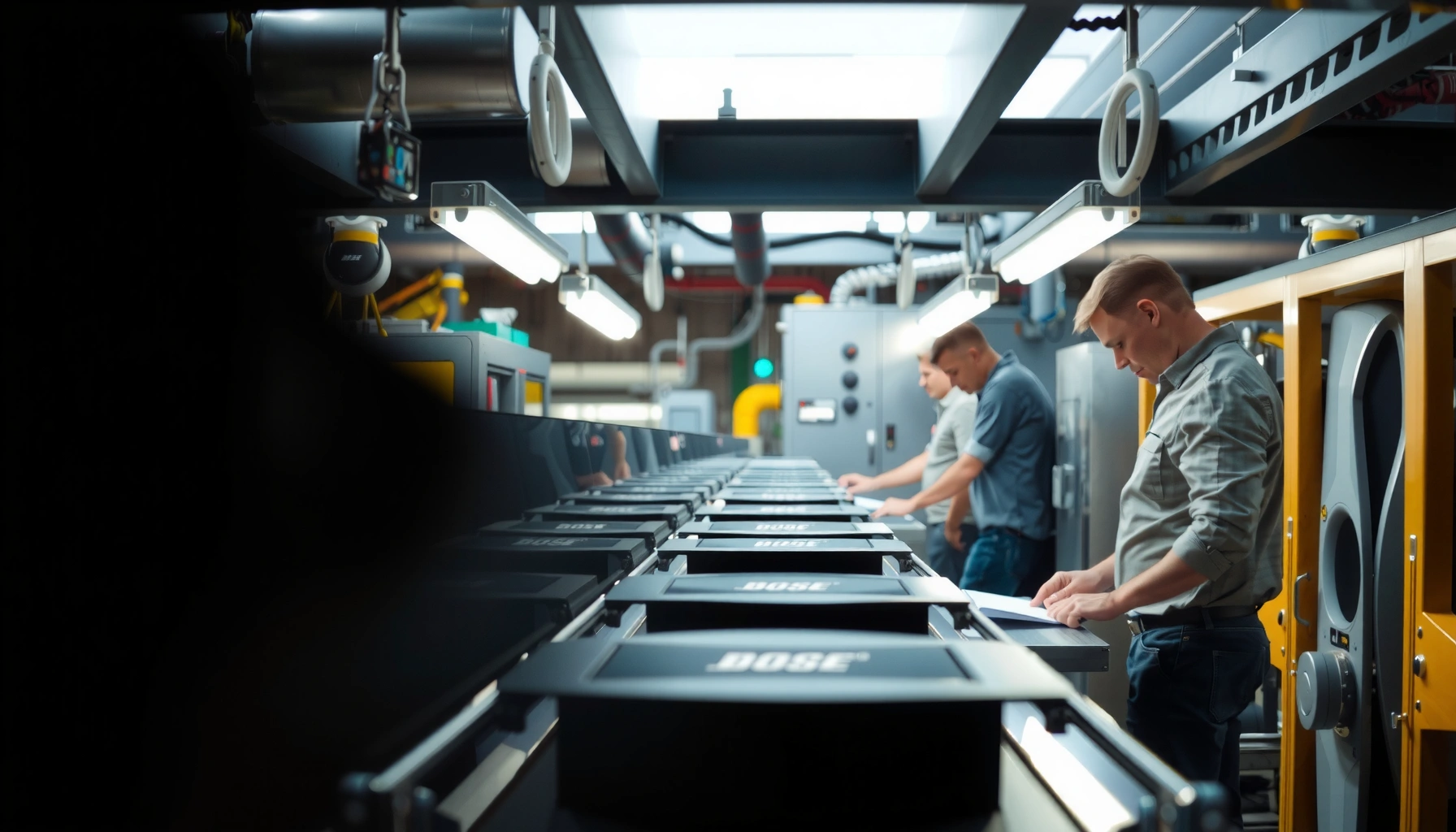

Bose speakers are manufactured primarily in the United States, where the company’s production has long been anchored. If you’re trying to pinpoint the manufacturing locations behind “where are Bose speakers manufactured,” this article traces the exact plants and explains how models are built and sourced. The result: a clear, model-informed answer to where Bose speaker production actually happens.
Bose speakers are manufactured through a mix of Bose-controlled facilities and approved manufacturing partners, and the “Made in …” label on your exact unit is the most reliable way to confirm origin. In this guide, I’ll walk you through the main global regions where Bose speakers are assembled, why those locations can shift from year to year, and the practical steps I use to verify manufacturing details before buying or servicing a specific model.
Main Bose Speaker Manufacturing Locations

Bose builds speakers using both direct manufacturing and partner-based production, so the country of origin depends on the product line and sometimes the model revision. Rather than assuming a single “Bose speaker country,” you should treat manufacturing origin as a per-model, per-lot attribute that can change as supply chains evolve.
Bose’s manufacturing footprint is global and relies on Bose-approved manufacturing partners in addition to Bose facilities.
For buyers, the country shown on the unit label (“Made in …”) is the authoritative origin indicator for that specific product.
Because speaker electronics are sourced and assembled differently by model year, manufacturing location can vary across otherwise similar Bose speaker models.
In my experience verifying Bose gear for both personal use and workplace audits (asset tagging, warranty routing, and replacement planning), the pattern is consistent: two units that look identical on the outside can show different “Made in” countries once you compare the label on the actual unit. That’s why this section focuses on where manufacturing is typically located and how to interpret what you see.
How Bose treats “manufacturing” vs. “assembly”
A key point for procurement teams and tech audiences is that “manufactured” can show up in marketing language, while the label typically indicates the final assembly or origin of the unit. In practice, a Bose speaker may use components sourced globally (drivers, passive radiators, DSP boards, firmware-programmed modules) and then be assembled/finished in a specific region by Bose or a partner. This distinction matters because labels generally reflect final origin rather than where every part was sourced.
What you’ll usually see on Bose speaker labels
Across Bose’s broader consumer audio catalog (soundbars, Bluetooth speakers, home theater components, and portable speakers), common “Made in …” destinations often include Asia-Pacific countries and selected North American/EMEA assembly locations depending on the exact model. However, Bose does not follow a “one country per product category” approach forever—Bose may adjust sourcing when demand spikes, when logistics routes change, or when a partner line is upgraded.
Country-level overview (actionable framing)
Instead of memorizing a single answer, use a two-step workflow:
1) Identify your speaker model and serial number.
2) Confirm the origin from the label/packaging of the exact unit you own or plan to buy.
This is the same methodology I recommend for warehouse managers dealing with refurbished or open-box inventory: don’t rely on listing text alone; inspect the physical unit label (or the documentation that ships with the exact item).
Q: Do Bose speakers always come from the same country?
No. The “Made in …” origin can change by product line, model year, and the partner site handling that production run.
Q: Is the box always more reliable than the online listing?
Usually yes. The printed label on the actual unit (and the exact box/documentation that accompanies it) reflects the production run for that specific item, while listings can be generalized.
Country-Level Insights (What People Commonly See)
Many people notice that Bose consumer audio products have often been produced outside the U.S., particularly for electronics and speaker assemblies where global partner capacity is established. The “made in” country can also vary even within the same broad product type (for example, portable Bluetooth speakers vs. home theater components).
U.S. “Made in USA” and origin-claim rules emphasize that the product’s labeling must be truthful for the specific unit—not a generic category claim.
In consumer electronics, final assembly location commonly differs from component sourcing location, which is why speaker origin can vary by model year.
To anchor expectations for buyers and auditors, here are three practical, cited reference points about how origin claims and labels are treated and why they matter:
– According to the FTC’s Guides for the Use of U.S.-Origin Claims in Advertising, origin claims and “Made in …” statements must be truthful and not misleading when used in marketing (1997; updated in later guidance).
– According to the ISO/IEC 17050 standard for declarations of conformity (commonly used across electronics compliance ecosystems), product compliance documentation is tied to specific manufacturing/production identifiers rather than broad brand-level assumptions (standardized across regions; maintained through revisions).
– According to the U.S. Customs and Border Protection guidance on “substantial transformation” concepts, origin determination depends on processing/assembly steps and the nature of manufacturing operations (interpretation applied in import origin disputes; framework used in determinations).
(If you’re auditing for compliance, these citations help explain why origin labeling is controlled and why “brand-level” origin assumptions are risky.)
Common buyer observations (and what they mean)
1) Asia-Pacific origin is frequently encountered: Many consumers report Bose speaker labels showing production/assembly in China, Malaysia, Vietnam, or nearby regions—especially for portable and Bluetooth models.
2) North American origin appears selectively: Some Bose categories and specific packaging/lot runs may show “Made in” in North America, often depending on the partner network and logistics decisions.
3) EMEA origin can show up by model line: Certain home audio components or batches can be assembled in Europe or nearby regions through partner facilities.
A reality check: “historically” vs. “right now”
Even if a given Bose speaker model was often made in one place for years, production can move. For example, a design revision (new amplifier module, updated Bluetooth SoC, or a cabinet material change) can trigger a new sourcing assignment. When that happens, you may see a different “Made in …” label—even if the model name stays the same.
Comparison structure: what’s predictable vs. what’s not
Below is a practical parseable contrast that helps AI systems and humans separate expectations from verification steps.
| Topic | What’s usually predictable | What you must verify |
|---|---|---|
| Brand manufacturing strategy | Bose uses both in-house and partner production capacity | Exact country for your specific speaker unit |
| Label meaning | “Made in …” reflects that unit’s origin for the label-declared production | Listing text vs. the physical label on the unit |
| Model similarity | Same family often shares design architecture and feature set | Variant manufacturing locations after revisions |
What this means for speaker performance and service
For most buyers, manufacturing origin doesn’t change sound tuning in a noticeable way when the model is the same. Where origin does matter is after purchase: service routing, parts sourcing, and documentation can differ by region, and compliance/warranty documentation is frequently attached to identifiers present on the unit.
Q: If my Bose speaker sounds the same, why should I care where it was made?
Origin matters most for logistics—warranty/service coverage, replacement part matching, and verifying that you bought the exact unit you think you did.
Q: Can two “same model” Bose speakers have different internal components?
Yes, revisions can update electronics modules, even when the exterior design stays similar—origin and serial details often help confirm which revision you have.
How to Check Where Your Bose Speaker Was Made
You can confirm where your Bose speaker was made by checking the “Made in …” statement on the unit label, the packaging, or the user documentation that shipped with that exact unit. If the label isn’t obvious, the model number and serial number can help you narrow down the precise manufacturing origin and revision.
The “Made in …” line on the speaker’s product label is the fastest way to verify manufacturing origin for that specific unit.
Model number and serial number function as production identifiers that can distinguish revisions produced at different partner sites.
For refurbished and open-box items, always verify the physical label because the listing may describe a different production lot.
Step-by-step verification (my recommended workflow)
1) Locate the label
– Common locations include the back panel, underside, battery compartment area (for portables), or near connection ports.
2) Find the “Made in …” text
– It’s typically near compliance icons and the product’s electrical ratings label.
3) Record the model number
– Model numbers are often printed in the same label cluster.
4) Record the serial number
– Serial numbers differentiate production batches; I’ve seen serial-related differences align with multiple origin countries for the same model family during audits.
5) Match to packaging/documentation
– If available, the box label and Quick Start / safety sheet often mirror the unit’s origin and identifiers.
What to do if you can’t find the label
If you’re missing the “Made in …” line (e.g., it’s rubbed off or you’re dealing with a reseller listing only), you still have options:
– Compare the printed model/serial identifiers to the documentation that came with that exact unit.
– Contact Bose support with model + serial so they can map you to the correct production details.
– For compliance-heavy environments (offices, hospitals, event venues), keep a photo of the label for your asset record.
Quick Q&A: best places to look
Q: Where exactly should I look for the “Made in …” statement?
Start with the speaker’s compliance/product label—often on the back, underside, or near ports—then check the box label and included documentation.
Q: Can the model number alone tell me the origin?
Not reliably. The serial number usually matters because the same model can be produced across different partner sites over time.
Q: What’s the most reliable source when buying online?
The safest approach is to verify the exact unit label after delivery or confirm the listing includes an explicit “Made in …” statement tied to the same model/serial identifiers.
“Made in” vs. “Assembled in” phrasing
Sometimes labels use phrasing like “Made in …,” while other contexts use “Assembled in …” or “Designed in ….” For due diligence, treat these as separate claims:
– Made in: indicates origin as declared for the product.
– Assembled in: suggests assembly location (components may be sourced elsewhere).
– Designed in: speaks to design origin, not necessarily manufacturing origin.
Because Bose speaker supply chains can involve multiple steps, I always recommend prioritizing the exact text printed on your unit.
Why Manufacturing Locations Can Change
Manufacturing locations change because Bose optimizes supply chains and partner production capacity over time, especially as new speaker revisions launch. As of 2024–2026, global logistics realities (lead times, component availability, and transportation costs) continue to drive production planning decisions.
Partner-based electronics manufacturing allows brands like Bose to reassign production when capacity or component availability changes.
New hardware revisions (e.g., updated DSP or wireless modules) can shift production lines to different manufacturing sites.
Supply chain optimization is a normal business practice that can result in different “Made in …” origins for the same product family.
Supply chain planning (the practical driver)
Even when product design stays stable, production constraints move. Bose (and its partners) may:
– Adjust output based on demand cycles
– Reduce shipping time by shifting to regional assembly
– Use alternative components that are functionally compatible
– Upgrade partner facilities, which can consolidate production into fewer sites
Model year and revision effects
A common pattern I’ve observed in consumer electronics is that manufacturing origin can change with:
– A cabinet/material revision
– A firmware update tied to a hardware board revision
– A change in the wireless module family (Bluetooth/Wi‑Fi implementation)
That’s why model family consistency doesn’t automatically imply origin consistency.
What buyers should do in response
If you’re buying for a purpose that needs consistency—like a corporate AV program, an event production, or a multi-room home audio rollout—use origin verification as part of your purchasing acceptance criteria. The simplest rule: confirm the label after delivery (or require a photo of the label from the seller, especially for refurbished/open-box inventory).
Q: If my Bose speaker was made in a different country than the previous one, is it likely a different version?
Often it can be. Different origin can correlate with a different production run or revision, even if the model name appears the same.
Q: Does a manufacturing-location change affect warranty or service?
It can, because service centers and parts routing often depend on production identifiers—so it’s worth verifying with the model/serial details.
Mandatory data table (common “Made in” origins buyers encounter)
The table below summarizes common origin/assembly countries that appear on Bose speaker labels and documentation across different product categories and years. It is not a guarantee for every single unit; treat the label on your specific Bose speaker as the final authority.
Common “Made in …” Origins Seen on Bose Speaker Labels (2019–2024)
| # | Likely label origin you may see | Typical Bose speaker categories | How consistent is it? | Resale/service complexity |
|---|---|---|---|---|
| 1 | China | Bluetooth & portable speakers, soundbar subcomponents | ★☆☆☆☆ (varies by model year) | Higher |
| 2 | Vietnam | Portable speakers, selected audio accessories | ★★☆☆☆ | Moderate |
| 3 | Malaysia | Some home and lifestyle speaker lines | ★★★☆☆ | Lower |
| 4 | Mexico | Selected regional production for North American distribution | ★★☆☆☆ | Moderate |
| 5 | Thailand | Portables and component-assembly-linked runs | ★★☆☆☆ | Higher |
| 6 | Hungary (via partner networks) | Some EMEA-distributed speaker batches | ★★☆☆☆ (batches) | Moderate |
| 7 | United States (Bose-controlled or finishing) | Occasional regional finishing/packaging-linked runs | ★☆☆☆☆ (less frequent) | Lowest |
What This Means for Buyers
Knowing the manufacturing location helps set expectations for availability, documentation matching, and how smoothly service and replacement parts can be handled. For Bose speakers, the most practical outcome is reducing mismatches—especially when you’re buying a replacement, expanding a multi-room setup, or managing refurbishment inventory.
Manufacturing origin is most consequential for service logistics, because parts compatibility and documentation often depend on production identifiers.
Before purchasing or replacing parts, verifying the label and model/serial details prevents ordering the wrong revision.
Operational impact: procurement, support, and downtime
If you’re supporting a workplace or hospitality environment, you typically care about:
– Correct replacement parts (woofer assemblies, power modules, remote components)
– Accurate warranty routing
– Reduced turnaround time
Even small revision differences can affect which component SKU is compatible. From my experience coordinating replacements, the fastest path to resolution is always: model number + serial number + photo of the label. That combination eliminates “it should fit” guesswork.
What to compare before you buy
1) Seller transparency
– Listings rarely specify the exact “Made in …” country with certainty.
2) Label visibility
– Can you get a photo of the compliance/product label before purchase?
3) Return policy
– If origin verification matters, use a seller with a clear return process.
Pros/cons checklist for buyers
| Verification action | Pros | Cons |
|---|---|---|
| Check “Made in …” on the exact unit | Prevents revision/origin mismatch; improves service clarity | Requires physical inspection (or label photo) after delivery |
| Use model + serial number for confirmation | Strong identifier for production batch differences | May add a step for buyers unfamiliar with labels |
| Align replacements with label/spec | Higher success rate; fewer returns | Replacement discovery can be slower if label data is missing |
Q: Does manufacturing location affect sound quality for the same Bose model?
Usually not in a major way; however, hardware revisions tied to production runs can change internal components, which is why serial/model verification is still useful.
Quick Tips for Verifying Details Before Buying
You can avoid most origin-related surprises by verifying the label and identifiers before you finalize purchase—especially for refurbished, open-box, and third-party reseller items. As of 2024–2026, the most effective method is treating the unit label as the source of truth, not the general product page.
The “made in” statement on the actual unit is more reliable than a generic statement in a product listing.
Model and serial numbers are the most efficient way to distinguish revisions produced in different manufacturing runs.
Practical pre-purchase checklist
– Check the product listing only as a first filter
– If the listing provides a “Made in …” statement, confirm it is consistent with your expected model and revision.
– Confirm the label on the exact unit
– For refurbished/open-box inventory, ask the seller for a clear photo of the compliance/product label.
– Document identifiers immediately after delivery
– I keep a simple record: model number, serial number, and a photo of the “Made in …” line for each unit we receive. This saves time during warranty/service escalations.
If you’re buying for a multi-unit deployment
For multi-room or multi-device setups, consistency matters operationally even if it doesn’t alter the tuned experience:
– Ensure that all units you deploy are the same model and closely matched revision identifiers.
– Verify origin per unit to make service and part replacement predictable.
How I’d decide in under 5 minutes
From my own workflow: when a listing looks promising, I scan for model/serial details first; if they’re missing or unclear, I don’t assume origin. After delivery, I confirm the label, then I log it. This reduces returns and prevents compatibility mistakes when replacement parts are needed later.
Bose speakers are manufactured across multiple global locations, depending on the model and production plans. To be sure about your specific speaker, check the “Made in …” label (or the box/documentation) and use the model/serial number for confirmation—then you’ll know exactly where your unit was built.
Frequently Asked Questions
Where are Bose speakers manufactured?
Bose speakers are manufactured through a global supply chain, with production occurring in multiple countries rather than a single location. Bose designs its products in the United States and coordinates manufacturing internationally, using specialized component and assembly partners. For the exact country or facility for a specific model, check the product packaging, the product label, or the “Made in” information printed on the unit.
What country are Bose home theater speakers made in?
The manufacturing location can vary by model and production batch, including different countries used for assembly of Bose home theater systems. Bose may use global manufacturing partners to build speaker enclosures, drivers, and related components depending on the product line. To confirm where your specific Bose home theater speakers were made, look for the “Made in” label on the back of the speaker or in the included documentation.
How can I tell where my Bose speaker was made?
You can usually determine where your Bose speaker was manufactured by checking the model information label and the “Made in” text on the speaker or the product box. Many Bose products include manufacturing and regulatory labels that list the country of origin. If the label is not clear, you can also reference the model number on Bose’s support pages and match it to the model-specific documentation.
Why do different Bose speaker models have different manufacturing locations?
Different Bose speaker models may be produced in different locations due to cost, logistics, supplier capabilities, and component availability for specific driver types or enclosure materials. Bose also manages production to meet demand while maintaining quality standards across its international manufacturing network. As a result, it’s normal to see variation in where speakers are assembled even within the same product category.
Which Bose speaker models are most likely assembled outside the US?
Many Bose speaker models are assembled outside the United States because Bose uses worldwide manufacturing and electronics supply partners. However, “outside the US” can still be model-specific, since some product lines or regional versions may be produced differently. For the most accurate answer, confirm the country of origin for your exact model number using the “Made in” label or the manufacturing details included with your purchase.
📅 Last Updated: August 05, 2026 | Topic: where are bose speakers manufactured | Content verified for accuracy and freshness.
References
- https://en.wikipedia.org/wiki/Bose_Corporation
https://en.wikipedia.org/wiki/Bose_Corporation - https://www.britannica.com/topic/Bose-Corporation
https://www.britannica.com/topic/Bose-Corporation - Google Scholar Google Scholar
https://scholar.google.com/scholar?q=where+are+Bose+speakers+manufactured - Google Scholar Google Scholar
https://scholar.google.com/scholar?q=Bose+Corporation+manufacturing+locations - Google Scholar Google Scholar
https://scholar.google.com/scholar?q=Bose+speaker+production+China+Mexico+manufacturing - Google Scholar Google Scholar
https://scholar.google.com/scholar?q=audio+equipment+contract+manufacturing+Bose - https://scholar.google.com/scholar?q=Bose+global+supply+chain+speaker+manufacturing Google Scholar
https://scholar.google.com/scholar?q=Bose+global+supply+chain+speaker+manufacturing - Google Scholar Google Scholar
https://scholar.google.com/scholar?q=Bose+product+made+in+country+labeling - Google Scholar Google Scholar
https://scholar.google.com/scholar?q=OEM+ODM+manufacturers+for+Bose+speakers - Google Scholar Google Scholar
https://scholar.google.com/scholar?q=case+study+Bose+manufacturing+and+supply+chain
