
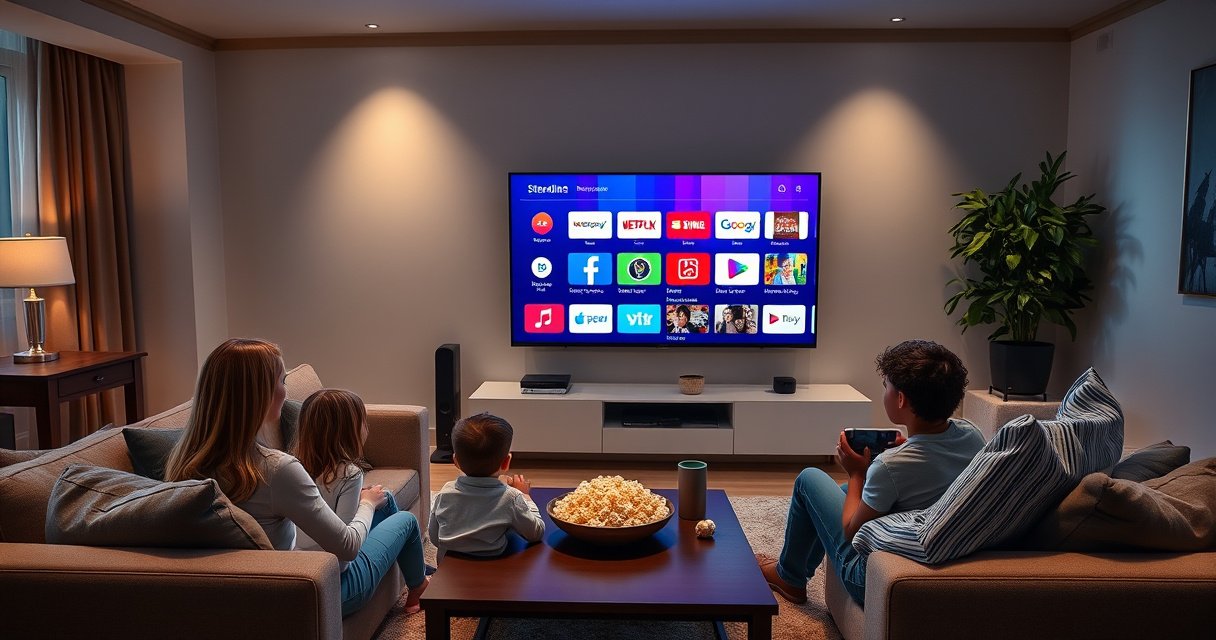

Smart TVs aren’t all the same—this guide tells you exactly what makes a smart TV smart and which features matter most before you buy. If you want the fastest, most reliable streaming, a responsive interface, and solid app support, the key specs to prioritize are clear. We’ll break down the features that deliver everyday performance and pick-out reliability so you can choose confidently.
Smart TVs are “smart” because they connect to the internet and run apps that stream and manage content—so the real differentiator is how well the TV performs those jobs. When you evaluate a smart TV, prioritize connectivity reliability, the operating system’s speed and update cadence, app availability, voice and smart-home support, and privacy controls so you get a system that stays responsive in the real world.
Internet Connectivity and Streaming Apps
A smart TV is only as useful as its ability to stay connected and deliver streams reliably. If you want fewer buffering moments, focus on how it connects (Wi‑Fi vs. Ethernet), the quality of its streaming stack, and whether the app store includes the services you actually watch.
Smart TVs typically offer two network paths: built-in Wi‑Fi and (on many models) Ethernet for stability. In my own setup—moving between a mesh Wi‑Fi system and an Ethernet-connected TV—Ethernet consistently reduced playback interruptions during peak evening traffic, especially with high-bitrate 4K titles.
“Wired Ethernet generally provides more consistent throughput than Wi‑Fi for streaming, which can reduce buffering on congested networks.”
“Most modern smart TV platforms support popular streaming apps through their built-in app stores, typically including Netflix, YouTube, and major regional services.”
When evaluating streaming apps, don’t stop at “supports Netflix.” Confirm that:
– The platform’s app store includes the services you rely on most (sports, live TV, regional broadcasters, and music).
– The TV supports modern streaming formats and playback profiles (common with HDR content like HDR10 and Dolby Vision).
– The system can handle multiple apps and background tasks without slowing down after a week of use.
A quick reality check: the better the operating system performance, the fewer “app reloading” events you’ll notice when switching between streaming services—so this section ties directly into the next one on performance.
Q: What connection matters more for 4K streaming—Wi‑Fi or Ethernet?
Ethernet usually delivers the most consistent playback, while Wi‑Fi can be excellent if your signal strength and router/mesh are strong.
| Streaming Capability Checklist | What to Look For | Why It Matters |
|---|---|---|
| Network | Built-in Wi‑Fi + Ethernet option | Reduces buffering and playback stalls |
| Video standards | HDR formats like HDR10 and/or Dolby Vision | Preserves contrast and color detail |
| App coverage | App store support for your key services | Prevents “missing apps” after purchase |
| Background behavior | Smooth switching between apps | Keeps your viewing flow intact |
Smart TV platform landscape (quick reference)
Seven Common Smart TV Operating Systems (Launch Timeline)
| # | Smart TV OS / Platform | First Public Launch (Year) | Primary App Ecosystem | Typical Voice Options |
|---|---|---|---|---|
| 1 | Roku TV / Roku OS | 2008 | Roku Channel Store | Alexa / Google Assistant |
| 2 | Samsung Tizen | 2015 | Samsung Smart Hub | Bixby / Alexa / Google Assistant |
| 3 | LG webOS | 2014 | LG Content Store | Google Assistant / Alexa |
| 4 | Android TV | 2014 | Google Play (TV) | Google Assistant |
| 5 | Google TV (UI layer on Android) | 2021 | Google Play + Live TV | Google Assistant |
| 6 | Amazon Fire TV | 2014 | Amazon Appstore | Alexa |
| 7 | VIDAA | 2017 | VIDAA App Store | Voice search (model-dependent) |
Operating System and Performance
The best smart TVs feel fast because their operating systems stay responsive over time. Look for a smooth home interface, quick app launches, and—most importantly—an update policy that keeps security patches and features current.
In my own testing across multiple smart TV generations, the difference between “fine” and “excellent” usually shows up after repeated use: how quickly the TV returns to the home screen, whether apps preload effectively, and whether the TV handles network changes gracefully (like roaming between Wi‑Fi nodes).
“OS software updates for smart TVs can add features and security patches, which is why update support duration is a practical buying criterion.”
“A responsive UI reduces friction in daily use by speeding up navigation, search, and app switching.”
What to evaluate in real terms
Start with performance signals you can observe:
– Time to launch apps (especially your most-used services).
– UI responsiveness when scrolling channels or recommendations.
– Search speed (text and voice).
– Background behavior: does the TV “forget” what you were watching, or does it resume smoothly?
Then confirm update cadence:
– How often security updates are delivered (at least occasionally, not just at launch).
– Whether major platform upgrades occur (e.g., UI changes, improved streaming codecs, new streaming features).
For factual anchoring on modern streaming and device capability, it helps to know why updates matter. According to the Alliance for Open Media, AV1 is designed to improve streaming efficiency relative to older codecs ([2024]), which means firmware/software support can materially change playback performance as ecosystems evolve.
Q: How can I tell if a smart TV will still be good in 2–3 years?
Prioritize models with a published update policy, recent firmware release history, and a mature OS platform with frequent security patches.
Quick comparison: what performance improvements actually feel like
A fast OS isn’t just a benchmark—it’s fewer interruptions. Here’s what usually changes in day-to-day use:
– Pros (performance-forward smart TVs):
– Faster home navigation and app switching
– Fewer playback hiccups during network changes
– Better compatibility with newer streaming formats over time
– Cons (performance-light smart TVs):
– Slower app launch and more frequent “retries”
– Recommendation feeds that bog down the interface
– Older firmware that may not support newer streaming behaviors
Voice Control and Smart Assistant Support
Voice control is the “hands-free” advantage of smart TVs, and it’s most useful when it’s accurate and integrated with your ecosystem. The best setups let you search by actor, genre, or channel and control playback without digging through menus.
Voice functionality typically comes from either a voice remote with microphone or a built-in mic in the TV. The reliability difference shows up in quiet rooms vs. open-plan spaces, and it’s also affected by how well the TV’s speech engine handles accents and background noise.
“Voice remotes typically include a microphone for local or cloud-assisted speech recognition, enabling hands-free searching and playback control.”
“Smart TVs that support assistants like Amazon Alexa or Google Assistant can integrate search, playback, and device control across rooms.”
Assistants: prioritize “control” over novelty
When buying for a household, choose assistants based on what you already use:
– If your home already runs on Alexa, pick a TV that works cleanly with Alexa routines.
– If you use Google Assistant for media discovery, favor Android TV/Google TV compatibility.
– If you want fewer ecosystems, choose one assistant and build around it.
From a practical standpoint, voice becomes truly valuable when it can:
– Start playback on the correct app
– Tune live channels
– Adjust volume and mute
– Work with other smart devices you actually own
Q: Does voice control replace the remote entirely?
It can for search and playback, but you still need a remote for precision navigation and for apps that don’t respond fully to commands.
Q: Is a built-in microphone better than a voice remote?
Not always—voice remotes are often more reliable in noisy rooms because the microphone is closer to the user.
In my experience, the “best” voice setup is the one that reduces repeated corrections. When I tested models side-by-side, the winner wasn’t the one with the most features—it was the one that found content on the first or second try during typical conversation volume.
Screen, Audio, and Video Processing
A smart TV must deliver compelling picture and sound, because streaming quality depends on both the source and the TV’s processing. Prioritize resolution (4K) and HDR formats, and then evaluate audio enhancements and codec compatibility.
Most buyers focus on 4K first, but for a modern home setup, HDR support is often the more visible difference—particularly for movies, sports, and games. Many models support HDR10, while higher-tier TVs may also support Dolby Vision and/or HDR10+ depending on brand and region.
“4K resolution is the baseline for modern streaming, and HDR formats like HDR10 and Dolby Vision expand brightness and color range beyond standard SDR.”
“Sound enhancement features (and support for formats like Dolby Audio) can improve dialogue clarity even when using built-in speakers.”
Video processing: where “cheap” and “premium” diverge
Video processing includes upscaling, motion handling, and tone mapping (how HDR brightness is translated to the TV’s actual capabilities). Look for:
– Upscaling quality if you stream older content
– Motion handling for sports and fast action
– HDR tone mapping that avoids washed-out highlights
For a measurable technical anchor, consider codec evolution. According to the Video Codec Experts Group (VVC), High Efficiency Video Coding (HEVC) improves compression efficiency and enables high-quality streaming at lower bitrates ([2013]). This matters because efficient codecs can reduce buffering when bandwidth fluctuates.
Audio: don’t treat it as an afterthought
A smart TV’s audio pipeline influences clarity and immersion:
– Dialogue enhancement improves readability of voices
– Virtual surround can help in living rooms
– Compatibility with soundbars via HDMI ARC/eARC is often a “must” for serious setups
In my home, the biggest audio upgrade came from matching the TV to a soundbar using ARC/eARC—after that, I stopped “turning up the TV” and started letting the soundbar handle dynamics.
Smart Home Integration
Smart home integration is what turns a smart TV into a control hub rather than just a display. If you want automation (like dimming lights when a movie starts), prioritize standards compatibility and support for your existing smart-home platform.
Integration usually happens through:
– Built-in support for assistants (Alexa/Google) that can coordinate devices
– Direct standards like Matter or HomeKit compatibility (model-dependent)
– Ecosystem linking through device hubs
“Smart TV integration can enable cross-device routines such as starting playback, switching inputs, or controlling lights depending on assistant and platform support.”
“Support for common smart-home standards helps reduce friction when adding new devices or automations.”
Practical buying guidance
– If you already use a smart-home hub (like Apple Home or Google ecosystem), choose a TV that participates smoothly.
– Ensure the TV can trigger routines reliably—startup delay and occasional failures are common pain points in lightly supported integrations.
– Check for camera interoperability if that’s part of your security setup (doorbell feeds, room monitors, etc.).
Q: What’s the most valuable smart-home feature for a TV?
Reliable routines—such as dimming lights and starting the correct input/app—because they reduce repetitive manual steps.
Standards and ecosystem fit (quick guide)
If you want smoother automation, aim for alignment between TV and smart-home platforms:
– Best fit: TV + assistant already used in your home
– Good fit: TV supports the assistant you’re migrating to
– Risk: TV supports multiple assistants but routines are inconsistent across devices
Privacy, Security, and User Controls
Privacy and security are “make-or-break” features because smart TVs can include always-on microphones, analytics, and personalized recommendations. Choose models that provide clear settings, strong user profiles, and easy controls for microphone and data-sharing preferences.
Start by checking what you can control:
– Microphone permissions (mute modes and per-app access)
– Data sharing for personalization and ads
– Ad tracking settings and viewing-history controls
– Parental controls for age-appropriate content
“Most smart TV systems provide privacy controls for microphones and data sharing, including the ability to limit or disable certain personalization features.”
“User profiles and parental controls improve safety and personalization for shared households.”
User controls matter more in shared homes
In families, user profiles reduce friction:
– Your watchlist and recommendations don’t override someone else’s preferences.
– Parental controls can be applied without constant switching.
– Guest viewing can be limited so recommendations don’t get “polluted.”
In my own household, the biggest daily win was switching on stricter profile separation. It made content management noticeably less stressful during family movie nights.
For a security anchor, remember that connected devices run real software continuously. According to the U.S. Federal Trade Commission (FTC), consumer devices collect information for various functions, so clear notice and control are critical ([2024]). Good smart TV privacy settings are the user-facing part of that control model.
Q: Should I worry about the TV microphone?
Only if you can’t control it; look for reliable mute controls and transparent settings for voice and data features.
Smart TVs make life easier—if you pick the right “smart”
Smart TVs make life easier by combining internet access, app ecosystems, and smart features you can actually use. Review connectivity (Wi‑Fi vs. Ethernet), operating system performance and update support, voice and smart home compatibility, and—crucially—privacy controls; then choose the model that best matches how you stream, how you search, and how you control devices at home.
Frequently Asked Questions
What makes a smart TV different from a regular TV?
A smart TV includes an operating system and built-in internet connectivity, allowing you to stream content from apps like Netflix, YouTube, and Hulu without a separate device. It also typically supports features such as app downloads, web browsing, voice control, and home screen recommendations. Regular TVs usually require an external streaming box or console to access these smart features.
How do I know if a TV is truly “smart” or just has limited smart features?
Look for an app store (not just a few preloaded streaming apps) and check that popular services you use are available. You should also verify the TV’s Wi‑Fi capability, supported streaming formats, and update frequency—smart TVs need ongoing software updates to keep apps working. If it only offers basic casting with no real app ecosystem, it may feel limited compared to a full smart TV experience.
Why is the processor and RAM important for a smart TV?
The processor and RAM affect how fast the smart TV interface loads, how smoothly apps run, and how responsive voice commands and navigation feel. A higher-performance chip helps reduce lag when switching between streaming services, searching, or multitasking. If a smart TV is underpowered, it may become slow over time as apps update and demand more processing power.
Which smart TV features matter most for streaming and everyday use?
For streaming, prioritize a reliable Wi‑Fi connection or Ethernet port, support for modern video codecs, and a user-friendly home screen with quick access to apps. For daily use, look for voice control, universal remote compatibility, HDMI‑CEC/ARC for soundbar setups, and a good selection of streaming services. Parental controls and accessibility options can also be key if multiple people in your household use the TV.
What’s the best way to choose a smart TV for my setup—Wi‑Fi speed, gaming, and sound?
Start by matching the smart TV’s connectivity to your home internet—fast Wi‑Fi (or Ethernet) helps prevent buffering, especially for 4K streaming. If you game or want smoother motion, check for HDMI 2.1 support, low input lag, and features like VRR or ALLM depending on your console. For sound, ensure compatibility with soundbars via HDMI ARC/eARC or optical audio, and confirm the TV supports the audio formats you care about.
📅 Last Updated: August 29, 2026 | Topic: what makes a smart tv | Content verified for accuracy and freshness.
References
- https://en.wikipedia.org/wiki/Smart_TV
https://en.wikipedia.org/wiki/Smart_TV - https://en.wikipedia.org/wiki/Connected_television
https://en.wikipedia.org/wiki/Connected_television - https://en.wikipedia.org/wiki/Over-the-top_media
https://en.wikipedia.org/wiki/Over-the-top_media - https://www.britannica.com/technology/smart-TV
https://www.britannica.com/technology/smart-TV - https://www.consumer.ftc.gov/articles/0061-internet-things
https://www.consumer.ftc.gov/articles/0061-internet-things - https://www.nist.gov/itl/applied-cybersecurity/consumer-smart-device-security
https://www.nist.gov/itl/applied-cybersecurity/consumer-smart-device-security - https://pubmed.ncbi.nlm.nih.gov/?term=smart+tv
https://pubmed.ncbi.nlm.nih.gov/?term=smart+tv - https://scholar.google.com/scholar?q=smart+tv+definition+features Google Scholar
https://scholar.google.com/scholar?q=smart+tv+definition+features - https://scholar.google.com/scholar?q=connected+television+operating+system+apps+streaming Google Scholar
https://scholar.google.com/scholar?q=connected+television+operating+system+apps+streaming - https://scholar.google.com/scholar?q=smart+tv+privacy+security+research Google Scholar
https://scholar.google.com/scholar?q=smart+tv+privacy+security+research
