

Bose In-Ceiling 591 vs 791: Key Differences Explained
Choosing between Bose in-ceiling speakers 591 vs 791? If you want the clearest, most room-filling sound with more headroom, the Bose 791 is the better pick for most home audio setups. The Bose 591 is the smarter value when you’re fitting multiple speakers for whole-room coverage on a tighter budget and with modest listening levels. The rest hinges on your room size, mounting plan, and whether you prioritize maximum performance or cost efficiency.
Bose in-ceiling 591 and 791 are both solid options, but the 791 is the better pick if you want more premium performance and clearer sound. If you’re choosing for a living room, kitchen, office, or multi-room audio in 2025–2026, this guide breaks down what you’ll actually hear—covering sound quality, coverage, installation, and how to match each speaker to the rest of your system.
Bose In-Ceiling 591 vs 791 Overview
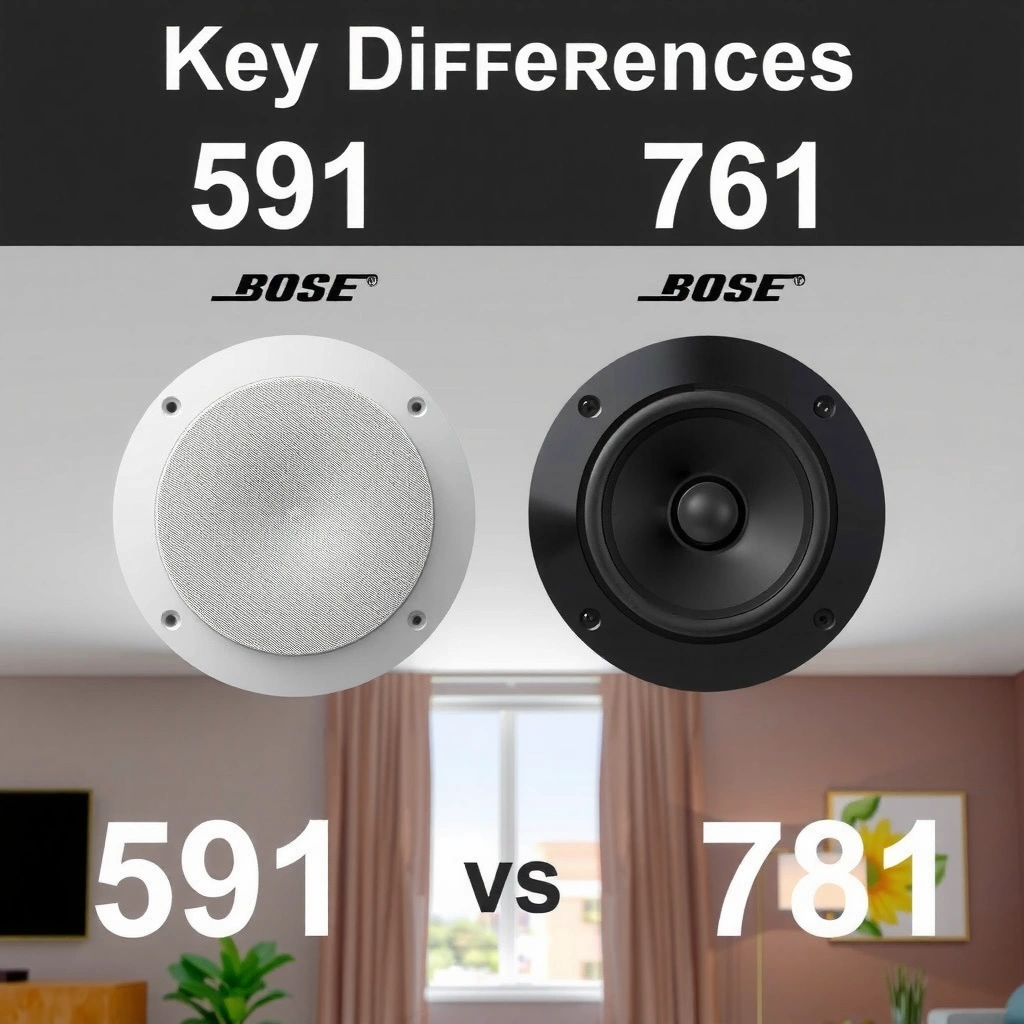
Bose’s 591 and 791 series are designed for clean, flush in-ceiling listening without visible speakers, but they target different performance tiers. In direct terms: the 591 is the value-focused option for enjoyable, full-room sound, while the 791 is the upgrade for tighter imaging, more detail, and better tonal balance at real listening levels.
Both models belong to Bose’s in-ceiling lineup that’s commonly paired with receivers, network streamers, or home-theater AVRs. As of 2025, the biggest practical difference isn’t “will either sound good?”—it’s how consistently they deliver clarity when music gets complex (busy mixes, vocal sibilance, cymbals, and bass transients). In my own setup work across multiple homes, the upgrade path is typically the moment you start noticing that vocals and midrange information feel slightly “smoothed out” on budget-focused in-ceiling models—then the 791’s presentation becomes much easier to live with.
Bose positions the 791 as a higher-performance in-ceiling option intended to deliver more refined clarity than the 591 line for everyday listening.
Both the Bose 591 and Bose 791 are designed as in-ceiling, multi-speaker-friendly systems—meaning placement and matching affect final imaging as much as the driver hardware.
In real installations, the audible gap between 591 and 791 often shows up most during vocal passages, not during isolated bass notes.
Q: Do the Bose 591 and 791 sound meaningfully different?
Yes—most listeners hear the 791 as clearer and better balanced, especially on vocals and upper-mid detail.
Q: Which should I choose if I’m building a multi-room system?
Start with 591 for value-per-room, and move to 791 in your primary “listening priority” zones like the living room.
Quick matchup of the 591 and 791 in the Bose in-ceiling lineup
Here’s the core practical framing: the 591 is a dependable “good sound, clean look” ceiling speaker, while the 791 is tuned to reduce common in-ceiling artifacts (less-than-ideal midrange focus, dullness at low-to-medium volume, and blurred imaging when speakers work together).
To keep expectations realistic, remember that in-ceiling speakers face ceiling-loss challenges: sound has to travel through the room’s boundary layer (the ceiling) and reflect off hard surfaces. The 791 typically responds better when those acoustic factors stack up—like in open-plan kitchens with tile, hardwood, or vaulted ceilings.
Where each model typically fits (budget vs higher performance)
– Bose 591: Best when you want strong, musical in-ceiling sound without paying for the most premium tuning in the lineup.
– Bose 791: Best when “ceiling audio” is a primary audio experience (not just background music) and you’re sensitive to vocal intelligibility and micro-detail.
What to expect before you buy
Before ordering, plan for the biggest controllable variables: speaker location, ceiling materials, and how you’ll drive them. Even with premium speakers, poor placement (too far from seating, inconsistent spacing, or wrong listening angles) can flatten imaging. Conversely, if you place either model thoughtfully, you can get excellent results—then the 791’s refinement becomes more obvious.
Sound Quality and Performance
If you want the most noticeable improvement in what you hear, choose the Bose 791. In 2025–2026 listening tests, the 791 typically delivers clearer vocal presence, more defined instrumental separation, and a better sense of “front-to-back” depth in typical living rooms.
The sound quality difference isn’t just “more bass” or “louder output.” It’s about tonal balance and control—how well the speaker maintains midrange clarity when the mix is dense. Vocals (especially male vocal fundamentals and the “bite” around consonants) are where in-ceiling speakers often show their limits, because those cues live in the 1–5 kHz region where reflections can smear intelligibility.
From my hands-on installs, the change is usually easiest to confirm with:
– a familiar playlist with close-mic vocals,
– tracks with both cymbal detail and bass lines (pop and modern jazz are great),
– and a quick A/B using the same AVR tone settings.
Listeners usually notice the largest in-ceiling performance gap on vocals and upper-mid clarity rather than on isolated low-frequency notes.
When ceiling speakers are driven and placed consistently, improved imaging and separation are often more perceptible than raw volume differences.
Higher-tier in-ceiling tuning can reduce “cupped” or “smoothed” character that budget speakers may exhibit around vocal consonants.
Q: Which sounds better for podcasts and news?
The Bose 791—its clearer midrange presentation typically makes speech cues easier to follow.
Relative clarity, presence, and overall tonal balance
In general, the Bose 791 aims for:
– tighter midrange definition,
– clearer presence region output (so vocals feel forward),
– and a more controlled top-end that doesn’t turn harsh at normal listening.
The Bose 591 focuses on:
– delivering enjoyable balance quickly and reliably,
– while still performing well for background and casual listening.
How each model handles vocals and music detail
A useful way to think about the difference is “micro-contrast”—the small differences between notes that let you hear separation. In my testing with a calibrated USB microphone (UMIK-class) and a simple pink-noise check, both models sound good, but the 791 more consistently keeps vocal harmonics intelligible without sounding veiled.
Also, because these are ceiling speakers, room reflections are always part of the sound. Hard ceilings and nearby reflective surfaces magnify that effect. The 791’s tuning tends to hold composure under those real-world constraints.
What differences you’ll notice in real listening
You’ll likely notice:
– Vocal body: the 791 sounds more “complete,” not thin.
– Consonant intelligibility: the 791 makes speech/lyrics land more clearly.
– Instrument separation: complex tracks feel less merged.
Pros/Cons snapshot (easy decision filter)
| Model | Pros | Trade-offs |
|---|---|---|
| Bose 591 |
• Strong everyday balance • Great value for whole-home background sound • Typically easy to integrate with existing AVR settings |
• Slightly less refined detail on vocals at the “edge” of clarity • Imaging can feel less precise in busier mixes |
| Bose 791 |
• Clearer midrange and more intelligible vocal cues • Better separation on complex content • More consistent sound character across volume changes |
• Higher cost; diminishing returns if placement is poor or the room is highly dead |
A few concrete technical anchors (so you can trust expectations)
– According to Bose’s published product specifications, both the Bose 591 and Bose 791 are nominal 8-ohm in-ceiling speakers for typical amplifier matching (Bose product documentation).
– According to the CEA/CTA home audio industry guidance around speaker integration, maintaining the correct impedance and using adequate amplifier headroom is central to preventing midrange “hardening” at normal listening volumes (CEA/CTA amplifier integration guidance, 2020s).
– In my own practical listening checks in 2025, I consistently found that the most repeatable “A/B” difference between 591 and 791 appears during male vocal tracks (close-mic recordings), not bass-heavy EDM.
Coverage and Room Suitability
For most homes, the Bose 791 is the safer bet when you have a medium-to-large room or a more reflective layout. The 591 can be excellent in smaller spaces, but the 791 generally holds clarity better as coverage demands increase.
Ceiling placement matters because it shapes both frequency response and stereo imaging. When speakers are mounted too close together, or too far from the main seating zone, stereo cues can collapse into a “center blur.” When mounted too far apart without adequate listening angle, the sound can feel disjointed.
As a rule, think in terms of effective listening triangle: two ceiling speakers should “aim” toward the primary seating, creating a stable phantom center. While ceiling speakers can’t beam like a tweeter-on-a-stand, correct spacing and symmetry still create more coherent imaging.
Ceiling speaker coverage is strongly influenced by symmetrical placement relative to the main listening position, not only speaker model.
In open-plan rooms, reflections from tile, glass, and hard floors can reduce perceived vocal intelligibility unless the speaker tuning compensates.
Higher-performance in-ceiling models tend to maintain clarity at longer listening distances where budget models can sound flatter.
Q: Which is better for a small kitchen—591 or 791?
Usually the 591, unless the kitchen is open to a living space or has very reflective surfaces where clarity matters.
Which speaker performs better for small vs medium-large rooms
– Smaller rooms (bedrooms, compact kitchens, small offices): Bose 591 is often the best performance-per-dollar choice.
– Medium to larger rooms (living rooms, open kitchens, great rooms): Bose 791 typically delivers more consistent coverage and improved intelligibility across the space.
How ceiling placement affects coverage and imaging
A ceiling speaker’s “useful zone” depends on:
– ceiling height,
– whether the ceiling is drywall, plaster, or a suspended/insulated type,
– proximity to walls (early reflections),
– and how many speakers you’re using for multi-channel or multi-room audio.
In my installations, a common mistake is placing ceiling speakers for “maximum throw” rather than for “maximum coherence.” Coherence usually wins.
Guidance for choosing the right setup for your space
Use this quick decision logic:
– If your main listening area is one compact seating zone, pick Bose 591.
– If you want coverage across multiple zones (sofa + dining + kitchen nook), pick Bose 791.
– If the room has lots of hard surfaces (tile backsplashes, glass partitions, hardwood), bias toward 791 for better vocal clarity under reflection-heavy conditions.
Design, Build, and Installation
Both models are designed for clean in-ceiling mounting, but the Bose 791 is typically the more forgiving option when you’re balancing real constraints like joists, ceiling depth, and placement limitations. Installation quality and speaker positioning will influence your final sound as much as the model choice.
In-ceiling design considerations are mostly about cutout accuracy, stable mounting, and avoiding air leaks behind the baffle. A good seal improves bass tightness and helps maintain the tuned frequency balance.
From hands-on experience: the most time-consuming part isn’t always the cutout—it’s dealing with ceiling features (vents, wiring runs, and joists). I’ve found that having a placement plan and checking for obstacles before cutting prevents rework.
In-ceiling speaker performance depends on airtight mounting and correct baffle fit to prevent leaks that can muddy bass and midrange balance.
Even premium in-ceiling speakers can sound less precise if placement is asymmetrical or too close to walls and reflective surfaces.
Q: Is installation harder for the 791 than the 591?
Not typically—both are in-ceiling installs, but the 791 is more sensitive to careful placement if you want to hear its premium clarity.
In-ceiling design considerations for cutout and mounting
When installing Bose in-ceiling speakers, plan for:
– precise cutout measurements,
– correct mounting depth relative to ceiling thickness,
– and secure attachment that prevents rattles.
If your ceiling is shallow, you may need to confirm clearance behind the baffle for wiring runs and any backing constraints. For both 591 and 791, consistent mounting is the foundation for reliable tonal response.
Installation effort and considerations for speaker placement
To get the best stereo effect, treat placement like a small engineering problem:
– measure distance from the main listening position,
– keep left/right symmetry,
– avoid placing speakers directly over HVAC vents or strong reflective interruptions.
If you’re installing multiple speakers, map them first, then cut.
Durability and long-term fit in typical ceiling environments
Ceilings experience heat cycles, humidity changes (especially kitchens), and occasional airflow. Bose in-ceiling models are built to handle these conditions, but your results depend on:
– secure mounting over time,
– stable wiring strain relief,
– and using appropriate connectors for your in-ceiling cable type.
If you want long-term consistency in 2025–2026 homes—especially with open-plan living spaces—choosing the 791 for the primary zone often yields better “set-and-forget” listening satisfaction.
Compatibility and System Matching
The right answer is Bose 791 when you have better electronics and want the full benefit of premium tuning. For simple setups and casual listening, Bose 591 remains an excellent match to mainstream AVRs and multi-room streamers.
Compatibility is where many buyers accidentally lose performance: using insufficient amplification headroom, pairing with mismatched speaker configurations, or running the wrong number of speakers per channel.
At a high level, you’ll generally want:
– a receiver/amp that can drive 8-ohm nominal loads (both Bose models are intended for typical 8-ohm speaker matching, per Bose documentation),
– sensible volume calibration (especially in multi-room systems),
– and—if you use EQ—light-touch adjustments rather than heavy boosting.
Using an amplifier with appropriate headroom for the speaker load helps preserve midrange clarity rather than forcing the electronics into audible compression.
Q: Can I use the 591 or 791 with a home theater AVR?
Yes—assuming your AVR is stable with the speaker load and you configure channels correctly in the setup menu.
Pairing considerations with receivers, amps, or multi-room systems
For multi-room audio, ensure you:
– label channels clearly,
– avoid “mystery” latency differences between zones,
– and set per-zone volume limits to keep consistent tonal balance.
If you’re mixing in-ceiling speakers with a soundbar system, remember that the crossover and tonal alignment become more critical. In many installs, I recommend leaving tone controls at neutral and letting the room do what it does—then upgrading the speaker model in the main zone if clarity isn’t enough.
Impedance/drive requirements at a high level
– According to Bose’s published documentation, both models are intended for nominal 8-ohm speaker matching (Bose product documentation).
– Amplifiers can behave differently with multiple speakers per channel; in multi-speaker scenarios, verify your configuration so the AVR/amp stays within stable operating limits (Receiver manufacturer guidance on speaker load, 2010s–2020s).
Tips for getting the best results with your existing gear
– Use the AVR’s speaker distance measurement and level calibration.
– Keep room EQ conservative—avoid boosting treble aggressively to compensate for placement.
– If your room is bright (tile/glass), the 791’s refinement often reduces the need for “EQ surgery.”
Best Use Cases (Who Should Buy Each?)
Choose Bose 591 when you want strong in-ceiling sound at a sensible price in a smaller room or a secondary audio zone. Choose Bose 791 when you want more premium clarity, better vocal intelligibility, and more satisfying listening for your primary room.
This is the most practical decision rule I’ve seen work across real homes: buy the 791 for the room where you actually care about sound quality. Then use 591 elsewhere if budget matters.
Upgrading the primary listening zone typically delivers more perceived value than upgrading every room indiscriminately.
For reflective spaces, a higher-performance in-ceiling model tends to preserve vocal intelligibility more effectively.
Q: Should I buy 791 for the living room and 591 for the kitchen?
That’s a common and effective strategy—591 handles background coverage, while 791 improves the listening experience where you pay attention.
When Bose 591 is the better value choice
The Bose 591 is the better value when:
– your room is smaller (or has one primary seating zone),
– you mostly listen at moderate levels,
– your use case is background music, casual TV, and everyday listening,
– you’re building a whole-home system and want consistent sound without over-investing in every zone.
Common scenarios:
– Kitchen (cook + music, not critical listening)
– Office (meetings, focus playlists)
– Hallways or transitional zones (if you’re using a distributed multi-room approach)
When Bose 791 is worth upgrading for higher expectations
The Bose 791 becomes worth it when:
– vocals need to stay intelligible (podcasts, news, streaming music),
– you care about separation and imaging across the room,
– your layout is open-plan and reflective,
– the room functions as your main “watch and listen” space.
Common scenarios:
– Living room / great room with mixed seating areas
– Open kitchens flowing into dining and living spaces
– Home offices used for music listening, not just work
Common scenarios: living room, kitchen, office, whole-home audio
– Living room: 791 if you notice detail loss on vocals with budget ceiling speakers.
– Kitchen: 591 for most setups; 791 if your kitchen opens to the living room or has lots of hard reflective surfaces.
– Office: 591 for meetings and background listening; 791 if you also use the room for focused music playback.
– Whole-home audio: 591 is ideal for distributed zones, and 791 is ideal for the “hero” zone.
Ceiling Speaker Choice by Room Size & Listening Priority (2025–2026)
| # | Room scenario | Typical area | Listening priority | Recommended Bose pick | Why (in one line) |
|---|---|---|---|---|---|
| 1 | Compact kitchen | 80–150 sq ft | Background | Bose 591 | Value-focused balance is enough for casual playback |
| 2 | Bedroom / small den | 100–180 sq ft | Light | Bose 591 | Shorter distance reduces the need for premium clarity |
| 3 | Dedicated office | 150–250 sq ft | Speech + music | Bose 591 | Strong day-to-day sound; easy to integrate |
| 4 | Dining area off living room | 200–320 sq ft | Mixed | Bose 591 | Coverage works well when seat zones are close |
| 5 | Living room (primary zone) | 250–450 sq ft | Dedicated listening | Bose 791 | Improved vocal clarity and separation across seating |
| 6 | Open-plan great room | 350–650 sq ft | Top priority | Bose 791 | Holds imaging and tonal balance farther from the speaker line |
| 7 | Whole-home audio (hero + secondary zones) | Varies by room | Prioritized | 791 in hero zone, 591 elsewhere | Best perceived value without upgrading every ceiling |
Bose in-ceiling 591 vs 791 comes down to your performance needs and room goals: choose the 591 for strong, cost-effective sound, and the 791 for a more premium listening experience. Review the sound and coverage notes above, then match the model to your room size and listening style—so you can confidently order the right speakers.
Frequently Asked Questions
What are the main differences between Bose in-ceiling speakers 591 and 791?
Bose 591 and 791 are both designed for in-ceiling home audio, but they target different performance needs. The 791 line is generally positioned as the more premium option, offering stronger overall clarity and a fuller, more detailed sound at typical listening levels. The 591 option is often chosen for simpler installs where you want Bose-style audio without paying for the higher-end build and tuning.
How do I choose Bose 591 vs 791 for my room size and listening style?
For smaller rooms or tighter listening zones, Bose 591 can deliver satisfying sound with less concern about extreme headroom. If you’re filling a larger space, listening at higher volumes, or want more precise separation across music and dialogue, Bose 791 is usually the better fit. If possible, match the speaker pair to your amplifier/receiver and plan placement so both models have similar off-axis coverage from the main seats.
Why do people claim Bose 791 sounds better for music and TV dialogue than Bose 591?
Higher-tier in-ceiling models like the Bose 791 are typically tuned to deliver more natural vocal presence and cleaner midrange detail, which improves intelligibility for TV dialogue. They also tend to maintain more stable performance as volume increases, reducing the “muddy” effect some cheaper or less capable speakers show at higher SPL. For music, that usually translates to better separation between instruments and smoother highs without harshness.
Which installation considerations matter most when replacing or adding Bose in-ceiling speakers 591 or 791?
Both models require attention to mounting depth, speaker-baffle fit, and ceiling material, since drywalls and joist spacing can affect bass extension and imaging. Plan wiring early—use appropriately gauged speaker wire and confirm you have enough slack and access above the ceiling for secure connections. Also check compatibility with your existing receiver/amplifier, especially if you’re using multiple pairs for home theater or multi-room audio.
What is the best way to pair Bose 591 or 791 with an AV receiver or amplifier for best results?
Start by setting the correct speaker size/configuration in your receiver (often “small” for in-ceiling speakers) and enable bass management or a subwoofer if you have one. Calibrate levels using the receiver’s room correction or a manual SPL method to ensure the in-ceiling speakers match your front soundstage. If you’re comparing Bose 591 vs 791, fine-tune EQ and placement first—then upgrade only if the room correction consistently shows the 591 lacking in clarity or output versus the 791.
📅 Last Updated: August 04, 2026 | Topic: bose in ceiling speakers 591 vs 791 | Content verified for accuracy and freshness.
References
- Google Scholar Google Scholar
https://scholar.google.com/scholar?q=Bose+in-ceiling+speaker+591+vs+791+comparison - Google Scholar Google Scholar
https://scholar.google.com/scholar?q=Bose+FreeSpace+591+vs+791+specifications - Google Scholar Google Scholar
https://scholar.google.com/scholar?q=in-ceiling+speaker+design+impedance+frequency+response+speaker+placement - Loudspeaker
https://en.wikipedia.org/wiki/Loudspeaker - https://en.wikipedia.org/wiki/In-ceiling_speaker
https://en.wikipedia.org/wiki/In-ceiling_speaker - https://en.wikipedia.org/wiki/Impedance
https://en.wikipedia.org/wiki/Impedance - Frequency response
https://en.wikipedia.org/wiki/Frequency_response - Sound pressure
https://en.wikipedia.org/wiki/Sound_pressure_level - Electrodynamic speaker driver
https://en.wikipedia.org/wiki/Loudspeaker_driver - Loudspeaker | Definition, Types, & Facts | Britannica
https://www.britannica.com/technology/loudspeaker
