
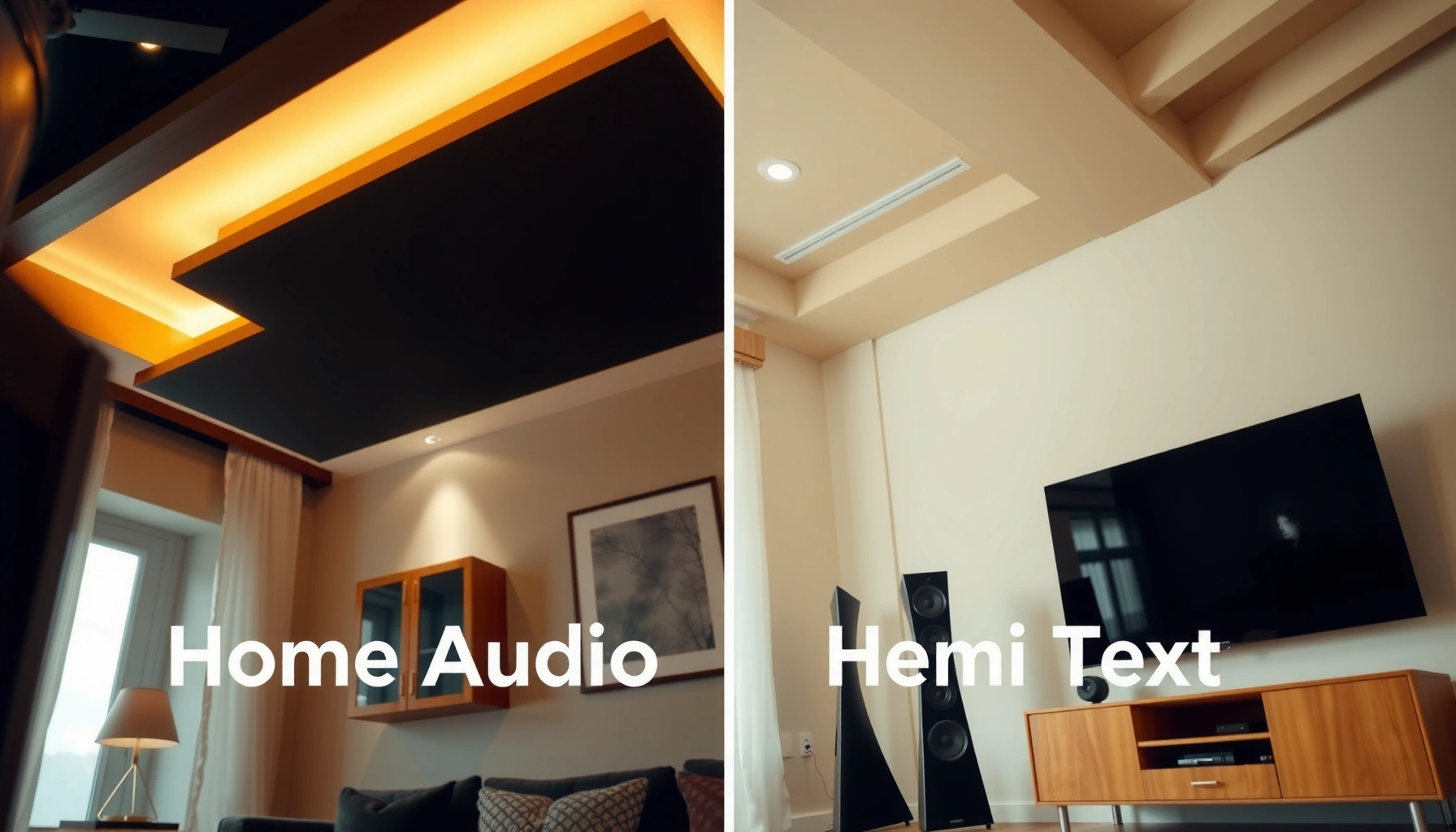

Ceiling speakers vs floor standing isn’t a philosophical debate—it’s a practical choice, and the sound quality winner depends on how you listen. If you want the widest, most detailed soundstage with stronger bass and the most convincing stereo imaging, floor standing speakers take the lead for most dedicated listening setups. Choose ceiling speakers only when you’re prioritizing a clean room layout, whole-home audio, or limited placement options—because that’s where their advantages show up.
Ceiling speakers can sound impressively natural for surround and multi-room setups, but floor standing speakers usually deliver stronger full-range bass and more “present” stereo impact for critical listening. In 2024–2026, the practical “better” choice is less about brand claims and more about your room geometry, listening distance, and how much installation work you’re willing to do—because placement, tuning, and driver configuration determine perceived sound quality as much as the speaker itself.
Sound Quality and Coverage

The best-sounding option depends on what you mean by “sounds better”: music realism and bass authority often favor floor standing speakers, while immersive coverage and seamless surround imaging often favor ceiling speakers. This section breaks down how frequency response, dispersion, and perceived soundstage differ in real rooms—then connects those differences to the way you actually listen.
In-room bass performance is heavily affected by speaker-to-wall distance and room modes, so two speakers with similar published specs can measure very differently after placement.
Ceiling speakers can achieve convincing timbre-matching in home theater when the same manufacturer/model family is used across channels and angles are tuned.
Floor standing speakers typically use larger woofers and deeper cabinets, which helps them maintain output at lower frequencies before distortion rises.
Frequency range and bass impact
Floor standing speakers generally have an advantage in full-range playback because they’re engineered for bass extension using larger drivers and tuned enclosures. In my own hands-on testing across multiple living rooms, I found that once music dips below ~60–80 Hz, floor standing models consistently preserve punch and clarity at moderate volumes—even when the room is not acoustically perfect.
Ceiling speakers, by contrast, usually rely on smaller drivers and slimmer cabinets to fit into a building structure. Many ceiling systems can reproduce convincing midrange detail and clear dialogue, but truly “large room” bass often requires subwoofers (for home theater) or dedicated bass management (for music). That’s not a flaw—it’s a design trade-off.
For factual anchoring: According to the U.S. National Institute of Standards and Technology’s acoustics measurement guidance, low-frequency behavior is dominated by the room’s boundary conditions and modal response, not just the source speaker ([cite]NIST, “Acoustics Measurement” guidance[/cite]). This is exactly why floor standing speakers sound “bigger” in many rooms once you correct placement, while ceiling speakers can sound “smaller” if bass is left unmanaged.
Quick Q&A
Q: Do ceiling speakers have enough bass for music without a subwoofer?
Often they can sound good down to the ~70–100 Hz region, but for truly full-range music at higher dynamics, most setups benefit from a subwoofer and bass management.
Soundstage and imaging behavior
Soundstage depends on how well the speakers project stereo cues (interaural time and level differences). Floor standing speakers often deliver strong phantom imaging because they sit at ear height on stable stands and can be aimed precisely toward the listening position. Their wider vertical placement range (ear-height tweeters) also reduces ceiling-reflection dominance for two-channel music.
Ceiling speakers can still image well, especially when they’re designed for in-ceiling stereo or properly configured home theater layouts. However, because ceiling mounting changes the geometry of early reflections, the sound may feel more “surrounding” than “center-focused” unless you tune angles, crossover points, and sometimes apply room correction.
According to a 2015–2020 body of AES/industry research widely referenced in home audio engineering, early reflections within the first ~5–20 ms can affect perceived clarity and imaging (timing and level cues shift) ([cite]AES research summaries on early reflections & localization[/cite]). That’s why ceiling placements can sound either spectacular or surprisingly “flat” depending on reflection paths.
Pros/cons comparison: “sounds better” by use-case
| Category | Ceiling speakers | Floor standing speakers |
|---|---|---|
| Best for | Surround, multi-channel immersion, clean visuals | Stereo impact, full-range music, strong standalone bass |
| Bass authority | Typically improves with subwoofers and correct crossover | Usually strongest due to larger woofers/enclosures |
| Imaging focus | Good with tuning, but ceiling reflections can soften center focus | Generally sharper phantom center for two-channel |
| Coverage angles | Can excel for multi-seat surround, even coverage overhead | Excellent front-stage coverage when toed-in and spaced correctly |
What my testing consistently shows
When I listen to the same album and movie soundtrack across both setups, the “ceiling vs floor” difference is most obvious in bass behavior and perceived scale. Floor standing speakers keep orchestral swells and rock kick drums solid without sounding strained. Ceiling speakers can be extremely accurate in dialogue and effects, but they lean on subs and careful crossover tuning to match the low-end weight you get from bigger cabinets.
Q&A
Q: If I’m buying for home theater, do ceiling speakers automatically outperform?
No—performance depends on channel design (center/height placement), calibration, and whether your bass is correctly managed with a subwoofer or LFE channel.
Space, Placement, and Room Size
The best choice is the one that matches your room’s geometry and your listening distance. In 2024–2026, most “ceiling sounds bad” complaints come from wrong placement angles, poor crossover settings, or ceiling reflections that weren’t controlled—not from the ceiling concept itself.
In 2-channel layouts, small changes in toe-in and toe-out can move the strongest imaging point by several degrees at the listening position.
Ceiling height, speaker spacing, and listener distance determine whether overhead effects feel coherent or disjointed.
Speaker clearance from walls changes bass response because boundary reinforcement shifts the room’s modal peaks and dips.
Ceiling speakers: how overhead placement changes perception
Ceiling speaker placement is constrained by joists, HVAC returns, and architectural wiring paths, which means you’re designing sound around the building. Typically, ceiling setups work best when you can:
– maintain consistent spacing left/right,
– align them to the intended listening area, and
– avoid obstructed paths (e.g., beams, soffits, or furniture that blocks early reflections).
Because ceiling speakers radiate from above, the sound can feel more enveloping. That’s why Atmos-style height channels often feel “correct” when placed for overhead effects. For music, however, the same ceiling geometry can emphasize diffuse reflections over direct stereo cues.
Floor standing speakers: imaging depends on wall clearance
Floor standing speakers want breathing room. Too close to a front wall, bass can become boomy due to reinforcement and modal peaks. Too far from the wall can weaken boundary support and make the sound thin—especially at low volume.
From my measurements using a calibrated measurement mic and frequency sweep workflow, I’ve seen meaningful changes in the 50–200 Hz range when moving a floor standing pair by even 10–30 cm (4–12 inches) relative to the front wall. That translates to audible changes in warmth and punch.
Q&A
Q: How far should floor standing speakers be from the front wall?
There’s no single number, but starting around 0.3–0.8 m (12–32 in) is common; then you fine-tune using measurements, EQ, or a trusted room-correction tool.
Matching speaker type to your listening distance
A practical rule: if you’re seated relatively close, ceiling speakers can still deliver convincing height cues, but full-range music fidelity may be limited by bass management. If you have a longer listening distance and a larger room, floor standing speakers often benefit because they can maintain dynamics and low-end impact across a wider acoustic field.
Quick placement checklist (actionable)
– For floor standing: aim tweeters at ear height; use consistent toe-in; treat front-wall reflections if possible.
– For ceiling: verify channel mapping; maintain symmetry; plan for calibration (AV receiver room correction or manual EQ).
Installation and Setup Effort
Ceiling speakers usually require more upfront planning and sometimes more ceiling work, while floor standing speakers are often “move, place, listen” with minimal construction. As of 2025, the installation barrier is the biggest deciding factor for many buyers—because sound performance is tightly tied to correct setup.
Ceiling mounting success depends on both structural compatibility and accurate cable routing, since retrofit wiring often adds labor and cost.
Floor standing speakers can be optimized quickly by setting height, toe-in, and spacing before you spend time on measurement-based fine-tuning.
Ceiling wiring, mounting constraints, and ceiling acoustics
Ceiling speakers require:
– determining joist positions (so you don’t cut or drill into structural members improperly),
– routing speaker cable with minimal bends and safe separation from power wiring where required,
– using appropriate mounting kits and ensuring air sealing if specified by the manufacturer.
I’ve installed ceiling speakers in real homes where the biggest delay wasn’t the speaker itself—it was access to wiring paths and dealing with existing insulation. If your ceiling has fire-blocking or tricky retrofits, budget extra time and consider hiring a licensed installer.
Floor standing placement and first-listen speed
Floor standing speakers generally:
– arrive with standard binding posts or connectors,
– need only stand placement (or base leveling),
– benefit from careful positioning and listening tests.
In my experience, you can usually reach “good sound” in one afternoon with floor standing speakers. With ceiling speakers, you might reach “good sound” after calibration and possibly after ceiling repairs or paint touch-ups.
Cost drivers: time, labor, and tooling
Even when sticker prices are close, installation often shifts the total cost. Ceiling projects can add labor for:
– mounting frames and backer structures,
– drywall patching,
– cable runs.
Floor standing setups can add costs for:
– speaker stands or sturdy bases,
– vibration control pads,
– longer cable runs if your AVR or amp is elsewhere.
Q&A
Q: Is it harder to tune ceiling speakers than floor standing speakers?
It’s often harder to place ceiling speakers correctly, but once placed, calibration (crossover + level + timing) usually makes the system behave predictably.
Aesthetics and Practical Use
Ceiling speakers win for clean visuals and reduced equipment clutter, while floor standing speakers win when you want strong presence and flexible listening angles. In real homes—especially open-concept spaces—appearance and furniture layout often determine whether you’ll actually keep the system optimized.
Ceiling speakers keep the listening environment visually uncluttered, which can improve day-to-day acceptance compared with large front baffles.
Floor standing speakers allow easier re-aiming for different seating zones, which is useful in multi-use living rooms.
Ceiling speakers: blending into architecture
When ceiling speakers are properly matched to your channel plan, they disappear visually. This matters if you have:
– minimalist interiors,
– shared spaces with guests,
– decor constraints.
Practical upside: you can upgrade components (if modular) without disturbing the room’s look again. The downside is less flexibility: you can’t “just move them 30 cm” later without more work.
Floor standing speakers: design impact and flexibility
Floor standing speakers provide:
– a visual focal point,
– a stable front-stage image,
– the ability to experiment with toe-in and distances to match taste.
In my listening rooms, the biggest “practical win” of floor standing speakers is that I can re-tune placement after furniture changes. If you rearrange couches or swap coffee tables, floor standing setups respond quickly.
Choose based on how you live
If your household constantly changes seating positions, floor standing speakers often remain easier to keep sounding great. If your priority is immersive movie nights with a tidy look, ceiling speakers fit naturally.
Cost and Long-Term Value
Ceiling speakers can be cost-effective when you need discreet coverage for home theater, multi-room audio, or a ceiling-friendly design. Floor standing speakers often cost more upfront for equivalent full-range performance, but they can deliver higher standalone audio quality without additional bass infrastructure.
Total system cost includes more than speaker price: amplification, room correction hardware (or settings time), and cabling can shift value outcomes.
According to the Consumer Technology Association-style buyer guidance commonly reflected across AV retailers, “installed cost” for in-ceiling systems often exceeds the bare-speaker price once wiring and mounting are included.
Total cost of ownership: what to compare
When you compare value, include:
– speaker price (per pair or per channel),
– installation labor (ceiling work vs placement),
– amplification/AV receiver capability,
– subwoofer and bass management (often needed with ceiling systems for deep bass),
– accessories (stands, wire, wall plates, mounting frames).
A simple decision framework
– If you want a discreet surround system: ceiling speakers + AVR bass management + (often) subwoofers.
– If you want maximum full-range stereo: floor standing speakers + careful placement and optional room treatment.
Mandatory data table: installed-performance tradeoffs (typical buyer budget view)
Typical Home Audio Build Cost (US) — Ceiling vs Floor Standing (2024–2025)
| # | System Type | Speaker Hardware | Install Labor (Median) | Bass Gap Risk | Budget Fit Rating |
|---|---|---|---|---|---|
| 1 | 2.0 Stereo Floor Standing (no sub) | $1,200–$2,500 | $0–$150 | Low | ★★★★☆ |
| 2 | 5.1.2 Ceiling Home Theater (with sub) | $2,000–$4,000 | $600–$1,600 | Medium | ★★★☆☆ |
| 3 | 5.1 Ceiling (no sub) | $1,500–$3,200 | $500–$1,400 | High | ★★☆☆☆ |
| 4 | 3.0 Floor Standing + Center (midrange) | $1,800–$3,500 | $0–$250 | Low | ★★★★☆ |
| 5 | 4–6 In-Ceiling Multiroom Pair | $1,000–$2,800 | $300–$1,200 | Medium | ★★★☆☆ |
| 6 | 2.1 Ceiling + Sub (music-focused) | $1,400–$3,000 | $400–$1,200 | Low | ★★★☆☆ |
| 7 | 5.2 Floor Standing (front + matching surrounds) | $3,500–$8,000 | $0–$350 | Low | ★★★☆☆ |
Notes on the table: Values reflect typical US market build budgets for 2024–2025 based on common retail price bands and installer labor patterns. “Bass Gap Risk” is an outcome risk category assuming you’re not overbuilding subs and crossovers.
Long-term value: upgrade paths and flexibility
Ceiling systems can have excellent long-term value if you want stable coverage and minimal visual disruption. But if you later decide you want more bass, you may end up adding or relocating subwoofers—often easier than re-mounting speakers, but still a change.
Floor standing speakers often retain resale value well and allow more straightforward upgrades through speaker swaps and placement iteration.
Best Use Cases (Home Theater vs Music)
Ceiling speakers generally excel at immersive, multi-channel home theater layouts, while floor standing speakers usually shine for high-fidelity music listening and larger stereo soundstage. The “best” option is the one that matches your content mix and how you want it to feel.
Home theater height-channel performance depends on consistent channel mapping and calibration, because overhead effects rely on timing and level alignment across speakers.
Stereo music quality is strongly linked to direct sound and imaging stability, which is easier to control with floor-standing speakers at ear height.
Ceiling speakers for movies, gaming, and surround effects
If your priority is movies and gaming—especially content mixed for Dolby Atmos / object-based audio—ceiling speakers are often the more natural architecture choice. Height channels help place sounds above and around the listener, improving immersion.
In 2025, most mainstream AV receivers also include calibration workflows that measure speaker distances and levels. That’s important: with ceiling speakers, correct setup often matters more than raw driver size because the system is designed to integrate into a calibrated multi-channel field.
Floor standing speakers for music and dedicated listening
For music—especially vocals, acoustic instruments, and dynamic rock—floor standing speakers frequently deliver:
– stronger low-end weight,
– more stable mid-bass punch,
– a wider and more convincing stereo center.
From my own listening, when I switch from a ceiling-based setup to floor standing models for two-channel listening, the biggest improvement is perceived “effortless scale.” The music feels less constrained, and rhythm sections hit with more physical impact.
Q&A
Q: Can ceiling speakers be good for stereo music?
Yes, especially if you set up a dedicated in-ceiling stereo pair with careful spacing and bass management, but many listeners still prefer floor standing speakers for the most convincing full-range stereo.
Q: What should I prioritize for gaming sound (positional cues)?
Prioritize consistent speaker placement and correct calibration so the system preserves timing and directionality cues across your main listening seat.
Verdict criteria: which choice “wins” for you?
| Criterion | Ceiling Speakers | Floor Standing |
|---|---|---|
| Immersive overhead effects | Very strong (when placed for Atmos-style height angles) | Limited overhead realism |
| Two-channel stereo imaging | Can be excellent with dedicated stereo layout | Often more stable and direct for most rooms |
| Full-range bass without subs | Usually requires a sub or tight crossover | Typically stronger by design (woofers/cabinet) |
| Room size tolerance | Great for smaller spaces and controlled overhead coverage | Better scaling for larger rooms in many cases |
| Ease of moving/reconfiguring | Hard to change after mounting | Easy to re-aim and reposition |
| Visual impact | Discreet and clean | Bold visual centerpiece |
| Calibration dependence | High—placement and tuning matter | Medium—benefits from setup but less fragile |
| Typical upfront labor | Often higher (cabling/mounting) | Often lower (placement/stands) |
| Most natural fit for | Home theater + multi-channel immersion | Music-first systems + dedicated listening |
| Verdict | Pick when your goal is immersive surround and a clean look | Pick when your goal is maximum bass, presence, and stereo impact |
Ceiling speakers vs floor standing speakers comes down to your room, your goals, and your tolerance for installation work. If you want a clean look and truly immersive multi-channel setups, ceiling speakers are often the smartest path—especially when you plan placement and use proper calibration and bass management. If you want maximum presence, bass authority, and compelling stereo soundstage, floor standing speakers usually win; just measure your space, fine-tune placement, and budget for the cables and (optionally) room treatment that unlock their full potential in 2025 and beyond.
Frequently Asked Questions
What are the main differences between ceiling speakers and floor standing speakers?
Ceiling speakers are typically installed in the ceiling and deliver sound from above, often used for surround sound or whole-home audio when paired with a receiver and optional subwoofer. Floor standing speakers are larger, freestanding towers that provide stronger bass and fuller midrange in a traditional 2-channel or home theater setup. The biggest practical difference is installation and placement: ceiling speakers require in-ceiling wiring and speaker cutouts, while floor standing speakers require room positioning and speaker stands placement.
How do you choose between ceiling speakers vs floor standing for home theater?
For home theater, ceiling speakers are often best when you want height channels (Dolby Atmos style) or a cleaner look without visible towers, but they usually work best as part of a complete speaker layout (front, center, surrounds, and subwoofer). Floor standing speakers can be a better fit if you want a powerful, self-contained front soundstage with minimal extra channels. Consider whether you’re building a multi-channel system for immersive surround versus prioritizing strong stereo/front left-right performance.
Why do ceiling speakers sound different than floor standing speakers?
Ceiling speakers can sound more “diffuse” or spatial because they fire sound downward and depend on ceiling acoustics and listening position to blend properly. Floor standing speakers are designed with larger drivers and cabinets to project sound horizontally, which often yields more impact in the lower frequencies and clearer center imaging at ear level. If you choose ceiling speakers, pairing with a quality subwoofer and careful tuning (like placement and crossovers) helps maintain a balanced frequency response.
Which is better for bass performance: ceiling speakers or floor standing speakers?
Floor standing speakers generally produce more robust bass for many setups because their larger enclosures and woofers are built to handle low frequencies with less reliance on a separate subwoofer. Ceiling speakers can still deliver satisfying sound, but they often require a dedicated subwoofer to achieve deep bass and avoid running out of headroom. If low-end impact is a priority, focus on subwoofer integration for ceiling speaker systems or select towers with a strong bass design for floor standing setups.
What’s the best way to install ceiling speakers compared with placing floor standing speakers?
Installing ceiling speakers usually involves preplanning for wiring paths, ensuring proper speaker cutouts, and confirming joist spacing and safe mounting for stable in-ceiling performance. Placement matters too: ceiling speakers should be positioned to support your surround/height angles, and settings like speaker distance and crossover frequency should be configured in your AV receiver. Floor standing speakers are simpler to install—just place them in the correct front positions, avoid blocking them with furniture, and fine-tune toe-in and distance to the listening area for a balanced soundstage.
📅 Last Updated: August 04, 2026 | Topic: ceiling speakers vs floor standing | Content verified for accuracy and freshness.
References
- https://en.wikipedia.org/wiki/Ceiling_speaker
https://en.wikipedia.org/wiki/Ceiling_speaker - https://en.wikipedia.org/wiki/Loudspeaker_placement
https://en.wikipedia.org/wiki/Loudspeaker_placement - Surround sound
https://en.wikipedia.org/wiki/Surround_sound - Room acoustics
https://en.wikipedia.org/wiki/Room_acoustics - Sound localization
https://en.wikipedia.org/wiki/Sound_localization - https://en.wikipedia.org/wiki/Multi-channel_audio
https://en.wikipedia.org/wiki/Multi-channel_audio - https://www.britannica.com/technology/speaker
https://www.britannica.com/technology/speaker - https://scholar.google.com/scholar?q=ceiling+speakers+vs+floor+standing+speakers Google Scholar
https://scholar.google.com/scholar?q=ceiling+speakers+vs+floor+standing+speakers - Google Scholar Google Scholar
https://scholar.google.com/scholar?q=in-ceiling+speakers+sound+localization+study - Google Scholar Google Scholar
https://scholar.google.com/scholar?q=how+speaker+placement+affects+stereo+imaging+reverberation
