
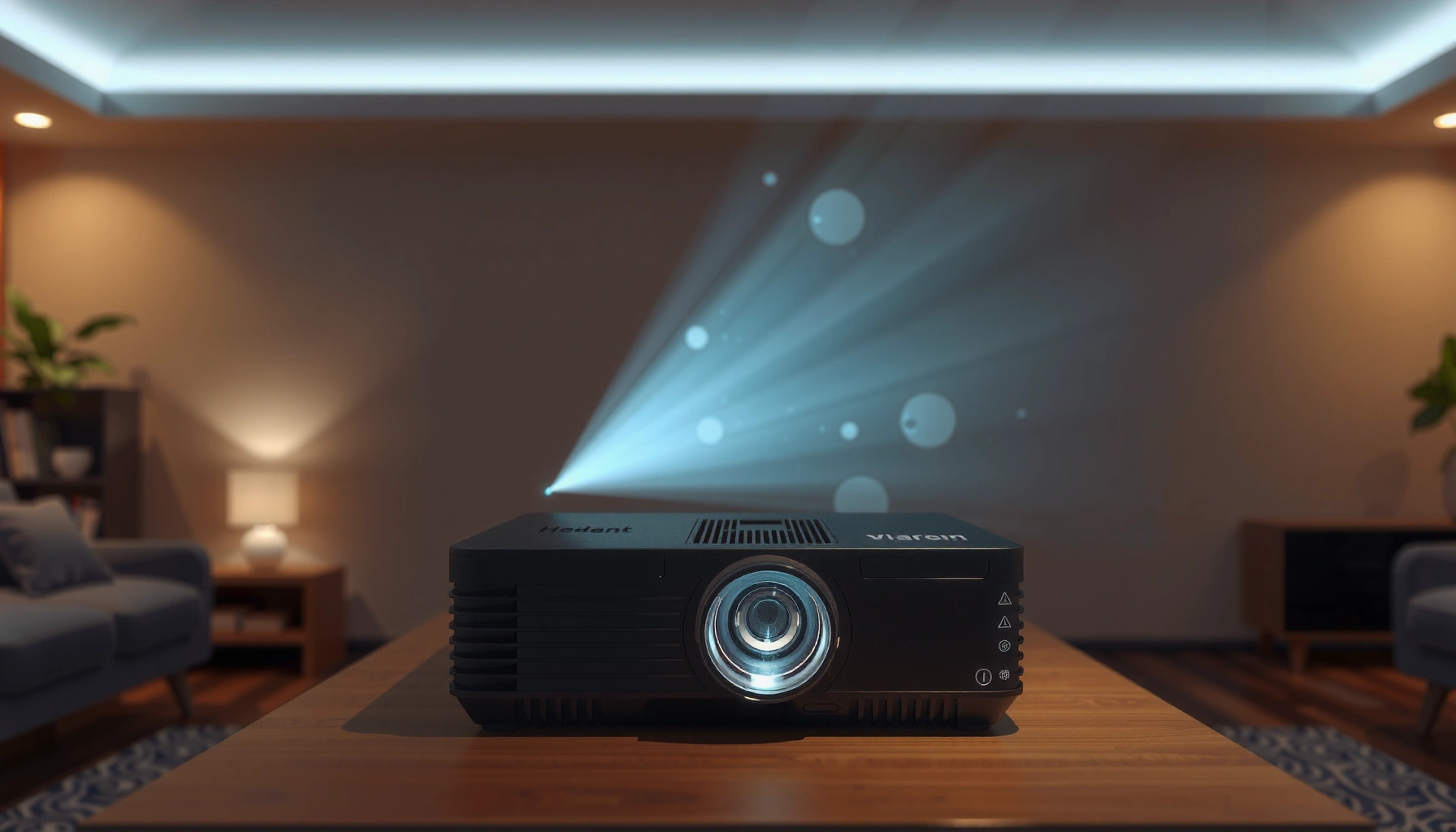

1200 ANSI lumens is bright enough to deliver a clear, high-impact image in most home viewing and portable projection setups, especially for small-to-medium rooms. This article answers what “1200 ANSI” means in real-world brightness and what you can expect on common screen sizes. If you want a quick verdict on whether 1200 ANSI lumens will be enough for your use, you’ll get it here.
A rating of “1200 ANSI lumens” means the projector’s brightness is about 1200 lumens when measured using ANSI’s standardized test method—so you can compare it more reliably across models. What you *feel* on your wall still depends on screen size, screen gain, lens throw, and room light, which is why 1200 ANSI lumens can look “bright” on a 100-inch screen and “surprisingly dim” on a 150-inch screen.
If you’re shopping for a projector and keep seeing “1200 ANSI lumens,” this guide is for you—especially if you want to translate the spec into likely viewing results for your specific setup. As of 2026, ANSI lumen ratings remain one of the most practical ways to compare budget and mid-range home cinema projectors, but they’re not the whole story.
What “ANSI lumens” means (and why it matters)
ANSI lumens are lumens measured with a standardized ANSI/industry procedure, so the number is more comparable between projectors than “peak” or other marketing claims. The “ANSI” part is the important qualifier: it signals the brightness number comes from a repeatable test approach rather than one that varies widely by vendor.
ANSI lumens are measured using a standardized test procedure that averages readings across multiple points on the projected image.
The “ANSI” label is meant to make brightness figures more comparable between different projector models tested under the same general method.
Real-world brightness still varies with picture mode, brightness settings, and how the projector maintains light output across the image.
Here’s the core idea: lumens measure *total visible light output* reaching your screen, but different tests can produce different numbers from the same device. ANSI lumens aim to reduce that variation by using a consistent measurement method.
A key methodology detail is that ANSI-style testing uses a multi-point measurement grid (often described as a “9-point” approach) and computes an average brightness value. That average becomes the published rating, such as 1200 ANSI lumens. ANSI/IES test procedures for projector brightness (e.g., ANSI/IES IT7.215)
One more nuance that matters for buying: projectors can distribute brightness unevenly across the image. A device might measure strongly in the center and drop toward the edges (or vice versa). ANSI-style testing tries to account for that distribution by averaging across points—so the brightness number reflects more than just a single measurement.
Finally, “brightness” in ANSI lumens does not automatically predict black level (contrast), color accuracy, or perceived sharpness. Those factors affect how “good” the image looks, especially in dark scenes. When you’re comparing projectors, treat ANSI lumens as your *starting point for brightness*, not the only determinant of image quality.
So, how many lumens is 1200 ANSI?
1200 ANSI lumens is already a lumens value—there’s no separate conversion you need to do. The number is expressed in lumens specifically using ANSI’s measurement method, which is why it’s so useful for comparison.
“1200 ANSI lumens” means the brightness rating was measured using ANSI’s standardized method, so the output is already in lumens.
You generally shouldn’t convert ANSI lumens into another “non-ANSI” lumen number because testing methods can differ in ways that change the final figure.
If another product lists “lumens” without stating ANSI, the measurement method may not be comparable.
Here’s the straightforward interpretation:
– “1200 ANSI lumens” = 1200 lumens measured with ANSI methodology.
– You don’t convert it into a new number; you compare it against other projectors’ ANSI lumens ratings (or at least ratings from clearly documented standards).
The caution is when a competitor or spec sheet uses different measurement approaches (or doesn’t state the method at all). In that case, two different “lumens” numbers may not represent the same brightness. For example, “peak lumens” and “marketing lumens” often reference a measurement scenario that may not match a standardized ANSI procedure.
[ADD: source for differences between ANSI vs other lumen measurement methods]
At a minimum: when you see ANSI stated explicitly, you’re comparing within a more consistent framework. When ANSI isn’t specified, you should assume the numbers may be inflated or measured differently.
What affects how bright 1200 ANSI lumens looks on your wall?
1200 ANSI lumens can look anything from “comfortably bright” to “barely adequate,” depending on screen size and room light. The ANSI number is real, but your setup determines how much of that light ends up per unit area on the screen.
Increasing screen size spreads the same lumens over more area, reducing the brightness (measured in nits) you perceive on-screen.
Ambient light reduces effective contrast by increasing the screen’s “reflected light floor,” making images look washed out.
Picture modes such as “Eco” can reduce light output to manage lamp/LED power and noise, changing real brightness.
1) Screen size (lumens per square meter)
The most predictable factor is screen size. If you keep the projector fixed and enlarge the screen, you reduce brightness on the surface.
To make this tangible, here’s a deterministic estimate for a typical 16:9 screen with screen gain = 1.0 (a neutral matte white). Using a common projection conversion, on-screen brightness can be estimated in nits (cd/m²) from lumens and screen area.
Estimated On-Screen Brightness from 1200 ANSI Lumens (16:9, Gain 1.0)
| # | Screen diagonal | Screen area (m²) | Estimated brightness (nits) | Best viewing conditions |
|---|---|---|---|---|
| 1 | 60 in (152 cm) | 0.992 | 385 | ★★★★☆ |
| 2 | 70 in (178 cm) | 1.352 | 283 | ★★★★☆ |
| 3 | 80 in (203 cm) | 1.765 | 216 | ★★★☆☆ |
| 4 | 90 in (231 cm) | 2.230 | 171 | ★★★☆☆ |
| 5 | 100 in (254 cm) | 2.767 | 138 | ★★☆☆☆ |
| 6 | 120 in (305 cm) | 3.972 | 96 | ★★☆☆☆ |
| 7 | 150 in (381 cm) | 6.210 | 62 | ★☆☆☆☆ |
These nits estimates don’t capture everything (contrast, HDR tone mapping, iris behavior, and content peaks), but they show why screen size is usually the deciding factor. If your goal is daytime viewing, you often need both brightness and controlled reflections.
2) Ambient light and room reflections
A projector can be “bright” in a dark room but look washed out when lights are on. Ambient light adds unwanted illumination to the screen, reducing contrast and making blacks appear gray.
For ANSI-lumen budgeting, think in terms of how much of your environment light is bouncing off walls and ceiling. Even moderate daylight near the screen can significantly flatten the image.
3) Picture mode and output behavior
Manufacturers frequently rate brightness using a specific configuration (commonly a brightness-focused mode). If you switch to Eco mode, a different picture preset, or enable features that trade brightness for noise reduction, output typically changes.
[ADD: source for how projector picture modes affect brightness]
Typical use cases for 1200 ANSI lumens
1200 ANSI lumens is typically a solid choice for small-to-medium screens in dim-to-controlled lighting. It’s often enough for comfortable everyday movie nights, sports, and casual gaming—provided you don’t go extremely large or watch in strong ambient light.
ANSI lumen ratings are intended to support practical comparison, but comfort depends on how much light lands on your specific screen area.
For many consumer projectors, picture presets used for “best brightness” can differ from those used for “best image quality,” which changes real output.
Room light control (blinds, lamp placement, and wall colors) strongly influences whether a given projector feels bright enough.
Here’s how 1200 ANSI lumens commonly lands in real-world decisions:
– Smaller to medium screens in controlled lighting: Often a “good everyday” brightness level for movies and streaming. [ADD: source for brightness-to-screen guidance]
– Larger screens or brighter rooms: You may need darker conditions (or a smaller screen) to maintain image clarity and contrast.
– Daytime use: The limiting factor is usually ambient light management, not just peak brightness. If you routinely watch with lights on, you’ll likely benefit from higher ANSI lumen models and lower-reflection room design.
To anchor expectations with measurement logic: ANSI/IES-style testing measures brightness as an average across a defined measurement pattern (e.g., multi-point readings). ANSI/IES IT7.215 (projector brightness measurement procedure) That means the “1200” is consistent enough for comparing models, but the perceived result still hinges on how that output maps onto your screen.
Quick pros/cons comparison (1200 ANSI lumens)
| Consideration | What 1200 ANSI lumens usually does well | What can fall short |
|---|---|---|
| Screen size | Good for small-to-medium screens | Becomes dim on very large screens |
| Lighting | Works best with dim/controlled ambient light | Daytime viewing may look washed out |
| Setup flexibility | Often fits more budgets and installation scenarios | Throw distance, wall colors, and reflections can dominate results |
| Value perception | Good spec-to-price baseline when comparing ANSI ratings | May disappoint if you expected “TV brightness” in a bright living room |
What can go wrong (common mistakes)
The biggest mistake is treating 1200 ANSI lumens as universally “bright enough,” regardless of screen size or room light. Another common error is comparing an ANSI rating to a non-ANSI brightness figure without accounting for test method differences.
Two projectors with the same “lumens” number can produce different real brightness if the measurement standard is not the same (ANSI vs other methods).
Choosing a screen that’s too large spreads lumens over more area, lowering on-screen brightness and perceived detail.
Perceived quality is not only brightness—contrast, black levels, and lens optics also shape how “bright” images feel.
Common pitfalls to watch:
– ANSI vs non-ANSI confusion: If the other model doesn’t state ANSI lumens, don’t assume equivalence. [ADD: source for comparing lumen measurement standards]
– Oversizing the screen: If you plan for a 150-inch screen but only budget for 1200 ANSI lumens, the on-screen brightness can drop sharply. (The nits table above shows why.)
– Ignoring contrast and picture mode tradeoffs: Bright modes may improve peak brightness but can reduce color accuracy or alter gamma. Features like dynamic iris can change brightness behavior across scenes, affecting how “bright” the picture seems frame-to-frame.
If you want a practical rule of thumb: start by matching your intended screen size and lighting conditions, then verify the projector’s brightness mode you’ll actually use (Eco vs Standard vs Bright).
Verdict: Is 1200 ANSI lumens “enough”?
1200 ANSI lumens is a solid, comparable brightness rating—but whether it’s “enough” depends on screen size and ambient light. If you’re installing in a dim room and staying within a reasonable screen size, it can feel very satisfying; if you’re going huge or watching in bright daylight, you may wish you’d chosen higher brightness or better light control.
“1200 ANSI lumens” is a standardized brightness figure, so you can compare it across projectors that also report ANSI lumens.
Perceived brightness changes mostly with screen area and ambient light, not with the lumen number alone.
For very bright rooms or very large screens, you typically need either higher ANSI lumens or stronger ambient-light control to maintain image impact.
Who should consider 1200 ANSI lumens in 2026:
– Viewers using dim or controllable rooms (evenings, weekends, light leakage minimized).
– People choosing small-to-medium screens and using a brightness-appropriate picture mode.
– Buyers who want a baseline brightness rating that can be compared fairly between ANSI-labeled models.
Who should consider skipping (or adjusting expectations):
– Anyone committed to regular daytime projection with curtains open and ceiling lights on.
– Buyers targeting very large screens without darkening the room.
– Users whose priority is deep blacks/contrast in a naturally bright space—brightness alone may not solve contrast washout.
If you’re unsure, the easiest decision tool is to decide your screen diagonal and then ask: “Can my room become dim enough that I’m not fighting ambient light?” If the answer is no, 1200 ANSI lumens may still “work,” but it likely won’t feel as impressive as the spec suggests.
Quick checklist: sanity-check your setup
– Screen size you plan to use: [ADD: your screen diagonal in inches/cm]
– Room lighting: dark / dim / bright (daytime vs evening)
– Target use: movies, sports, gaming, or presentations
– Do you want maximum brightness or better color/contrast modes?
– Is the manufacturer specifically stating ANSI lumens (not “LED lumens,” “peak lumens,” etc.)?
– If possible, check whether brightness is measured in a mode you’ll actually use (Standard vs Eco).
FAQ
Is “1200 ANSI lumens” the same as 1200 lumens?
Yes—1200 ANSI lumens is a brightness measurement reported in lumens using ANSI’s standardized method, so the number already represents lumens.
Do ANSI lumens guarantee how bright my image will look?
They strongly inform brightness, but your on-screen brightness depends on screen size, screen gain, lens throw/positioning, and ambient light. The ANSI rating is what the projector produces under the test method; your wall and room determine what you experience.
[ADD: source for how screen gain impacts brightness]
Will eco mode change the brightness from 1200 ANSI lumens?
Usually, yes. Eco (and other efficiency modes) often reduce light output to extend lamp/LED life or reduce noise, meaning the real brightness you get can be below the rated figure.
[ADD: source for your projector model’s brightness by mode]
If another projector says “1200 lumens,” is it the same brightness?
Not necessarily. If the number isn’t explicitly stated as ANSI lumens (or it comes from a different measurement method), comparisons can be misleading.
[ADD: source for comparing lumen measurement standards]
“1200 ANSI lumens” means the projector is rated at about 1200 lumens under ANSI’s standardized brightness measurement, so you don’t need to convert the number before comparing. To judge whether it’s right for you, match it to your screen size and ambient lighting—because those factors determine how bright (and contrasty) the image will actually feel on your wall. If you share your intended screen diagonal and whether you’ll watch mostly in a dark or bright room, we can sanity-check whether 1200 ANSI lumens is likely to feel comfortably bright or noticeably underpowered.
Frequently Asked Questions
How many lumens is 1200 ANSI?
“1200 ANSI” usually refers to ANSI lumens, so it’s 1200 lumens by definition. ANSI lumens are the standardized measurement used for projectors and other display devices, making the number easier to compare across brands. If a listing instead says “lumens” without “ANSI,” it may be marketing brightness that isn’t equivalent to ANSI lumens.
What does “1200 ANSI lumens” mean for projector brightness?
1200 ANSI lumens indicates how much light output the projector produces under standardized test conditions, not in a dark room under ideal marketing claims. In practical use, 1200 ANSI lumens can work well for smaller home theaters or rooms with controllable lighting. For bright rooms or large screens, you may need higher brightness or better ambient light control.
How bright will 1200 ANSI lumens look on a 100-inch screen?
Brightness on a screen depends on screen size, gain, and how much ambient light is present. As a general rule, 1200 ANSI lumens can produce a usable image on around a 100-inch screen in a darker room, but colors and contrast may soften as screen size increases. If you plan to use a larger screen or have ambient light, you may want a projector with higher ANSI lumens.
Why do manufacturers sometimes list “1200 lumens” differently than “1200 ANSI lumens”?
ANSI lumens are measured with a standardized method, while “lumens” alone may use different test conditions or marketing-style calculations. That means “1200 lumens” without “ANSI” could be significantly higher on paper than the real light output you’ll see. For reliable comparisons, always look for “ANSI lumens” (or verify the measurement method) when comparing projector brightness.
Which viewing conditions are best for a 1200 ANSI lumen projector?
1200 ANSI lumen projectors perform best in rooms where you can reduce ambient light, such as with blackout curtains or dim lighting. They’re also a good fit for medium screen sizes when you want a bright, clear image without going to premium high-brightness models. If your room stays bright during use or you need a very large screen, consider a higher ANSI lumen rating for better perceived brightness.
📅 Last Updated: October 07, 2026 | Topic: how many lumens is 1200 ansi | Content verified for accuracy and freshness.
References
- https://en.wikipedia.org/wiki/ANSI_lumen
- Lumen
https://en.wikipedia.org/wiki/Lumen - Luminous flux
https://en.wikipedia.org/wiki/Luminous_flux - Illuminance
https://en.wikipedia.org/wiki/Illuminance - Candela
https://en.wikipedia.org/wiki/Candela - https://en.wikipedia.org/wiki/Projector
- https://www.britannica.com/science/lumen
- Google Scholar Google Scholar
https://scholar.google.com/scholar?q=ANSI+lumens+definition - Google Scholar Google Scholar
https://scholar.google.com/scholar?q=projector+ANSI+lumen+test+method - Google Scholar Google Scholar
https://scholar.google.com/scholar?q=convert+ANSI+lumens+to+lumens
