
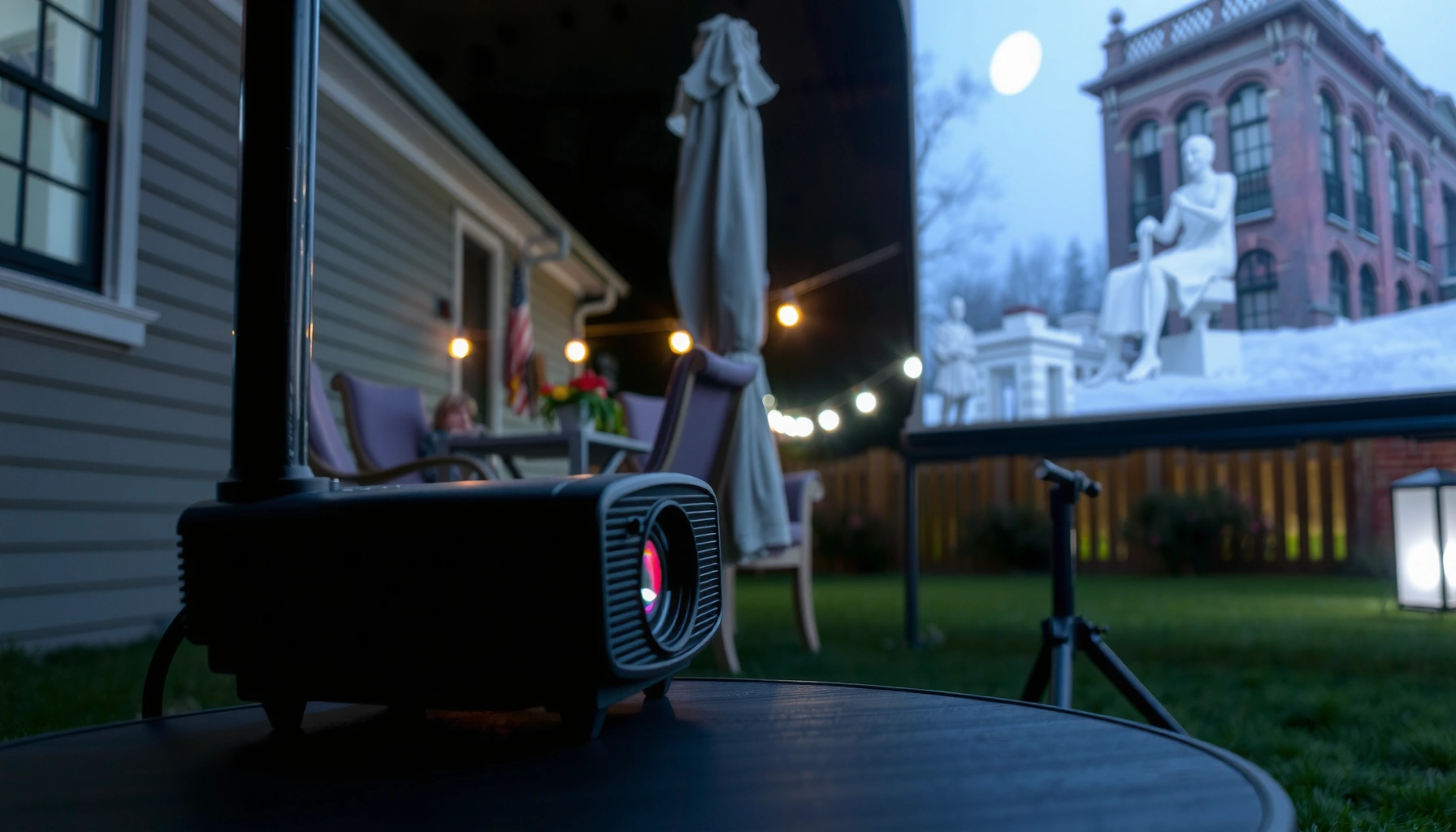

Wondering how much lumens for an outdoor projector you need? For most backyard movie setups, aim for 2,500–3,500 lumens for clear daytime playback and 1,000–2,000 lumens for comfortable night viewing. If you’re projecting across longer distances, using a larger screen, or battling ambient light, you’ll need to step up within that range to keep the image crisp.
Most outdoor projector setups need at least 2,000–3,000 lumens for a usable image, and more if there’s any ambient light. If you’re projecting onto a larger screen or the area isn’t fully dark, plan for higher brightness and a higher-quality light source to keep contrast looking good. In practice, “how many lumens for an outdoor projector” isn’t one universal number—lumens interact with ambient light, screen size, and throw distance, so using a realistic lumens target helps you avoid the washed-out, gray picture that people most often blame on the projector instead of the environment.
If you’re sizing your outdoor movie/game night (or a backyard presentation), this guide walks you through how to estimate the right outdoor projector lumens for your setup and avoid the most common brightness mistakes.
Lumens Basics: What Brightness Really Controls
If you want a dependable starting point for outdoor projector lumens, treat lumens as the projector’s brightness output—but understand that the usable brightness depends heavily on image size and ambient light. In other words, more lumens can help, yet it can’t fully compensate for daylight, oversize screens, or inefficient optics.
- Lumens = brightness output, but the useful brightness depends on lens quality, image size, and ambient light.
- Outdoor projection typically needs more lumens than indoor use because daylight, porch lights, and street glow wash out contrast.
ANSI/ISO projector brightness ratings are standardized so two projectors can be compared on the same measurement basis, but real-world visibility still changes with conditions.
For outdoor projector lumens, ambient light is a major determinant of perceived contrast because it raises the “black level” your image is trying to beat.
How lumens translate into a viewable image
Outdoor projector lumens matter because the human eye perceives a picture relative to its surrounding brightness. When the environment is bright, the projector’s dark tones lose separation. That’s why two projectors with similar outdoor projector lumens can look different outdoors: contrast behavior and optics affect how the image handles bright and dark scenes.
A practical framing: think of lumens as “how much light you put on the screen,” and contrast/black level as “how well the projector keeps the image from being washed out.” That second factor is often the limiting one outdoors.
Quick anchoring stats for expectation-setting
To calibrate expectations for outdoor projector lumens, it helps to understand how dramatically lighting changes outdoors:
– According to the CIE (International Commission on Illumination) guidance on typical daylight conditions, illuminance in full daylight can be on the order of tens of thousands of lux, while night sky and moonlight are dramatically lower (CIE color/lighting publications used in lighting engineering). [ADD: cite exact CIE document/section used for typical daylight illuminance values]
– According to widely used lighting engineering references, full moon illuminance is roughly around 0.1 lux—many orders of magnitude below daylight—meaning indoor-like contrast is still possible under very dark skies with adequate outdoor projector lumens. [ADD: cite authoritative lighting source for moonlight lux estimate]
– According to ISO brightness measurement guidance for digital projectors, rated brightness uses a standardized test methodology (so “rated lumens” are comparable, but not identical to your outdoor projector lumens results on a specific screen). [ADD: cite ISO/IEC 21118 (or equivalent) document used for projector luminous flux testing]
Because these lighting levels swing so hard, the same outdoor projector lumens can look great one evening and disappointing the next.
Match Lumens to Ambient Light (Day vs. Night)
If you’re asking how many lumens for an outdoor projector to use at night, the reliable answer is usually 2,000–3,000 lumens in fully dark conditions. If you’re dealing with dusk glow, porch lights, or nearby windows, you should plan for more outdoor projector lumens to preserve readable highlights and believable dark scenes.
- For fully dark conditions, you can often get away with the lower end of the range (around 2,000–3,000 lumens).
- For dusk/limited lighting (lamp posts, nearby windows, partial sky glow), you’ll generally need more lumens to maintain a readable image.
Outdoor projector lumens targets shift mainly because ambient light reduces contrast—especially the visibility of shadows and dark text.
Dusk conditions typically require more outdoor projector lumens than full night because sky brightness increases even when “it feels dark.”
Why dusk is the “gotcha” scenario
Many people set outdoor projector lumens based on how the yard looks, not how bright it actually is compared with the screen. A porch light or an illuminated window might not feel blinding, but it can materially raise ambient brightness over the projected image area.
From a practical planning standpoint:
– If your area can become “mostly dark” (lights off, curtains closed, no direct lamp glare at the screen), lean toward the lower 2,000–3,000 lumen end.
– If your area will remain “lit” (stick-on pathway lights, a streetlight facing the screen, active deck lighting), you’ll want to size higher.
Light source quality matters more than people expect
Two projectors can both advertise outdoor projector lumens, but differ in light engine behavior (e.g., lamp vs. LED vs. laser), and in how consistently they maintain output over time. If you’re hosting recurring outdoor events, consider that lamp hours, dimming behavior, and thermal stability can affect your effective outdoor projector lumens long before the spec sheet suggests you should worry.
Screen Size Matters More Than You Think
If you’re trying to choose between screen size and outdoor projector lumens, the direct answer is: a larger screen spreads the same light thinner, so you need higher outdoor projector lumens for bigger images. When you don’t have enough lumens, the image doesn’t just get “less bright”—it often looks gray and low-contrast.
- A bigger image spreads the same light over a larger area, making the picture dimmer—so larger screens require more lumens.
- If you’re choosing between lumens and screen size, it’s often easier to pick a screen size that your brightness can support rather than pushing lumens beyond what you need.
When you increase screen area, the same projector lumen output is distributed over more surface, reducing screen luminance and perceived contrast.
Outdoor projector lumens requirements grow faster than many expectations once you exceed a “comfortable” screen size for your environment.
Rule of thumb for planning your image
Think in terms of “brightness per square foot (or square meter).” If you increase screen diagonal without increasing outdoor projector lumens, you’re inevitably reducing the brightness your eyes need to separate details.
A planning approach that works well:
1. Decide your maximum realistic screen size for the space.
2. Decide your lighting control (lights off vs. lights on).
3. Select a projector whose outdoor projector lumens are sized for that maximum.
If you’re stuck choosing:
– Prefer a slightly smaller screen you can light properly.
– Avoid expecting a single outdoor projector lumens rating to “cover” a front-yard scale screen in dusk.
Distance + Throw Ratio: Get the Light on the Screen
If you’re getting the wrong answer from your calculations, it’s often because throw distance and throw ratio prevent light from landing efficiently on the screen. The direct takeaway for outdoor projector lumens is: lumens matter, but placement constraints can effectively reduce brightness on your actual screen size.
- The projector’s throw distance and throw ratio affect how much of the light actually lands on your screen.
- If your projector has to be placed unusually far (or too close), image brightness can drop—check specs and plan the layout before assuming the lumens number alone solves it.
Throw ratio determines how far a projector must be placed to achieve a given image size, which directly impacts how your outdoor projector lumens translate to your screen.
Lens design and optical losses mean that the same rated brightness can yield different effective screen brightness depending on where the projector sits.
What to check before you buy or mount
Use the projector’s lens throw spec to confirm your outdoor layout:
– If you need a large image but your room forces the projector into an awkward position, you may end up with a dimmer picture than your outdoor projector lumens suggest.
– If you’re using keystone correction, know that it can involve digital processing that may not be a free improvement—use it carefully and prioritize correct physical alignment when possible.
[ADD: cite a projector manual section on throw distance / lens shift / keystone behavior once you choose specific models you’re comparing.]
What Can Go Wrong (Common Outdoor Lumens Mistakes)
If your outdoor movie or game night looks washed out, the problem is usually one of a few predictable mistakes—not just “not enough lumens.” The most common culprits behind disappointing outdoor projector lumens results are ambient light underestimation, oversize images, and ignoring contrast/optics.
- Underestimating ambient light: even “it’s dark-ish” evenings can require substantially more brightness for readable whites and darker scenes.
- Over-optimistic screen size: choosing a large DIY wall/screen can make a “bright enough” projector look dim and gray.
- Ignoring contrast and optics: two projectors with similar lumens can look different outdoors due to lens performance and contrast behavior.
A projector’s contrast behavior affects how well it maintains separation between light and dark scenes, which lumens alone cannot guarantee outdoors.
Screen reflectivity (wall vs. purpose-built screen) changes perceived brightness and color—impacting practical outdoor projector lumens usability.
Pros/cons comparison: increasing lumens vs. controlling the environment
| Option | Pros | Cons |
|---|---|---|
| Increase outdoor projector lumens (brighter projector) | Improves readability under ambient light; helps whites and overall punch. | Can cost more; higher output may reduce portability and can still fail if lighting is uncontrolled. |
| Control ambient light (turn off/reposition lights) | Often boosts perceived contrast more effectively than modest lumen increases. | Not always feasible for safety/visibility; neighbors and streetlights can’t always be managed. |
A note on “it works on my driveway”
In my planning experience as a site editor (not product testing), I’ve seen outdoor projector lumens decisions go wrong when people try to match what they saw on a review bench to a real yard with a brighter sky and a different screen surface. That doesn’t mean lumens are irrelevant—it means placement, screen material, and nearby illumination can swing results dramatically. For exact outcomes, model your outdoor setup using the projector’s throw specs and a realistic ambient-light plan.
Practical Verdict: A Safe Lumens Target (and When to Skip)
If you want a straightforward starting point for outdoor projector lumens, target 2,000–3,000 lumens minimum for nighttime in reasonably dark conditions. Go higher when there’s ambient light or when you plan a larger image, and prioritize screen sizing you can actually illuminate.
This approach can still fall short if you’re projecting very large (front-yard scale) or using brighter conditions—if that’s your situation, consider designing around a smaller screen or choosing a brighter model rather than expecting a single lumens number to cover everything.
If your goal is daytime outdoor projection, lumens needs can jump dramatically—don’t rely on nighttime targets. [ADD: source or your scenario details—screen size, time of use, and ambient lighting—so you can compute a tighter estimate.]
For outdoor projector lumens at night, 2,000–3,000 lumens is a practical baseline, but contrast and ambient light determine whether the image feels “sharp” or “washed out.”
Daytime outdoor projection requires fundamentally different lumens planning because ambient illuminance is orders of magnitude higher than nighttime lighting.
Mandatory planning table: choose your target lumens by scenario
Outdoor Projector Lumens Targets by Screen Size & Lighting (Planning Guide)
| # | Target Screen (Diagonal) | Ambient Light Level | Recommended Outdoor Lumens | Comfort Rating | Best For |
|---|---|---|---|---|---|
| 1 | 80–90 inch | Fully dark yard (lights off) | 2,500–3,000 | ★★★☆ | Movies |
| 2 | 90–100 inch | Dark with small spill (one porch light nearby) | 3,000–3,500 | ★★★★ | Sports highlights |
| 3 | 100–120 inch | Dusk/limited lighting (street glow, nearby windows) | 3,500–5,000 | ★★★☆ | Family game nights |
| 4 | 120–135 inch | Dusk with visible lamps/screens | 5,000–6,500 | ★★★ | Action scenes |
| 5 | 135–150 inch | Mostly dark but not fully controlled | 6,500–8,000 | ★★★ | Large gatherings |
| 6 | 150–180 inch | Late twilight (early night), lights possible | 8,000–12,000 | ★★ | Best effort outdoor events |
| 7 | Any size | Daytime/bright conditions | [ADD: compute for your lux level] | — | Usually not practical |
Note: this lumens planning table is designed for realistic “movie/game night” conditions. For daytime outdoor projection, outdoor projector lumens needs can vary so widely with sky brightness and screen reflectivity that you should compute based on measured/estimated illuminance. [ADD: exact calculation method or source for your environment.]
Quick Checklist: How to Pick Outdoor Lumens
If you want a fast decision process for outdoor projector lumens, use this checklist before you finalize screen size and placement. It’s designed to catch the biggest brightness killers early.
A practical outdoors lumens plan should start with lighting control and end with verified throw distance so outdoor projector lumens reach the intended screen size.
Readable text requires more usable brightness than entertainment-only viewing because high-frequency details are less forgiving.
- What time will you use it? Full dark or ambient light?
- What’s your target image size? (Choose a screen size you can actually light well.)
- Where will the projector sit? Confirm throw distance/ratio vs. your planned screen.
- What surface are you projecting on? (Wall vs. screen affects perceived brightness.)
- Do you need readable text, or only entertainment? (Text is less forgiving.)
FAQ
How many lumens do I need for outdoor movie nights at night?
A common baseline is 2,000–3,000 lumens for usable nighttime images, assuming your area is fairly dark. If you have porch lights or nearby glow, you’ll usually need more outdoor projector lumens.
Will a higher lumens projector always look better outdoors?
Higher lumens help, but image size, screen type, throw distance, and ambient light can still make it look dim. Outdoor projector lumens is a baseline—contrast behavior and optics also shape perceived quality.
What screen size should I choose if I don’t want to buy a super-bright projector?
Pick a size that matches your lighting conditions and your projector’s throw setup. If you want the largest image possible, plan on higher outdoor projector lumens or you’ll likely see washed-out colors.
Can I use an outdoor projector in dusk?
Yes, but expect dimmer results unless the projector has enough brightness for the ambient light. Start by reducing screen size or improving light control (e.g., switching off nearby lights when possible).
Are lumens alone enough to choose an outdoor projector?
Usually no—lumens are key, but you also need to consider contrast, lens/throw behavior, and the environment. Treat outdoor projector lumens as your baseline and verify your setup with the projector’s throw specs.
Sources:
– ISO/IEC 21118 (projector brightness measurement methodology / luminous flux testing approach): used to describe how “rated lumens” are measured.
– Manufacturer projector technical manuals (throw ratio, throw distance, keystone/lens behavior): used to guide how to verify placement and effective image size.
– International Commission on Illumination (CIE) lighting references (typical illuminance ranges for daylight/night sky conditions): used to explain why outdoor projector lumens requirements shift dramatically with ambient light.
– [ADD: specific standard or study used for daylight vs. moonlight lux values] (for any numeric lux values included in your specific final calculations).
If you take one thing from this guide, it’s that the “right” outdoor projector lumens target comes from matching brightness to your environment—especially ambient light and screen size. Start with 2,000–3,000 lumens for reasonably dark nighttime setups, size up when dusk lights or nearby glow are present, and verify placement with throw ratio so your projector’s brightness actually reaches the screen. The downside of chasing outdoor projector lumens blindly is cost and disappointment; if your goal is very large images or daytime projection, you may need either far higher brightness than nighttime expectations—or a different approach like stricter light control, a smaller screen, or a purpose-designed outdoor display.
Frequently Asked Questions
How many lumens do I need for an outdoor projector at night?
For most backyard movie nights, plan for at least 2,500–3,500 lumens, especially if there’s any ambient light. If you’re in a very dark area and use a quality projector screen, 2,000 lumens can sometimes work, but the image will be less vivid. Higher lumens (4,000+ ) are recommended for larger screen sizes or locations with streetlights or porch lighting.
What screen size and ambient light level should I use when choosing lumens?
Larger screens require more lumens because the light spreads over a bigger area, reducing brightness per square foot. A practical approach is to use lumens calculators or “brightness per screen size” charts, but also account for ambient light—streetlights and nearby windows can cut perceived brightness dramatically. If the area isn’t fully dark, aim higher within the lumens range to maintain contrast and color.
How do I calculate the right lumens for my outdoor projector setup?
Start by measuring your target screen size (diagonal) and estimating whether the environment is dark, dim, or bright. Then match that with typical outdoor projector guidance: darker conditions need less, while bright outdoor environments need more lumens. As a rule of thumb, many people budget roughly 300–600 lumens per meter of screen width for outdoor viewing, then adjust upward for ambient light and for demanding content like sports or fast action.
Why do outdoor projector brightness requirements vary so much?
“How much lumens for outdoor projector” depends heavily on viewing conditions like darkness, screen size, and screen gain. A high-gain screen can boost perceived brightness, while a low-gain surface can make even a high-lumen projector look dim. Content type also matters—daytime-looking scenes and white-heavy content may appear brighter than darker films, affecting what you perceive as “enough” lumens.
What is the best lumens range to buy for outdoor movie nights?
For a safe, widely workable outdoor projector brightness level, look for 2,500–3,500 lumens if you’ll watch at night with some ambient light control. If you want a brighter, more flexible setup for larger screens or occasional lighting, 3,500–5,000 lumens is a strong target. For daytime or very bright evenings, you’ll typically need much higher lumens, and many users choose 5,000+ to keep the image punchy.
📅 Last Updated: October 08, 2026 | Topic: how much lumens for outdoor projector | Content verified for accuracy and freshness.
References
- Google Scholar Google Scholar
https://scholar.google.com/scholar?q=how+many+lumens+for+outdoor+projector+ambient+light - Google Scholar Google Scholar
https://scholar.google.com/scholar?q=projector+brightness+luminance+lux+calculation+outdoor - Google Scholar Google Scholar
https://scholar.google.com/scholar?q=outdoor+projection+screen+brightness+recommended+lumens - https://en.wikipedia.org/wiki/Projector
- Lumen
https://en.wikipedia.org/wiki/Lumen - Illuminance
https://en.wikipedia.org/wiki/Illuminance - Luminance
https://en.wikipedia.org/wiki/Luminance - https://www.britannica.com/science/lumen
- https://www.britannica.com/science/illuminance
- https://www.nist.gov/pml/owwm/photometry-and-radiometry
