
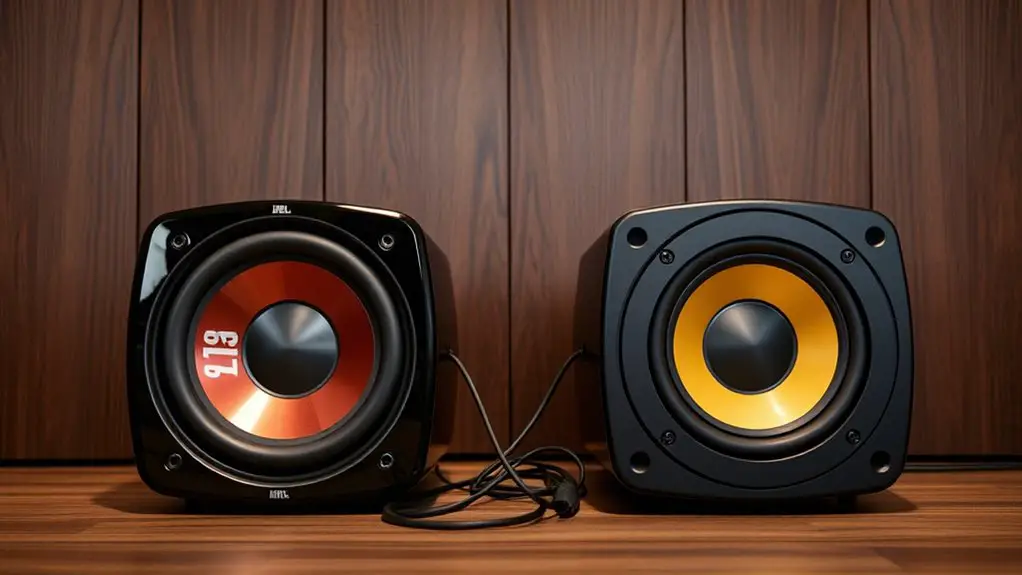

When comparing the JBL LSR310S and KRK 10S2, both are excellent for studio use. The LSR310S offers tighter bass and a lower frequency response, ideal for precision and clarity. In contrast, the KRK 10S2 provides a warmer sound with a pronounced low-end presence. Consider your room size and your personal sound preferences. Ultimately, the right choice hinges on how each aligns with your studio needs and listening goals. More insights follow to guide your decision.
Overview of JBL LSR310S
The JBL LSR310S is a compact yet powerful subwoofer designed for professional studio environments. Its robust performance stems from a 10-inch cone driver that delivers deep, accurate bass response, essential for critical listening and mixing. You’ll appreciate the innovative JBL features, such as the built-in low-pass filter, which allows seamless integration with your existing studio monitors, ensuring a smooth frequency shift.
The LSR310S performance excels in delivering precise low-end frequencies, enhancing the overall clarity of your audio projects. With a frequency response extending down to 27 Hz, it provides the depth needed for genres that demand strong bass, from electronic to orchestral. The front-firing port design minimizes distortion, allowing you to achieve high output levels without sacrificing sound quality. Fundamentally, the JBL LSR310S combines compact design with outstanding performance, making it a compelling choice for any serious audio engineer or producer. Additionally, it is classified as a powered speaker due to its built-in amplifier, simplifying setup for users.
Overview of KRK 10S2
While looking for a reliable subwoofer for your studio setup, the KRK 10S2 stands out with its impressive specifications and design tailored for professional audio applications. This subwoofer is engineered to deliver powerful low-end frequencies and offers a variety of KRK features that enhance its usability. With a 10-inch Kevlar driver, it guarantees consistent performance across the frequency spectrum, enabling you to experience accurate bass response. Additionally, the KRK 10S2 is a powered speaker that simplifies setup by eliminating the need for an external amplifier.
Here’s a brief overview of the KRK 10S2 specifications:
| Feature | Specification | Description |
|---|---|---|
| Driver Size | 10 inches | Kevlar cone for durability |
| Frequency Response | 28 Hz – 133 Hz | Extended low-end reach |
| Amplifier Power | 200 Watts RMS | Efficient power handling |
| Input Options | XLR, TRS, RCA | Versatile connectivity options |
With exceptional KRK performance, this subwoofer can elevate your studio monitoring experience considerably.
Sound Quality Comparison
When comparing the sound quality of the JBL LSR310S and KRK 10S2, you’ll find that both subwoofers excel in delivering deep, impactful bass, yet they achieve this through different design philosophies. The JBL LSR310S boasts a frequency response of 27Hz to 120Hz, ensuring excellent bass extension, making it ideal for genres that rely heavily on low-end frequencies. Its tuned port design minimizes distortion, providing a clear, punchy sound.
On the other hand, the KRK 10S2 has a frequency response of 30Hz to 130Hz. While it offers slightly less bass extension, it compensates with a more pronounced low-end presence, ideal for those who appreciate a fuller sound. Both models use advanced technology to manage power and minimize distortion, yet your choice will depend on whether you prefer the precise, tight bass of the LSR310S or the warmer, richer tones of the KRK 10S2.
Design and Build Quality
Design plays an essential role in the performance and usability of subwoofers like the JBL LSR310S and KRK 10S2. The JBL features a sturdy MDF cabinet, enhancing durability while minimizing resonance, which is vital for accurate bass response. Its robust construction supports the advanced driver technology, allowing for clear and powerful low frequencies.
On the other hand, the KRK 10S2 employs a similar MDF cabinet, but it integrates a unique ported design that optimizes airflow and reduces distortion. This design choice complements its proprietary driver technology, which is engineered to deliver punchy bass without muddiness.
Both subwoofers utilize high-quality cabinet materials, ensuring longevity and performance stability. However, your preference may hinge on the specific driver technology and design features that best suit your studio environment. Ultimately, the build quality and design of each unit can greatly impact your mixing and listening experience, making it essential to consider component speakers when evaluating overall audio performance.
Connectivity Options
Although both the JBL LSR310S and KRK 10S2 are designed for ideal performance, their connectivity options cater to different studio setups and user preferences. The LSR310S features XLR and TRS inputs, allowing for balanced connections that minimize noise and guarantee high-quality sound. This versatility makes it suitable for professional environments where signal integrity is paramount.
On the other hand, the KRK 10S2 offers a variety of connectivity options, including XLR, TRS, and RCA inputs. This range of cable types provides flexibility for users who may be integrating the subwoofer into more diverse systems, from home studios to larger setups. Additionally, understanding impedance ratings is crucial to prevent overheating or equipment damage when connecting multiple speakers or subwoofers.
Ultimately, your choice may depend on the specific connections available in your studio. Understanding these connectivity options will help you maximize your subwoofer’s performance and guarantee seamless integration with your existing gear.
Pricing and Value
While considering the pricing and value of the JBL LSR310S and KRK 10S2, it’s essential to evaluate not just the initial cost but also the long-term benefits each subwoofer offers. The JBL LSR310S typically comes at a lower price point, making it an attractive option for those on a budget. However, don’t overlook the KRK 10S2, which, while pricier, may provide superior build quality and performance longevity.
In your value assessment, consider factors like frequency response, power handling, and compatibility with your existing setup. A price comparison reveals that the investment in a more expensive model could lead to better sound quality and durability, ultimately saving you money in the long run. Consequently, weigh your immediate financial constraints against the potential advantages offered by each subwoofer to make an informed decision that aligns with your audio production goals. Additionally, powered speakers like the KRK 10S2 offer user-friendly design that can simplify your setup process and enhance your overall experience.
Final Thoughts on Choosing the Right Subwoofer
When choosing the right subwoofer, consider your room size, as it impacts sound distribution and performance. Your budget and the value offered by each model also play vital roles in your decision-making process. Finally, sound quality preferences will ultimately guide you toward a subwoofer that meets your specific audio needs. Additionally, understanding ideal speaker wattage for your room size can greatly enhance your overall listening experience.
Room Size Considerations
Understanding room size is essential in selecting the right subwoofer, as it directly impacts the sound quality and bass response you’ll experience. Your room dimensions and any acoustic treatment will dictate how low frequencies interact with the space, affecting clarity and punch.
| Room Size | Recommended Subwoofer Size |
|---|---|
| Small (up to 100 sq ft) | 8-inch or smaller |
| Medium (100-250 sq ft) | 10-inch |
| Large (over 250 sq ft) | 12-inch or larger |
Choosing a subwoofer that matches your room size guarantees ideal performance. Consider how acoustic treatment can further enhance your setup, allowing for a more accurate bass response and an overall better listening experience.
Budget and Value
Choosing the right subwoofer involves not just performance specifications but also a careful consideration of your budget and the value each option provides. When evaluating the JBL LSR310S and KRK 10S2, budget considerations are paramount. Both models offer competitive pricing, yet they differ in features that may affect your purchasing decision. A thorough value assessment can help you determine which subwoofer delivers the best performance for your investment. For instance, if you’re focused on low-end response and room integration, the LSR310S might justify a higher price. Conversely, if you prioritize brand reputation and aesthetics, the KRK 10S2 may align better with your needs. Ultimately, aligning your budget with your specific requirements guarantees you choose wisely.
Sound Quality Preferences
While personal preferences in sound quality can vary considerably among users, the choice of subwoofer ultimately hinges on how well it meets your specific auditory needs. When evaluating the JBL LSR310S and KRK 10S2, consider how each model’s sound signature aligns with your subwoofer preferences. Here’s a quick comparison to assist in your decision:
| Feature | JBL LSR310S | KRK 10S2 |
|---|---|---|
| Frequency Response | 27 Hz – 180 Hz | 30 Hz – 3 kHz |
| Power Handling | 200 W RMS | 200 W RMS |
| Port Type | Rear-Firing Port | Front-Firing Port |
| Weight | 32 lbs | 29 lbs |
| Price | Affordable | Premium |
Ultimately, your choice should reflect the sound profile that resonates with your unique listening experience.
Frequently Asked Questions
What Are the Warranty Details for JBL LSR310S and KRK 10S2?
When considering warranty comparison, the JBL LSR310S typically offers a longer coverage period than the KRK 10S2. This might enhance product longevity, giving you greater confidence in your investment for reliable performance over time.
Can These Subwoofers Be Used for Home Theater Setups?
Imagine your favorite movie’s explosive scenes coming to life! Both subwoofers can elevate your home theater’s audio performance, providing deep bass that immerses you in every moment, making your viewing experience truly exceptional.
What Is the Weight of JBL LSR310S and KRK 10S2?
The JBL LSR310S weighs around 38 pounds, while the KRK 10S2 is slightly lighter at approximately 33 pounds. This weight comparison, alongside subwoofer dimensions, can influence your setup and placement decisions considerably.
Are There Any Notable User Reviews for These Subwoofers?
User experiences and feedback reveal a spectrum of emotions, much like a symphony’s crescendo. Many praise clarity and depth, while others seek more bass. You’ll find insightful reviews guiding your choice between these formidable subwoofers.
How Do These Subwoofers Perform in Bass-Heavy Genres?
In bass-heavy genres, you’ll find both subwoofers deliver impressive bass response. Each offers unique genre suitability, with the JBL excelling in clarity and the KRK providing a warmer, punchier sound for those deep beats you crave.

[…] and evenly lit. Expect the biggest gains when you match the projector’s brightness to your room size and keep ambient light low for sharper contrast. Keep reading for the exact setup tips—screen […]
[…] choose color temperature and coverage (or add another light) to get the feel you want—check your room size and lighting setup […]
[…] – Brightness feel depends heavily on ceiling height and room size […]
[…] can judge whether 1560 lumens is enough by matching the lamp output to your room size, task intensity, and fixture type. The practical goal is not a single number—it’s getting […]
[…] brightness expectations. You’ll also learn when 1650 lumens is too much or just right, based on room size and how the light is […]
[…] it produces an effective brightness level (measured as illuminance in lux) that depends on your room size, ceiling height, light direction, and wall/ceiling reflectance—so this guide helps you compare it […]
[…] or warehouse lighting setup—but whether it’s “too much” or “just right” depends on your room size and how high the fixtures are mounted. This guide translates 24000 lumens into real-world […]
[…] lumens can read as anything from “very bright” to “only moderately bright,” depending on room size, ceiling height, color temperature (Kelvin), and how the light is distributed—so this guide […]
[…] larger spaces, and task-focused areas. In practice, how “bright” 3300 lumens feels depends on room size, fixture type, beam angle, surface reflectivity, and color temperature, and those variables are […]
[…] guide translates 5200 lumens into real-life brightness benchmarks (ceiling height, distance, and room size) so you can tell if it’s “highly bright” or “too much” for what you’re trying to […]
[…] distances, so you can judge brightness without guessing. If you need the practical answer for your room size and use case, you’ll get it […]
[…] lumens you need? Here’s the quick sizing guide that gives you a clear lumen target based on your room size and screen distance. If you want the simplest rule of thumb that actually lands the right picture […]