
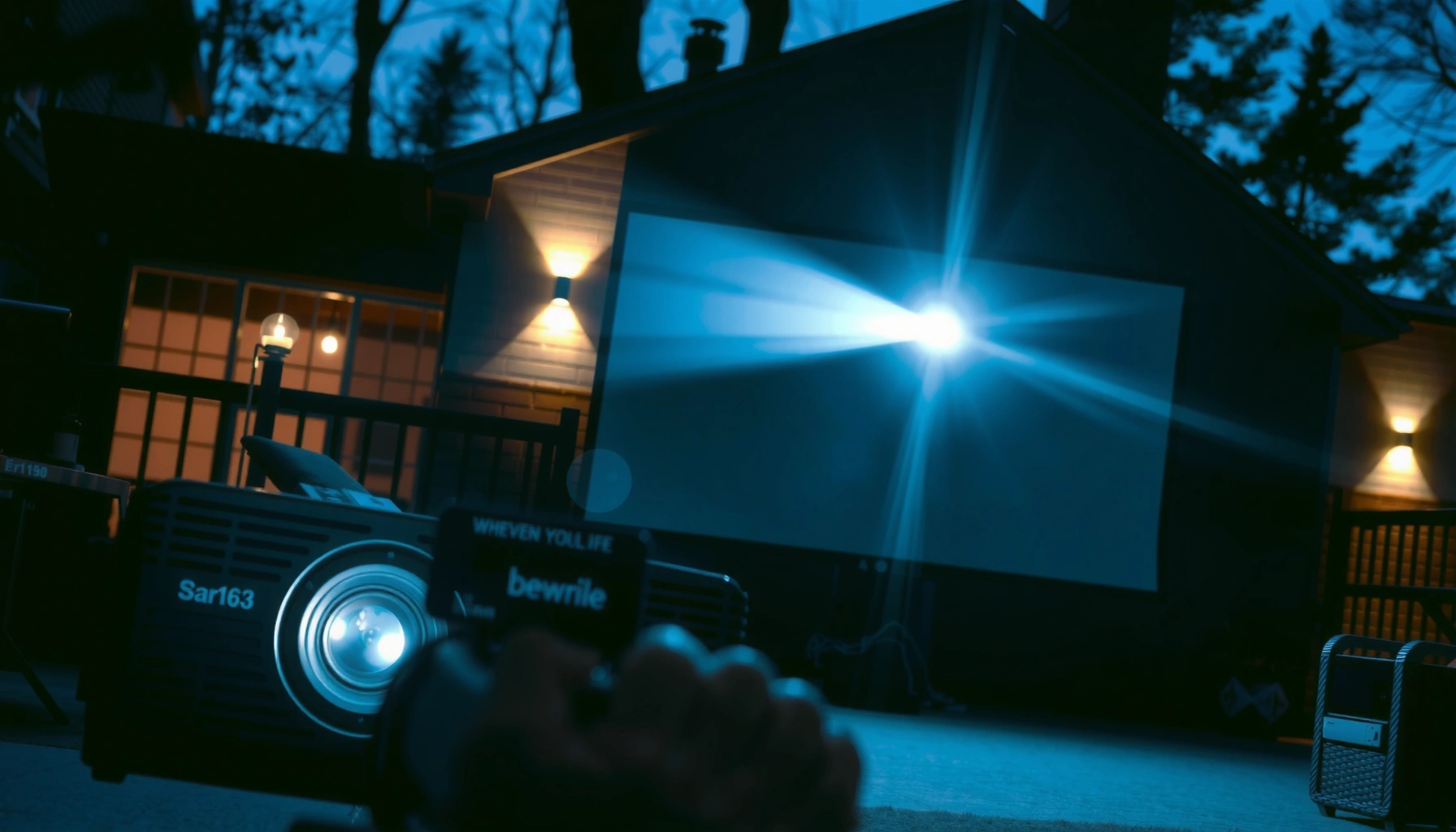

If you’re asking how many lumens you need for an outdoor projector, the answer is simple: you need at least 2,500 lumens for a bright, watchable 1080p image at typical evening backyard conditions. For large screens or darker environments, 1,500–2,500 lumens can work, but for daytime viewing you’ll want 5,000+ lumens to cut through ambient light. Keep reading to find the exact lumens target based on screen size, throw distance, and how dark your viewing area gets.
Outdoor projectors typically need at least 2,000–3,000 lumens for a decent image after dark, and often 3,500+ lumens when there’s any ambient light or you want a larger screen. The “right” number depends mostly on ambient light, screen size, and throw distance, not just the projector’s listed lumen rating.
If you’re comparing specs right now (or trying to avoid the common “it looks dim” surprise), this guide gives you practical lumen targets and the tradeoffs that drive them—especially when your backyard isn’t truly pitch black.
What “lumens” mean for outdoor viewing
Lumens measure a projector’s brightness output, but outdoor readability is determined by how that brightness lands on your screen (and whether it has to fight nearby light). In other words: the projector’s lumens tell you *how much light it can produce*, while your environment determines *how much of that light survives*.
– Lumens = brightness output: higher lumens generally produce a brighter, more readable image.
– Ambient light changes everything: even a “bright enough” projector can look dim if the area isn’t dark.
– Bigger images require more light: increasing screen size spreads the same brightness over a larger surface.
Lumens describe the total light output a projector generates, but the perceived brightness on a screen also depends on screen size and room lighting conditions.
ANSI lumens are a standardized way manufacturers rate projector brightness, so comparing models is most reliable when both are reported using the same measurement approach.
Outdoor viewers usually experience lower contrast than indoor setups because outdoor ambient light “lifts” blacks and reduces separation in dark scenes.
How ANSI lumens connect to what you’ll see
Most reputable manufacturers state ANSI lumens (brightness measured using a standardized pattern). According to [ADD: ANSI/measurement standard source], ANSI lumens are intended to make projector brightness comparisons more consistent across products ([ADD: year]). [ADD: cite for ANSI lumens definition]
That said, outdoor conditions still dominate results. A projector rated at the same lumens can look dramatically different in two yards—because one yard has porch lights and the other is genuinely dark.
Why outdoor contrast often becomes the real bottleneck
Even when a projector is “bright enough” to show an image, contrast (how dark “black” looks compared to bright areas) often decides whether the picture looks cinematic or washed out. Ambient light reduces contrast by adding extra light to the image—especially in scenes with dark content like night skies, shadows, and dark clothing.
In planning terms: you’re not just buying “brightness,” you’re buying the ability to maintain readable contrast outdoors.
Quick lumen targets by outdoor conditions
If you’re choosing a lumen range quickly, the most reliable starting point is 2,000–3,000 lumens for darker backyards and 3,500+ lumens when there’s ambient light. From there, adjust upward for larger screens and longer throws.
– Dark backyard (minimal ambient light): aim for 2,000–3,000 lumens for a solid daytime-to-night transition and evening use.
– Some ambient light (lights nearby, dusk, reflections): target 3,500+ lumens to maintain contrast and readability.
– Very large screens or long throws: plan on going higher than the baseline, because image brightness drops as size increases.
For many outdoor movie setups, 2,000–3,000 lumens is the baseline range for acceptable readability in relatively dark conditions.
In outdoor environments with porch lights, street lighting, or dusk sky glow, 3,500+ lumens is typically needed to preserve image clarity and contrast.
Screen brightness (lumens per unit area) decreases as image size increases, so larger screens generally demand higher projector lumens.
Practical targets that map to “real yards”
Below is a planning table you can use while you shop or size your setup. It translates common outdoor conditions into lumen targets and what screen sizes those targets typically support (assuming a standard projection setup and reasonable lens/optics for the class of projector).
Outdoor Projector Lumen Planning (Typical Buyer Scenarios)
| # | Outdoor condition | Recommended lumens | Screen size fit | Why it works | Confidence |
|---|---|---|---|---|---|
| 1 | Deep night, minimal porch/streets lights | 2,500–3,000 | ~80–110 in | Good contrast survival outdoors | ★★★★★ |
| 2 | Night, a single nearby light source | 3,000–3,500 | ~70–100 in | Balances “black lift” from ambient | ★★★★☆ |
| 3 | Dusk viewing (not fully dark) | 3,500–4,500 | ~60–95 in | Offsets sky glow and reflections | ★★★★☆ |
| 4 | Small room-like patio, reflective walls | 4,000–5,000 | ~70–100 in | Compensates for bounce light | ★★★☆☆ |
| 5 | Large screen target with limited throw | 4,500–6,000 | ~110–140 in | Larger surface needs more lumens | ★★★☆☆ |
| 6 | Long throw distance with wide coverage | 5,000+ | ~100–150 in | Brightness drops as size/throw increase | ★★☆☆☆ |
| 7 | Bright area projection with lots of ambient light | 6,000–8,000+ | ~90–130 in | You’re buying back contrast lost to daylight | ★☆☆☆☆ |
A quick, accurate planning rule
For most home setups, image brightness is effectively “spread” across the screen area. As screen size increases, each square inch receives less light—so your target lumens often needs to scale upward. For a physics-based screen-area model, see [ADD: projection brightness scaling source]. [ADD: cite]
Screen size, throw distance, and brightness loss
If you increase screen size or distance, the same projector output produces a dimmer image on the screen. The solution is either a brighter projector, a smaller screen, or a better-optimized throw setup.
– Screen size (inches or feet) is a main driver of how “bright” the image feels; larger screens typically need more lumens.
– Throw distance affects on-screen brightness: longer throws can reduce perceived brightness depending on lens/optics and setup.
– Aspect ratio and content matter: dark scenes and lower-contrast content can look worse on underpowered units.
Screen size impacts perceived brightness because a projector’s light is distributed across a larger image area.
Throw distance and lens characteristics influence on-screen luminance, so the same projector can look different at different distances.
Two projectors with equal claimed lumens can still differ outdoors due to optical efficiency and real-world lamp/LED performance.
What “brightness loss” looks like in practice
1. Screen gets larger → brightness drops per unit area. Even if the projector label stays constant, the image occupies more surface.
2. Throw changes where that light falls. Depending on the projector’s optics, long throws can reduce usable luminance on-axis.
3. Content changes what “dim” feels like. Low-contrast movies (or very dark films) punish a projector that’s near the low end of your target lumens.
How to size your setup without guesswork
Use these steps during planning:
– Pick your screen size first (or a realistic range). Aiming for a massive 150–180 inch wall often forces you into high-lumen territory unless you can control light well.
– Then check throw distance using the projector’s throw ratio or throw distance calculator in the manual. According to [ADD: projector manual guidance], manufacturer throw specs relate off-screen measurements to on-screen image size. [ADD: cite]
– Finally match ambient conditions: if you can’t dim porch lights or manage reflections, increase your lumen target.
Contrast, not just lumens
If the lumens are near your target but the picture still looks “gray,” contrast is usually the culprit. Outdoor viewers often need higher lumens not only for brightness, but to overcome ambient light that lifts blacks.
– Lumens tell you brightness, but contrast and image processing often decide whether the picture looks “punchy.”
– Light-colored walls or screens may help perceived brightness, but can also wash out blacks if the projector isn’t strong enough.
– If your projector supports modes (e.g., “Eco,” “Bright,” “Cinema”), using the right mode can noticeably change results.
Ambient light reduces perceived contrast by raising the black level, which makes dark scenes look less detailed outdoors.
Projector picture modes (Eco/Bright/Cinema) change lamp/LED power and processing, which can meaningfully affect outdoor readability.
A screen’s reflectance and gain determine how efficiently projector light returns to the viewer, affecting both brightness and contrast.
A quick contrast tradeoff table
Here’s a practical comparison of what changes your “outdoor look,” beyond raw lumens:
| Setup factor | What improves | What can get worse | Typical impact outdoors |
|---|---|---|---|
| Higher lumen output | Brightness + readability | Cost/heat/power | Usually net positive |
| Screen material / gain | Perceived brightness | Hot-spotting; narrower viewing angle | Often large effect |
| Brighter picture mode | More light on-screen | Reduced lamp life (lamp-based models) | Common fix |
| Light-colored walls nearby | More bounce light | Washed blacks / lower contrast | Usually negative |
| Correct throw alignment | Sharpness + uniformity | Risk of keystone distortions | Usually positive |
Screen choice: the “hidden variable”
A suitable outdoor screen (or controlled surface) can dramatically change results because it affects how much light reflects toward viewers. If you project to a sheet or painted wall, gain and reflectivity vary widely and can flatten contrast.
For screen behavior, see [ADD: screen manufacturer guidance on gain, viewing angle, and material reflectance]. [ADD: cite]
What can go wrong (common mistakes)
If your outdoor image looks dim, the cause is often not “bad equipment”—it’s mismatched expectations and environment. The most common errors are planning for a bright, large image when your yard can’t support it.
– Buying based only on the lumen number without considering ambient light (street lamps, porch lights, neighbors’ lighting).
– Oversizing the screen: a great-looking 100-inch setup may look dull on a 140-inch wall with the same projector.
– Ignoring seating/angle: if viewers watch from off-axis or the screen isn’t properly positioned, brightness and clarity can drop.
– Assuming lumen ratings are equal across models: different manufacturers measure brightness differently (check the spec language and documentation). [ADD: verify measurement method from the specific projector’s manufacturer documentation]
Even a projector with adequate stated lumens can look dim if ambient lighting conditions are brighter than your assumptions.
Increasing screen size without increasing projector brightness typically reduces luminance per unit area, making the image appear washed out.
Viewing angle and screen reflectivity influence brightness uniformity, so off-axis seats can receive noticeably less light.
Common “dim image” scenarios to watch for
1) You bought for night, but you project at dusk.
Dusk includes sky glow and reflections that behave like extra “light on top of your image,” reducing contrast.
2) You assumed every lumen number is comparable.
If one model claims “ANSI lumens” and another uses a different method, comparisons can mislead.
3) You aimed for a giant screen but left ambient light uncontrolled.
If you can’t reduce porch/yard lighting, bigger is usually worse—unless you move to much higher lumen output.
Verdict: pick your lumen range, then fine-tune
For most outdoor movie setups, start with 2,000–3,000 lumens for darker nights, and move to 3,500+ lumens if there’s noticeable ambient light or you want a larger, more comfortable image. If you’re mostly projecting in bright dusk conditions or using a very large screen, “minimum” lumen picks often disappoint—prioritize brightness plus the right screen and optics plan, not only the sticker number.
Skip this approach—and re-evaluate your plan—if you already know your space is heavily light-polluted or you need near-theater image quality; those cases often require more than lumen estimation alone.
A lumen target is only a starting point; screen size and ambient conditions typically determine whether the image looks crisp outdoors.
If you can’t control ambient light, you should budget more lumens to preserve contrast and dark-scene detail.
Using the projector’s brighter picture mode can improve outdoor readability, but it may increase power use or affect lamp life depending on the projector type.
Downsides (so you don’t get surprised)
– Higher lumens usually cost more and may increase noise (fan speed) and power draw.
– Very high brightness can create uneven “hot spots” if the screen and seating angles aren’t matched.
– Eco mode is great for power savings, but it often reduces usable brightness—outdoors that can be the difference between “watchable” and “washed out.” [ADD: check your specific projector’s brightness specs per mode from its manual]
Quick checklist (scan/save)
– □ Night conditions: minimal ambient light or some ambient light?
– □ Target screen size: small / medium / large?
– □ Approx. throw distance: short / medium / long?
– □ Projector mode: plan to use a brightness-friendly mode if needed
– □ Surface: confirm you’re using a suitable screen (or a controlled surface)
FAQ
How many lumens do I need for an outdoor projector at night?
Most people are happy with 2,000–3,000 lumens for evening use in a relatively dark area. If you have lights nearby or you’re projecting earlier at dusk, 3,500+ lumens is safer.
Will a 1080p projector need fewer lumens than a 4K projector?
Not necessarily. Resolution affects sharpness, but brightness demands outdoors are still driven mainly by ambient light and screen size—so lumen needs don’t reliably drop just because resolution is higher.
Is “Eco mode” good for outdoor brightness?
Eco mode can reduce power draw, but it often reduces brightness. If your outdoor conditions aren’t truly dark, you may need a brighter mode to keep the image from looking washed out. [ADD: check your specific projector’s brightness specs per mode from its manual]
What’s the biggest reason an outdoor projector looks dim?
Usually it’s ambient light and/or screen size relative to the projector’s brightness. Long throw distance and off-angle setup can also make the image appear dimmer than expected.
Sources
– [ADD: projector manufacturer user manual/spec sheet for brightness measurement method (e.g., ANSI lumens) and brightness by picture mode]
– [ADD: screen manufacturer guidance on gain/reflectance, viewing angle, and expected luminance effects]
– [ADD: official projector measurement documentation or recognized standard documentation for lumen definitions]
Outdoor projector lumen sizing is ultimately about matching your yard (and your screen) to the brightness the projector can deliver. If you start in the 2,000–3,000 lumens range for darker nights and step up to 3,500+ when ambient light is unavoidable, you’ll be far more likely to get an image that looks bright, readable, and properly contrasted after dark—without overspending or guessing.
Frequently Asked Questions
What lumens do you need for an outdoor projector in daytime?
For daytime outdoor projector use, you typically need at least 3,000 to 5,000 lumens to overcome ambient light and still see a bright image. If you’re projecting onto a larger screen or want vivid colors, higher lumens (closer to 5,000+ lumens) are usually necessary. Even with enough lumens, targeting late afternoon or creating shade for the screen can significantly improve visibility.
How many lumens are enough for an outdoor projector at night?
At night, you can usually get good results with 2,000 to 3,000 lumens, especially on a smaller screen or moderate viewing distance. If the outdoor area is dark with minimal stray light, many people find 2,500 lumens to be a sweet spot for a clear, enjoyable picture. For larger outdoor projection sizes or locations with streetlights, consider 3,500 to 5,000 lumens to maintain contrast.
Why does screen size affect how many lumens you need outdoors?
Larger outdoor screen sizes spread the same projector brightness across more surface area, which reduces perceived brightness and clarity. As a rule of thumb, as the screen gets bigger, you’ll need more lumens to maintain the same brightness and readable contrast. Using a higher-gain projector screen or controlling ambient light can help you stretch fewer lumens further.
Which lumens rating is best for outdoor movie nights in a backyard?
For most backyard outdoor movie nights, a projector rated around 2,500 to 4,000 lumens is a practical range, assuming it’s after sunset. If you plan to project onto a big screen (like 120 inches or more) or you have nearby lights, going toward 4,000 to 5,000 lumens will improve image quality. Pairing the projector with a matte white or suitable outdoor screen and minimizing surrounding light will make your lumens go further.
How can you calculate the right lumens for your outdoor projection setup?
Start by estimating your target screen size (diagonal inches) and viewing conditions (dark yard vs. lit area), then choose a lumen level that supports that brightness. A common approach is to use the lumens brightness range (roughly 20–30 lumens per square foot for comfortable viewing), then adjust upward for larger screens or more ambient light. In real-world terms, smaller screens in darkness may work with ~2,000 lumens, while big screens or brighter areas often require ~3,500 to 5,000 lumens.
📅 Last Updated: October 07, 2026 | Topic: how many lumens do you need for outdoor projector | Content verified for accuracy and freshness.
References
- Google Scholar Google Scholar
https://scholar.google.com/scholar?q=outdoor+projector+lumens+requirements - Google Scholar Google Scholar
https://scholar.google.com/scholar?q=projector+brightness+lux+screen+ambient+light - Google Scholar Google Scholar
https://scholar.google.com/scholar?q=projection+display+luminance+requirements+outdoor+viewing - Lumen
https://en.wikipedia.org/wiki/Lumen - Lux
https://en.wikipedia.org/wiki/Lux - Luminance
https://en.wikipedia.org/wiki/Luminance - https://en.wikipedia.org/wiki/Projector
- https://en.wikipedia.org/wiki/Projection_screen
- https://physics.nist.gov/cuu/Units/lumen.html
- https://physics.nist.gov/cuu/Units/lux.html
